
84 Gen Z Statistics for 2026
Gen Z is the generation now moving from school into work. Its members grew up with smartphones and social media. Many are starting adult life during high living costs and fast change in AI. The statistics below cover who Gen Z is, how the generation spends and works, and how it feels.
Top Gen Z Statistics
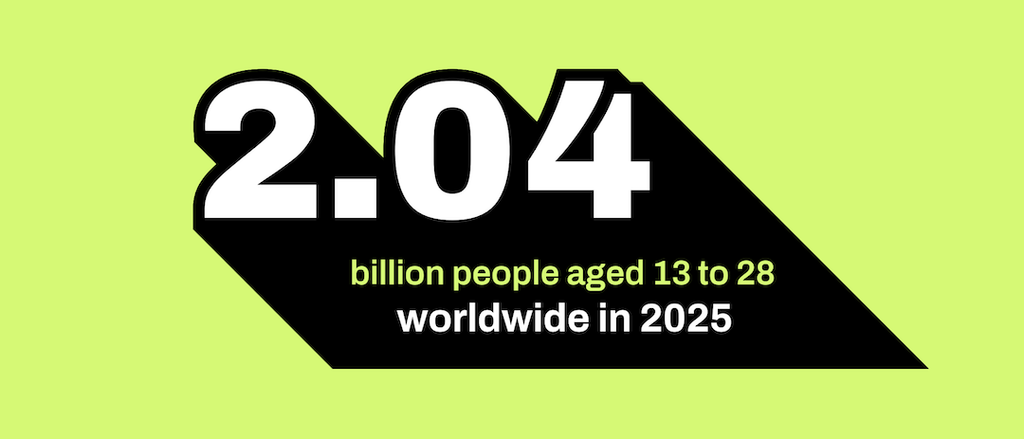
- About 2.04 billion people worldwide were aged 13 to 28 in 2025, roughly the Gen Z age range (UN World Population Prospects 2024).
- Gen Z spent about $9.8 trillion globally in 2024 (NIQ, Spend Z report 2024).
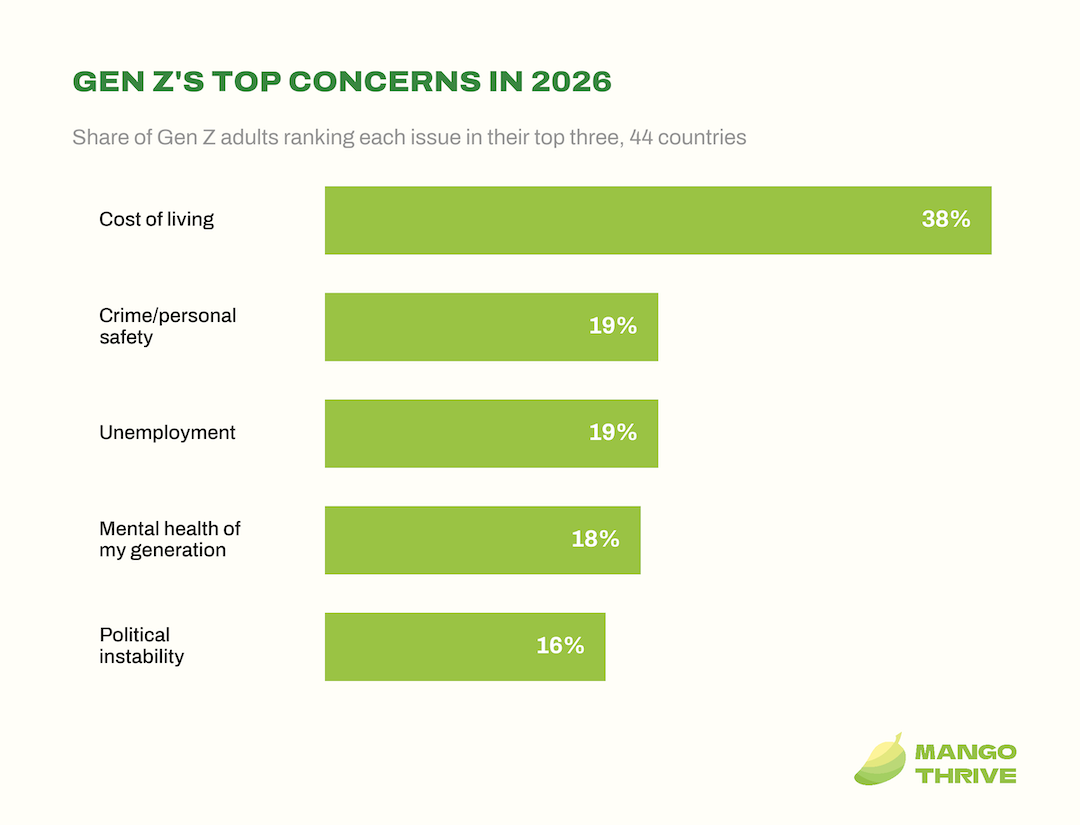
- 38% of Gen Z adults across 44 countries rank cost of living among their top three concerns in 2026 (Deloitte, 2026).
- 257 million young people aged 15 to 24 worldwide were not in employment, education or training in 2025 (ILO, 2026).
- 52% of 18- to 24-year-olds across 48 markets who used news in the last week say social media, video networks or AI chatbots are their main news source (2026) (Reuters Institute, 2026).
- 51% of U.S. Gen Zers ages 14 to 29 say they use generative AI at least weekly (2026) (Gallup, Gen Z and AI, April 2026).
- 45% of US Gen Zers ages 13 to 28 are “thriving” in 2025, their lowest level in the past three years (Walton Family Foundation–Gallup, 2025).
How Many Gen Z Are There?
Sources define Gen Z in slightly different ways. Some statistics cover only an age group, such as teens or young adults. Those statistics describe that age group, not all of Gen Z.
In Gallup’s reporting, “Generation Z” means people born between 1997 and 2012.
1. About 2.04 billion people worldwide were aged 13 to 28 in 2025, roughly the Gen Z age range (UN World Population Prospects 2024). The UN figure is a medium-variant projection for mid-2025.
Number of people aged 13 to 28 worldwide in 2025
Source: United Nations, World Population Prospects 2024. Medium-variant projection; sum of single years of age.
Who Is Gen Z? Demographics
These statistics show where Gen Z lives and how the generation breaks down in the US. Definitions differ slightly by source.
2. The US had an estimated 72.2 million residents aged 13 to 28 on July 1, 2025 (U.S. Census Bureau, Vintage 2025 estimates). That age range roughly matches Gen Z.
| Race and Hispanic origin | US residents aged 13 to 28, July 1, 2025 (millions) |
|---|---|
| Non-Hispanic White alone | 34.7 |
| Hispanic (any race) | 18.9 |
| Non-Hispanic Black alone | 9.6 |
| Non-Hispanic Asian alone | 4.8 |
| Non-Hispanic, two or more races | 3.5 |
| Non-Hispanic American Indian and Alaska Native alone | 0.55 |
| Non-Hispanic Native Hawaiian and Other Pacific Islander alone | 0.17 |
Source: U.S. Census Bureau, Vintage 2025 race and Hispanic origin estimates. Each value adds up single years of age from 13 to 28 in the same file.
3. India had about 408 million people aged 13 to 28 in 2025, according to UN projections (UN World Population Prospects 2024).
4. China had about 265 million people aged 13 to 28 in 2025, according to UN projections (UN World Population Prospects 2024).
5. Africa had about 475 million people aged 13 to 28 in 2025, according to UN projections (UN World Population Prospects 2024).
6. Canada had an estimated 8.3 million people aged 13 to 28 on July 1, 2025 (Statistics Canada, Table 17-10-0005-01).
7. 58% of US adults ages 18 to 24 lived in their parental home in 2025 (U.S. Census Bureau, 2025 living arrangements).
8. About 17.7 million US adults ages 18 to 24 lived in their parents’ home in 2025 (U.S. Census Bureau, Table AD-1).
What Is Gen Z’s Biggest Issue?
Surveys in different parts of the world point to the same pressure. Money comes up first.
In Deloitte’s 2026 survey, “Gen Z” means adults born between January 1995 and December 2007.
9. 38% of Gen Z adults across 44 countries rank cost of living among their top three concerns in 2026 (Deloitte, 2026). It has been the top concern for the fifth year in a row.
Top concerns of Gen Z adults in 2026
Source: Deloitte, 2026 Gen Z and Millennial Survey, p. 8. Gen Z respondents were born between 1995 and 2007.
10. 47% of Gen Z adults surveyed in 44 countries say they live paycheck to paycheck (Deloitte, 2026). The share is lower than in last year’s survey.
11. 51% of Gen Z adults surveyed in 44 countries say they cannot afford to own a house (Deloitte, 2026).
12. 55% of Gen Z adults in 44 countries say they have delayed major life decisions because of money (Deloitte, 2026). Examples include marriage, starting a family or business, or more education.
13. 69% of Gen Z adults in 44 countries say housing availability or affordability directly shapes their career decisions (Deloitte, 2026). It also affects where they can work.
14. Nearly 30% of Gen Z adults surveyed in 44 countries have a part- or full-time side job (Deloitte, 2026). Extra income is the most common reason.
15. 46% of Americans ages 18-29 call rising prices and inflation an urgent crisis in 2026 (Harvard Youth Poll, Spring 2026).
Gen Z Spending Power, Debt and Housing
Gen Z’s spending power is growing. Debt and housing costs weigh on many young adults at the same time.
16. Gen Z spending power is projected to reach $12 trillion globally by 2030 (NIQ, 2026). The projection comes from NIQ and World Data Lab.
In NIQ’s Spend Z report, “Gen Z” means people born roughly between 1997 and 2012.
In NIQ’s Spend Z report, the “consumer class” means anyone spending over $12 a day in 2017 purchasing power parity dollars.
17. Gen Z spent about $9.8 trillion globally in 2024 (NIQ, Spend Z report 2024). The estimate comes from World Data Lab’s spending model.
18. Gen Z accounts for approximately 17.1% of total global spending of $57.6 trillion in 2024 (NIQ, Spend Z report 2024). Its share is projected to grow to 18.7% by 2030.
19. Only 10% of Gen Zers are from North America or Europe, per NIQ’s 2024 report (NIQ, Spend Z report 2024). Only 44% of Gen Z’s total spending comes from Western countries (North America and the EU), making it the first generation ever with less than half its spend from Western nations.
20. Gen Z makes up 29.41% of consumer class spending in Sub-Saharan Africa in 2024 (NIQ, Spend Z report 2024). In North America the share is 14.7%.
21. Global per capita Gen Z spending will grow at a 4.02% compound annual growth rate over the next decade, per NIQ’s 2024 report (NIQ, Spend Z report 2024). NIQ says that is exactly twice the speed of previous generations.
22. Gen Z will add almost $9 trillion in global spending by 2034, per NIQ’s 2024 report (NIQ, Spend Z report 2024). That is more than any other generation, per World Data Lab forecasts.
In NIQ’s Spend Z report, Gen Z “consumption” means dollars spent benefitting Gen Z, no matter which generation pays.
23. Gen Z spending is forecast to overtake Baby Boomer spending globally by 2029, per NIQ’s 2024 forecast (NIQ, Spend Z report 2024).
24. Americans aged 18 to 29 held $1.1 trillion in household debt in Q2 2026 (New York Fed, 2026).
25. 10.1% of credit card balances held by Americans aged 18 to 29 became seriously delinquent over the four quarters to Q2 2026 (New York Fed, 2026). Seriously delinquent means 90 or more days late.
26. More than 460,000 Gen Z consumers in Canada became credit active in the year to Q1 2026 (TransUnion, Q1 2026). That 7.8% rise was the fastest growth of any generation.
In Redfin’s analysis, “Gen Z homeownership rate” means the share of households headed by adult Gen Zers that own their home.
27. 27.1% of US households headed by adult Gen Zers owned their home in 2025 (Redfin, 2026). People living with their parents or other family members are not counted.
In Capgemini’s consumer survey, “Gen Z” means adults born between 1997 and 2012.
28. 73% of Gen Z consumers in 12 countries say small indulgences help them cope with financial stress (Capgemini, 2026). The survey covered 12,000 adults in October 2025.
Gen Z Work and Careers
These numbers cover what young workers want from a job and how hard it is to find one.
29. 96% of Gen Z adults in 44 countries say a sense of purpose at work matters for their job satisfaction and well-being (Deloitte, 2026). That share rose over the past three years.
30. Only 6% of Gen Z adults in 44 countries say reaching a leadership position is their primary career goal (Deloitte, 2026).
31. 74% of Gen Z adults surveyed in 44 countries report using AI to some extent in their work (Deloitte, 2026). That is up sharply from just over half a year earlier.
In the ILO’s 2026 youth employment report, “youth” means people aged 15 to 24, unless otherwise indicated.
32. 12.4% of young people aged 15 to 24 in the global labour force were unemployed in 2025 (ILO, 2026). That equals 67 million unemployed young people worldwide.
In the ILO’s report, “NEET” means young people not in employment, education or training.
33. 257 million young people aged 15 to 24 worldwide were not in employment, education or training in 2025 (ILO, 2026). That is 20% of people aged 15 to 24.
34. 27.4% of young women aged 15 to 24 worldwide were NEET in 2025, more than double the 13.1% rate for young men (ILO, 2026).
35. 12.9% of Canadian youth aged 15 to 24 in the labour force were unemployed in August 2026 (Statistics Canada, 2026). That is still above the country’s 2017–2019 pre-pandemic average.
36. 15.9% of Canadian returning students aged 15 to 24 were unemployed on average over summer 2026 (Statistics Canada, 2026). Returning students are those who attended school full time in March and plan to return full time in the fall.
37. 53.8% of Americans aged 16 to 24 were employed in July 2026 (BLS, 2026). July is typically the summer peak for youth employment.
38. 9.1% of Americans aged 16 to 24 in the labour force were unemployed in July 2026 (BLS, 2026). The rate was lower than in July 2025.
39. 15.1% of young people under 25 in the EU labour force were unemployed in July 2026 (Eurostat, 2026). That is 2.93 million young people.
How Does Gen Z Use Social Media?
These statistics cover which platforms Gen Z uses and how often.
40. 92% of U.S. teens ages 13 to 17 say they use YouTube, per a 2025 survey (Pew Research Center, 2025). The survey covered 1,458 teens, interviewed online from late September to early October 2025.
| Platform | Share of U.S. teens ages 13 to 17 who use it, 2025 | 2024 |
|---|---|---|
| YouTube | 92% | 90% |
| TikTok | 68% | 63% |
| 63% | 61% | |
| Snapchat | 55% | 55% |
| 31% | 32% | |
| 24% | 23% | |
| 17% | 14% | |
| X (formerly Twitter) | 16% | 17% |
Source: Pew Research Center, Teens, Social Media and AI Chatbots 2025, topline.
41. 40% of U.S. teens ages 13 to 17 say they are online almost constantly in 2025 (Pew Research Center, 2025).
42. 36% of U.S. teens ages 13 to 17 use at least one of five platforms almost constantly (2025) (Pew Research Center, 2025). The five platforms were YouTube, TikTok, Instagram, Snapchat and Facebook.
43. 21% of U.S. teens ages 13 to 17 say they are on TikTok almost constantly, per 2025 data (Pew Research Center, 2025). That share was 16% in 2022.
44. 83% of UK social media users aged 16–24 used TikTok in 2025 (Ofcom, Adults’ Media Use and Attitudes 2026).
45. 98% of UK 16- and 17-year-olds own a mobile phone, per Ofcom’s 2025-26 research (Ofcom, 2026).
Gen Z and AI
Many in Gen Z use AI tools regularly. Many also say they feel uneasy about them.
In Gallup’s Gen Z survey, “generative AI” means technology that creates new content from what you tell it, such as writing, brainstorming or images.
In Gallup and the Walton Family Foundation’s research, “Gen Z” means people born between 1997 and 2012, ages 14 to 29 in 2026.
46. 51% of U.S. Gen Zers ages 14 to 29 say they use generative AI at least weekly (2026) (Gallup, Gen Z and AI, April 2026). That includes 22% who use it daily.
47. 42% of U.S. Gen Zers ages 14 to 29 say they feel anxious about AI (2026) (Gallup, Gen Z and AI, April 2026). 22% say they feel excited, down 14 percentage points from 2025.
48. Eight in 10 U.S. Gen Zers ages 14 to 29 say AI tools will likely make learning harder for them in the future (2026) (Gallup, Gen Z and AI, April 2026). That includes 34% who say it is very likely.
49. 48% of employed U.S. Gen Zers say the risks of AI in the workforce outweigh its benefits (2026) (Gallup, Gen Z and AI, April 2026). A year earlier, 37% said this.
50. 64% of U.S. teens ages 13 to 17 say they use AI chatbots, per a 2025 survey (Pew Research Center, 2025). About three in ten say they use them every day.
51. 59% of U.S. teens ages 13 to 17 say they use ChatGPT, per 2025 data (Pew Research Center, 2025). Gemini (23%) and Meta AI (20%) were the next most commonly used.
In Common Sense Media’s survey, “AI companions” means digital friends or characters teens can text or talk with, designed for conversations that feel personal.
52. 72% of U.S. teens ages 13 to 17 have used AI companions at least once, per a 2025 survey (Common Sense Media, 2025). Over half use them at least a few times a month.
53. 33% of U.S. teens who use AI companions have discussed serious matters with them instead of real people (2025) (Common Sense Media, 2025).
54. 66% of UK 16- and 17-year-olds say they have used AI, per Ofcom’s 2025-26 research (Ofcom, 2026).
55. 79% of UK 16–24-year-olds say they use AI tools, according to Ofcom’s 2025 survey (Ofcom, Adults’ Media Use and Attitudes 2026).
Where Does Gen Z Get Its News?
Social and video platforms are now a main news source for many young people.
56. 52% of 18- to 24-year-olds across 48 markets who used news in the last week say social media, video networks or AI chatbots are their main news source (2026) (Reuters Institute, 2026). That is 32 percentage points more than the next most popular main source.
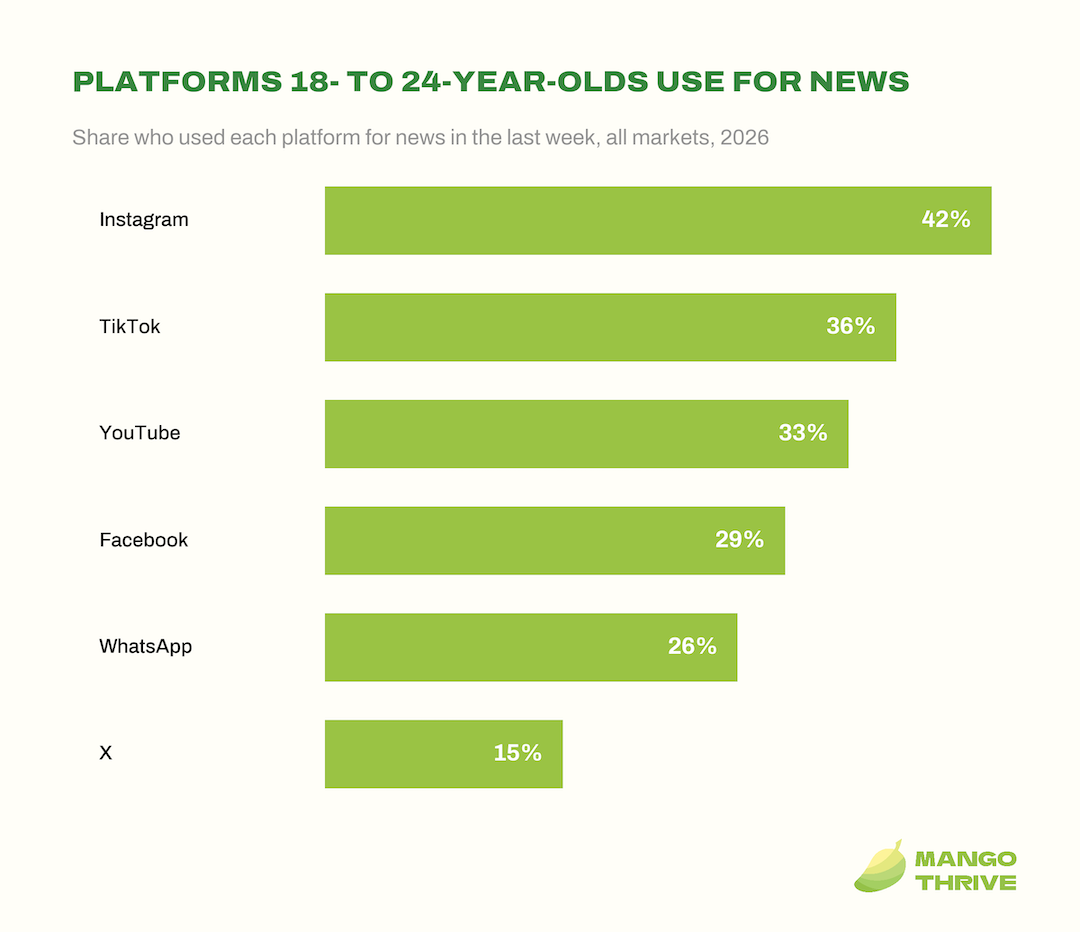
57. 42% of 18- to 24-year-olds across Reuters Institute markets used Instagram for news in the last week in 2026 (Reuters Institute, 2026). Instagram is now the biggest social platform for news in this age group.
Platforms 18- to 24-year-olds used for news in the last week, 2026
Source: Reuters Institute, Digital News Report 2026, p. 22. All markets; the 2026 data comes from a repoll conducted in March 2026.
58. 67% of 18- to 24-year-olds across 48 markets use Instagram weekly for any purpose (2026) (Reuters Institute, 2026). Over half (53%) use TikTok for any purpose.
In the Reuters Institute’s Digital News Report, “AI chatbots for news” means standalone chatbots such as ChatGPT, Perplexity and Google Gemini, not AI answers inside search.
59. 17% of 18- to 24-year-olds across 48 markets used AI chatbots for news in the last week (2026) (Reuters Institute, 2026). That is three times the share among people 55 and older.
60. 56% of 18- to 24-year-olds across 45 markets who skipped newspapers last week say they have never read one regularly (2026) (Reuters Institute, 2026). For TV news, the equivalent figure is 21%.
Gen Z Mental Health and Wellbeing
Wellbeing data for Gen Z is mixed. Some measures show strain, especially among young women and older Gen Zers.
In the Walton Family Foundation–Gallup study, “Gen Z” means people born between 1997 and 2012, surveyed at ages 13 to 28.
In Gallup’s Life Evaluation Index, “thriving” means people rate their current lives positively and expect to rate them positively in five years.
61. 45% of US Gen Zers ages 13 to 28 are “thriving” in 2025, their lowest level in the past three years (Walton Family Foundation–Gallup, 2025). The share was 49% in 2024.
62. 39% of US Gen Z adults were thriving in 2025, versus 56% of Gen Z middle and high school students (Walton Family Foundation–Gallup, 2025). Gallup says that gap widened to 17 points in 2025.
63. The share of adult Gen Z women in the US who are thriving fell from 46% to 37% in 2025 (Walton Family Foundation–Gallup, 2025). Among adult Gen Z men, it was steady at 44% in 2024 and 45% in 2025.
64. 45% of US Gen Zers report lacking meaning, purpose or both in their lives (Gallup, Voices of Gen Z, June 2026). The survey of 2,436 people aged 13 to 28 ran in December 2025.
65. 39% of US Gen Z adults said their life lacks meaning in December 2025, versus 22% of middle and high school students (Gallup, Voices of Gen Z, June 2026). Gallup says adults are nearly twice as likely to report this.
66. 29% of US Gen Z students say they missed at least one school day in the past year for tiredness or mental health reasons (Walton Family Foundation–Gallup, 2025). Reasons were feeling tired or needing a break, feeling anxious, stressed or overwhelmed, or another mental health issue. The share was 34% among girls and 25% among boys.
In the World Happiness Report, “life evaluations” are ratings on the Cantril ladder, a 0 to 10 scale.
67. The US, Canada, Australia and New Zealand rank 122nd to 133rd of 136 countries for happiness change among under-25s (World Happiness Report, 2026). The ranking compares life evaluations in 2023–2025 with 2006–2010.
68. An estimated 20.9% of 13–17-year-olds worldwide were lonely between 2014 and 2023 (WHO, 2025). WHO estimates this age group has the highest share of loneliness of any age group.
In NHS England’s survey, answers to the Strengths and Difficulties Questionnaire were used to rate each young person’s likelihood of a mental disorder as “unlikely”, “possible” or “probable”.
69. 21.7% of 20 to 25 year olds in England had a probable mental disorder in 2023 (NHS England, 2023). The rate was 23.3% among 17 to 19 year olds.
70. 30.4% of young women aged 20 to 25 in England had a probable mental disorder in 2023, versus 13.4% of young men (NHS England, 2023, Part 1). NHS England says the rate was more than twice as high for young women.
71. 40% of US high school students had persistent feelings of sadness or hopelessness in 2023 (CDC, 2024). That was down from 42% in 2021.
Gen Z Shopping, Travel and Drinking Habits
These numbers cover how Gen Z shops, travels and drinks.
In McKinsey’s ConsumerWise research, “Gen Z” means people aged 15 to 29.
72. 65% of Gen Zers ages 15 to 29 across 18 countries say they are willing to splurge on categories that matter to them (McKinsey, 2025). The share ranged from about 50% in South Korea to 85% in India.
In Deloitte’s Digital Media Trends survey, “Gen Z” means people born between 1997 and 2011.
In Deloitte’s survey, “fans” means people who self-identify as a fan of at least one entertainment category, such as TV shows, movies, gaming, sports or music.
73. 73% of US Gen Z fans say social media is their main way to discover new shows, movies, music, games or events, in a 2025 survey (Deloitte, 2026 Digital Media Trends). That compares with 52% of all fans surveyed.
74. Closer to 60% of US Gen Z fans say they discover content on social media, then watch, listen or buy elsewhere, in a 2025 survey (Deloitte, 2026 Digital Media Trends). Among all fans, the share is 44%.
75. 62% of US Gen Z adults shopped secondhand in 2025 (ThredUp, 2026). The survey covered 3,268 US adults in January–February 2026.
76. 58% of US Gen Z adults prioritize secondhand over new (ThredUp, 2026). Among Millennials, the share is 55%.
77. Gen Z will drive 40% of US secondhand apparel market growth through 2030, according to GlobalData estimates (ThredUp, 2026). Millennials are expected to drive 31%.
78. 61% of US Gen Z shoppers resell items for income (ThredUp, 2026). Across all shoppers, the share is 57%.
79. 75% of Gen Z travelers aged 18–28 say they want to travel more sustainably in the next 12 months (Booking.com, 2026). Booking.com surveyed 32,500 travelers in 35 countries and territories in January 2026.
80. 36% of Gen Z travelers who intend to travel more sustainably plan to travel outside peak season (Booking.com, 2026). Among Boomers in the same group, the share is 63%.
In IWSR’s 2026 survey, “Gen Z” means adults from legal drinking age to 28.
In IWSR’s reports, “LDA+” means consumers at or above the legal drinking age.
81. 74% of legal-drinking-age Gen Z adults across 15 markets drank alcohol, per IWSR’s H1 2026 survey (IWSR, 2026). That is up from 66% three years earlier. The drinking rate for all adults is 76%.
82. 84% of legal-drinking-age Gen Z drinkers reported drinking cocktails in the past six months, more than any other generation (IWSR, 2026).
83. Legal-drinking-age Gen Z adults make up 17% of the drinking population across 15 markets (IWSR, 2026). IWSR expects this share to grow as more reach drinking age.
84. 80% of high-income urban Gen Z adults over 21 in India drink alcohol, per IWSR’s 2026 survey (IWSR, 2026). Three years earlier, the rate was 60%.
Conclusion
One thing is clear: Gen Z is not one story. Money worries show up in survey after survey. Many in Gen Z now use AI tools every week. We’ll update this page as new data comes out.