
Millennials were once the generation everyone called young. Many are now parents, homeowners and managers. They also carry mortgages and student loans, and they are saving for retirement. Here are the latest statistics on millennials in the US and around the world.
Top Millennial Statistics
- 73.1 million people living in the US were aged 29 to 44 on July 1, 2025 (US Census Bureau, Vintage 2025 estimates).
- 1.86 billion people worldwide are aged 29 to 44 in 2025, UN projections show (UN World Population Prospects 2024).
- Millennials in the US held $20.8 trillion in net worth in Q2 2026 (Federal Reserve, Distributional Financial Accounts).
- Millennials held 11.2% of total US household net worth in Q2 2026 (Federal Reserve, Distributional Financial Accounts).
- 26% of US home buyers were Millennials in NAR’s 2026 report, down from 29% a year earlier (NAR, 2026 press release).
- 74% of millennials in 44 countries use AI to some extent in their work in 2026, up from 56% a year earlier (Deloitte).
- 45% of millennials in 44 countries say they feel burned out, according to Deloitte’s 2026 survey (Deloitte).
- $85,302 was the average 2024 spending of US households headed by someone born 1981 to 1996 (BLS, Consumer Expenditure Surveys).
How Many Millennials Are There?
Definitions of the millennial generation differ slightly by source. The population counts below use the age range that roughly matches Pew Research Center’s definition.
In Pew Research Center’s work, “Millennials” means people born between 1981 and 1996. (Pew Research Center)
1. 73.1 million people living in the US were aged 29 to 44 on July 1, 2025 (US Census Bureau, Vintage 2025 estimates). The figure comes from the Census Bureau’s 2025 population estimates.
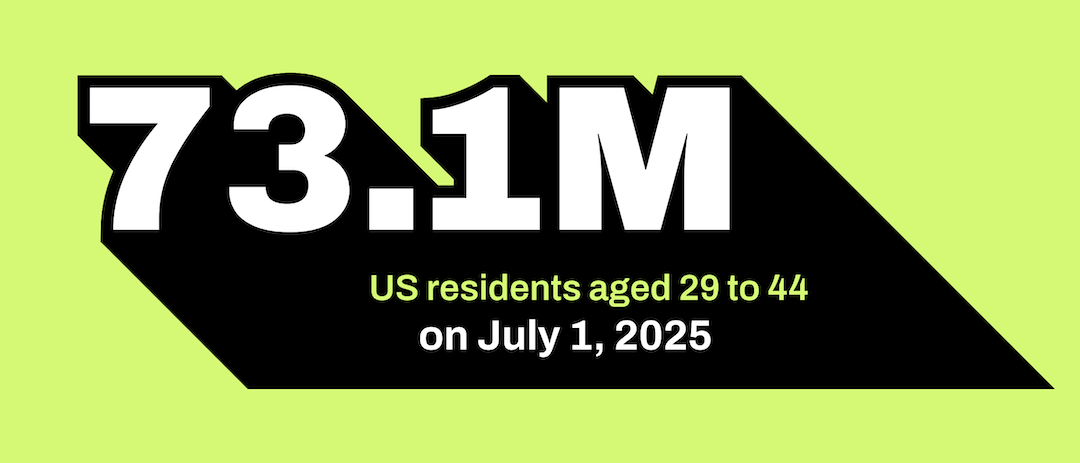
Number of US residents aged 29 to 44 on July 1, 2025
Source: US Census Bureau, Vintage 2025 estimates. Resident population estimates.
2. 1.86 billion people worldwide are aged 29 to 44 in 2025, UN projections show (UN World Population Prospects 2024).
Millennials Around the World
These counts show where people of millennial age live.
| World region | People aged 29 to 44, 2025 (thousands, UN projections) |
|---|---|
| World | 1,862,892 |
| Asia | 1,150,747 |
| Africa | 298,507 |
| Europe | 159,225 |
| Latin America and the Caribbean | 159,037 |
| Northern America | 84,871 |
| Oceania | 10,504 |
Source: UN World Population Prospects 2024. Medium-variant projections. Figures may not sum due to rounding.
3. 360 million people in India are aged 29 to 44 in 2025, UN projections show (UN World Population Prospects 2024).
4. 340 million people in China are aged 29 to 44 in 2025, UN projections show (UN World Population Prospects 2024).
5. 91.4 million people in the EU were aged 28 to 43 on January 1, 2025 (Eurostat, population on 1 January). Eurostat marks these figures as provisional estimates.
6. 15.0 million people in the UK were aged 28 to 43 in mid-2024 (UK Office for National Statistics).
7. 9.7 million people in Canada were aged 29 to 44 on July 1, 2025, according to preliminary estimates (Statistics Canada, population estimates).
Millennial Demographics
These statistics cover the makeup of the millennial generation in the US and Canada.
8. 16.3 million Hispanic people in the US were aged 29 to 44 on July 1, 2025 (US Census Bureau, Vintage 2025 race and Hispanic origin estimates). Hispanic people can be of any race.
9. 20.2 million US adults aged 30 to 39 held a bachelor’s degree or higher in 2024 (US Census Bureau, educational attainment 2024). The count comes from the Current Population Survey and covers people not living in institutions.
In Statistics Canada’s 2021 Census, “millennials” means people born between 1981 and 1996. (Statistics Canada, 2021 Census)
10. 33.2% of Canada’s working-age population (15 to 64) were millennials in the 2021 Census (Statistics Canada, 2021 Census).
11. More than half of immigrants who settled in Canada from 2016/2017 to 2020/2021 were millennials (Statistics Canada, 2021 Census).
Millennials at Work
The labor force counts people who are working or looking for work. A median is the middle value: half earn more and half earn less.
12. 84.4% of Americans aged 35 to 44 were in the labor force in 2025 (BLS, Current Population Survey). The 2025 figure averages 11 months, because October data were not collected during the federal government shutdown.
13. 78.2% of US women aged 35 to 44 were in the labor force in 2025, versus 90.7% of men (BLS, Current Population Survey).
14. $1,436 was the median weekly pay of full-time US wage and salary workers aged 35 to 44 in Q2 2026 (BLS, Usual Weekly Earnings). Men in that age group earned a median $1,596 a week, women $1,249.
15. $74,910 was the median 2025 earnings of full-time, year-round US workers aged 35 to 44 (US Census Bureau, Income in the United States: 2025). Full-time, year-round means at least 35 hours a week for at least 50 weeks a year.
16. 84.8% of people in Canada aged 40 to 44 were employed in 2025 (Statistics Canada, Labour Force Survey). For those aged 35 to 39, the rate was 84.0%.
17. 84.6% of EU residents aged 40 to 44 were employed in 2025 (Eurostat, Labour Force Survey). Among those aged 35 to 39, the rate was 83.6%.
In Deloitte’s survey, “millennials” means people born between January 1983 and December 1994.
18. 61% of millennials currently supervise or manage other people to some extent, Deloitte’s 2026 survey found (Deloitte). The survey covered 8,211 millennials in 44 countries.
19. Roughly one-quarter of millennials in 44 countries have a part- or full-time side job on top of their main role in 2026 (Deloitte).
20. 97% of millennials in 44 countries say a sense of purpose at work matters to their job satisfaction and well-being in 2026 (Deloitte). That share is up 8 points over the past three years.
How Much Money Do Millennials Have?
These figures cover wealth, income and how millennials feel about their finances.
In the Federal Reserve’s Distributional Financial Accounts, “Millennial” means anyone born in 1981 or later.
21. Millennials in the US held $20.8 trillion in net worth in Q2 2026 (Federal Reserve, Distributional Financial Accounts). Net worth is total assets minus total liabilities.
22. Millennials held 11.2% of total US household net worth in Q2 2026 (Federal Reserve, Distributional Financial Accounts).
23. Millennials held 2.2% of US household net worth at the end of 2015 and 10.7% at the end of 2025 (Federal Reserve, Distributional Financial Accounts).
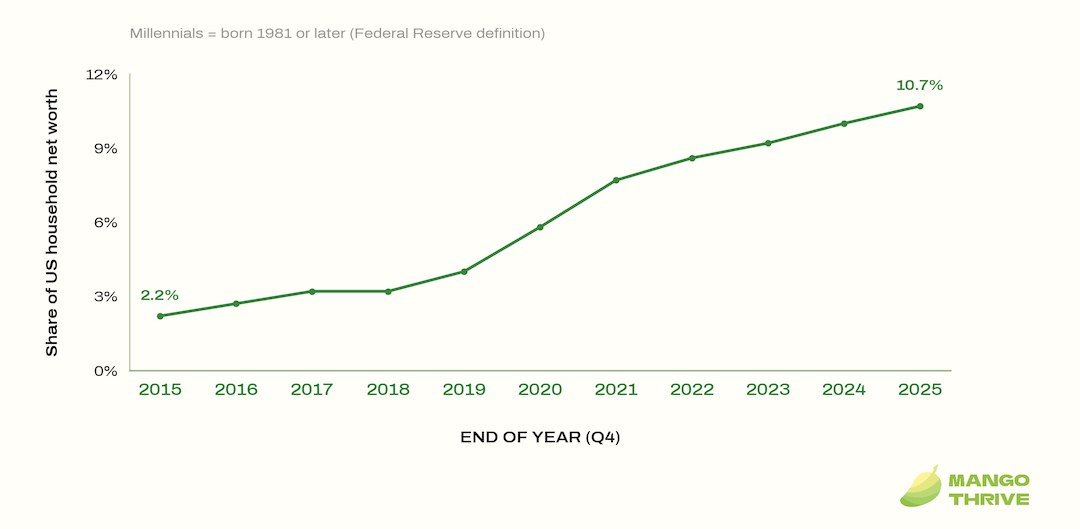
Share of US household net worth held by millennials, end of 2015 to end of 2025
Source: Federal Reserve, Distributional Financial Accounts. Fourth-quarter values.
24. $114,100 was the median 2025 income of US households headed by someone aged 35 to 44 (US Census Bureau, Income in the United States: 2025).
In Statistics Canada’s household wealth accounts, “millennials” means households whose main earner was born after 1980, including Gen Z.
25. Millennial households held 23.7% of Canada’s household net worth in Q4 2025 (Statistics Canada, household wealth accounts).
In the Federal Reserve’s SHED survey, “doing at least okay financially” means people who say they are “doing okay” or “living comfortably” financially.
26. 68% of US adults aged 30 to 44 were doing at least okay financially in 2025 (Federal Reserve, SHED 2025). The Fed survey was fielded October 17–28, 2025, with 12,934 adults.
27. 49% of US adults aged 30 to 44 had emergency savings to cover three months of expenses in 2025 (Federal Reserve, SHED 2025).
28. 42% of millennials in 44 countries cite cost of living as a top concern in 2026 (Deloitte). Cost of living has topped the list for five years running.
29. 47% of millennials in 44 countries say they live paycheck to paycheck in 2026, down from 52% a year earlier (Deloitte).
How Much Debt Do Millennials Have?
These figures cover what millennials owe, from mortgages to credit cards.
30. Americans aged 30 to 39 carried $3.99 trillion in household debt in Q2 2026 (New York Fed). The figure comes from Equifax credit records.
| Loan type | Debt held by Americans aged 30 to 39, Q2 2026 ($ billion) |
|---|---|
| Mortgage | 2,729 |
| Student loans | 522.7 |
| Auto loans | 380.7 |
| Credit card | 222.3 |
| Other | 96.6 |
| Home equity line of credit | 33.9 |
Source: New York Fed, Household Debt and Credit Report, Q2 2026.
31. Millennials owed 42.6% of all US household debt (liabilities) in Q2 2026 (Federal Reserve, Distributional Financial Accounts). The Fed counts anyone born in 1981 or later as a Millennial.
32. 50% of US credit card holders aged 30 to 44 carried a balance at least once in the past year, per a 2025 survey (Federal Reserve, SHED 2025).
Millennials and Retirement Savings
A 401(k) is a US workplace retirement savings account. These numbers come from plan providers and a Federal Reserve survey.
In Fidelity’s retirement data, “Millennials” means people born between 1981 and 1996.
33. The average Millennial 401(k) balance at Fidelity was $94,300 in Q2 2026 (Fidelity, Q2 2026 Building Financial Futures). The data covers 25.8 million plan participants in 27,300 corporate plans.
34. The average Millennial 401(k) balance at Fidelity rose 26.1% from Q2 2025 to Q2 2026 (Fidelity, Q2 2026 retirement analysis).
35. Savers aged 35 to 44 in Vanguard workplace retirement plans had a median balance of $46,919 in 2025 (Vanguard). Their average balance was $120,742.
36. 35% of non-retired US adults aged 30 to 44 said their retirement savings were on track in 2025 (Federal Reserve, SHED 2025).
Millennials and Homeownership
These numbers cover who is buying homes and how many millennials own one.
In NAR’s generational report, “Younger Millennials” were born 1990–1998 and “Older Millennials” were born 1980–1989.
37. 26% of US home buyers were Millennials in NAR’s 2026 report, down from 29% a year earlier (NAR, 2026 press release).
38. 60% of Younger Millennial home buyers were first-time buyers in NAR’s 2026 report, down from 71% a year earlier (NAR, 2026 press release). Among Older Millennial buyers, the share was 33%, down from 36%.
39. Younger Millennial home buyers had a median age of 32, and Older Millennials 40, in NAR’s 2026 report (NAR, 2026 Generational Trends report).
40. $132,700 was the median 2024 household income of Older Millennial home buyers, the highest of any generation (NAR, 2026 Generational Trends report).
41. 26% of Younger Millennial home buyers got down payment help from a friend or relative, per NAR’s 2026 report (NAR, 2026 Generational Trends report). The help came as a gift or a loan.
42. 39% of Younger Millennial home buyers had student loan debt, with a median balance of $30,000 (NAR, 2026 Generational Trends report). Among Older Millennial buyers, 27% had student loans, with a median balance of $40,000.
43. 60.8% of US households headed by someone aged 35 to 44 owned their home in 2025 (US Census Bureau, Housing Vacancy Survey 2025). The annual figure uses 11 months of survey data because October 2025 was not collected.
44. 46.6% of US households headed by someone aged 30 to 34 owned their home in 2025 (US Census Bureau, Housing Vacancy Survey 2025).
In Statistics Canada’s study, “adjusted homeownership” counts people aged 25 to 39 in an owned home, excluding those living with their parents.
45. 49.9% of Canadian millennials aged 25 to 39 lived in an owned home in 2021, not counting those living with their parents (Statistics Canada, millennials in the housing market). Gen-Xers at the same age had 56.2% and baby boomers 55.9%.
46. 16.3% of Canadian millennials aged 25 to 39 lived with their parents, without a spouse, partner or children, in 2021 (Statistics Canada, millennials in the housing market). That was around twice the share of baby boomers at the same age in 1991 (8.2%).
Millennials, Marriage and Kids
These figures cover family life and births.
47. 67% of Older Millennial home buyers had at least one child under 18 at home, per NAR’s 2026 report (NAR, 2026 Generational Trends report).
48. 96.2 births per 1,000 women aged 30 to 34 were recorded in the US in 2025 (CDC NCHS). That was up from 93.7 in 2024, and the 2025 figure is provisional.
49. 26.6% of Canadian millennials aged 25 to 39 were married with children in 2021 (Statistics Canada, millennials in the housing market). At the same age, 34.5% of Gen-Xers and 46.6% of baby boomers were.
How Do Millennials Spend Their Money?
Spending data from the US government shows where millennial household budgets go.
In the BLS Consumer Expenditure Surveys, a “consumer unit” (called a household in this article) has a “reference person”: the first person named as owning or renting the home.
50. $85,302 was the average 2024 spending of US households headed by someone born 1981 to 1996 (BLS, Consumer Expenditure Surveys).
| Spending category | Average spending per household, 2024 | Share of total spending, 2024 |
|---|---|---|
| Housing | $29,113 | 34.1% |
| Transportation | $14,856 | 17.4% |
| Personal insurance and pensions | $12,497 | 14.7% |
| Food | $11,345 | 13.3% |
| Healthcare | $5,092 | 6.0% |
| Entertainment | $3,842 | 4.5% |
| Apparel and services | $2,491 | 2.9% |
| Cash contributions | $1,348 | 1.6% |
| Education | $1,264 | 1.5% |
Source: BLS, Consumer Expenditure Surveys, Table 2602. US households headed by someone born 1981 to 1996.
51. $4,586 went to food away from home, on average, for US households headed by someone born 1981 to 1996 in 2024 (BLS, Consumer Expenditure Surveys).
52. $1,440 a year went to cellphone service, on average, for US households headed by someone born 1981 to 1996 in 2024 (BLS, Consumer Expenditure Surveys).
Millennials, Technology and AI
These statistics cover AI use, online shopping and where millennials get their news. The Reuters Institute calls the countries and territories it surveys “markets”.
53. 74% of millennials in 44 countries use AI to some extent in their work in 2026, up from 56% a year earlier (Deloitte).
54. 39% of people aged 35 to 44 in the EU used generative AI tools in the three months before being surveyed in 2025 (Eurostat, generative AI use).
55. 11% of people aged 35 to 44 across 48 markets used AI chatbots for news in the past week in 2026 (Reuters Institute).
56. 36% of news users aged 35 to 44 in 48 markets mainly get news from social media, video or AI in 2026 (Reuters Institute).
57. 36% of people aged 35 to 44 across 48 markets watched news video on YouTube in the past week in 2026 (Reuters Institute).
58. 85% of people aged 35 to 44 in the EU bought something online in the past 12 months in 2025 (Eurostat, online shopping).
Millennial Mental Health and Wellbeing
These figures cover stress, loneliness, health and life satisfaction.
59. 66% of millennials in 44 countries rate their mental health as good or extremely good in Deloitte’s 2026 survey (Deloitte). That is up from 58% in the previous year’s survey.
60. 30% of millennials in 44 countries say they feel anxious or stressed most or all of the time, per Deloitte’s 2026 survey (Deloitte).
61. 45% of millennials in 44 countries say they feel burned out, according to Deloitte’s 2026 survey (Deloitte).
62. 39% of millennials in 44 countries name their long-term financial future as a factor in their anxiety or stress, per Deloitte’s 2026 survey (Deloitte). The same share name the health and welfare of their family.
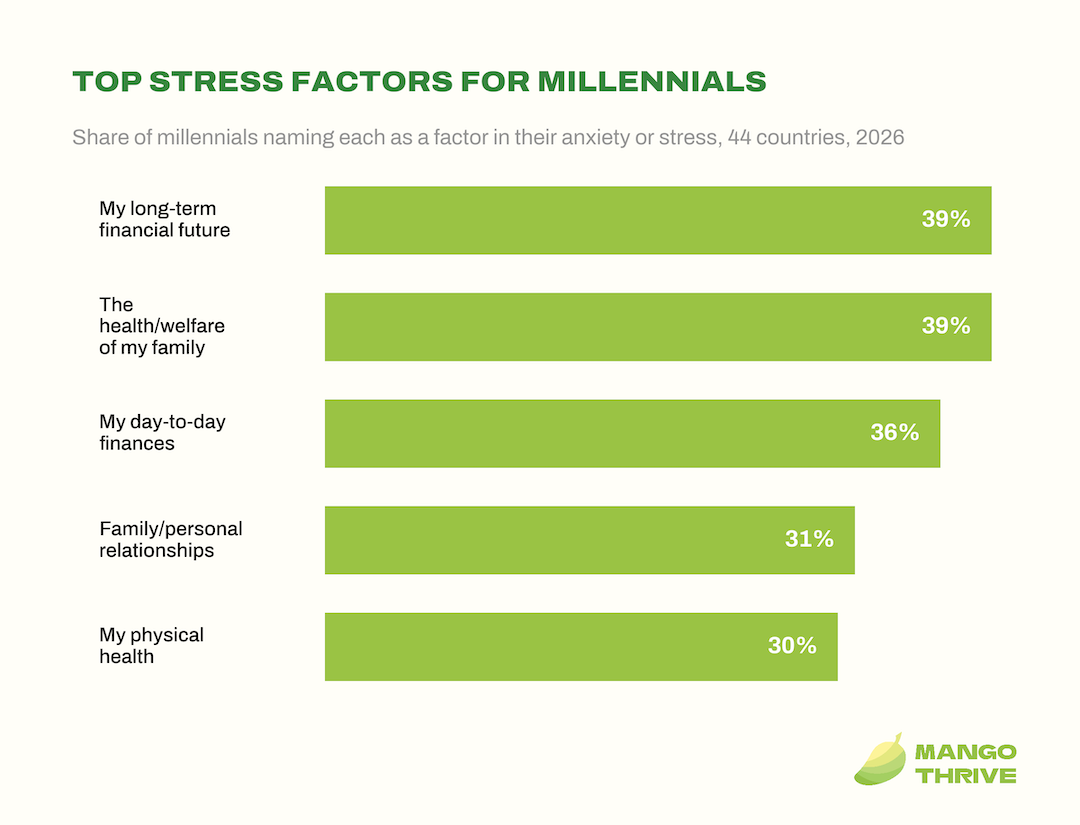
Top factors contributing to millennials’ anxiety or stress, 2026
Source: Deloitte, 2026 Gen Z and Millennial Survey, p. 34.
63. 54% of millennials in 44 countries say they regularly experience digital fatigue, per Deloitte’s 2026 survey (Deloitte).
In The Cigna Group’s loneliness report, “millennials” means people born between 1981 and 1996.
64. 65% of US millennials were classified as lonely in 2024 (The Cigna Group). The online survey covered over 5,000 US adults aged 18 and older.
65. 82.2% of EU adults aged 35 to 44 rated their health very good or good in 2025 (Eurostat, EU-SILC health data).
In Statistics Canada’s Canadian Social Survey, “life satisfaction” is rated from 0 (very dissatisfied) to 10 (very satisfied).
66. 6.6 out of 10 was the average life satisfaction of people aged 35 to 44 in Canada’s provinces in mid-2025 (Statistics Canada, Canadian Social Survey).
Conclusion
Millennials now sit in the middle of their working lives. Their share of US household wealth has grown over the past decade. Yet cost of living still tops their list of worries. We’ll update this page as new data comes out.