How Many ChatGPT Users Are There? 102 Statistics for 2026
ChatGPT has more than 900 million weekly active users.
Its mobile app reached 1 billion monthly users faster than any app ever, taking about three years.
Here are 102 ChatGPT user statistics for you. Let’s dive in:
Top ChatGPT User Statistics
- More than 900 million people use ChatGPT every week, and OpenAI has more than 50 million consumer subscribers (OpenAI, Scaling AI for Everyone).
- ChatGPT became the fastest app ever to reach 1 billion monthly active users, hitting the milestone in May 2026 (Sensor Tower, State of AI 2026 announcement).
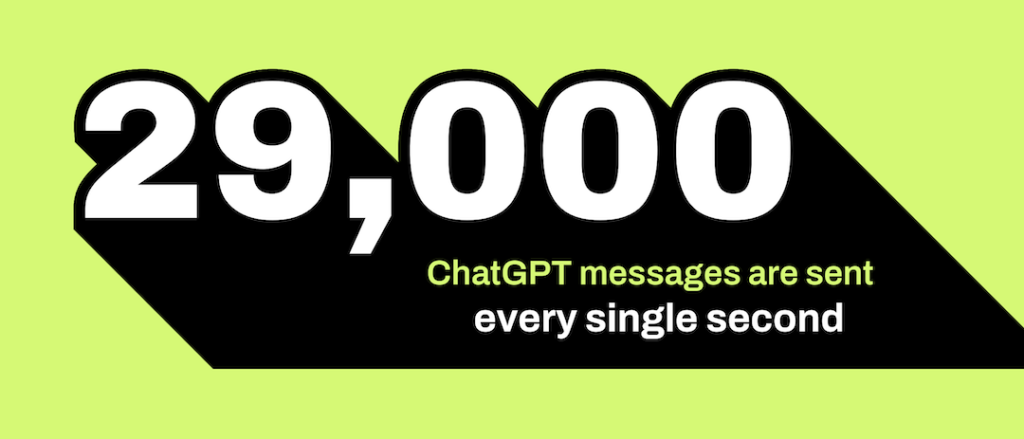
- Users send about 29,000 ChatGPT messages every second, roughly 2.5 billion messages a day (NBER Working Paper 34255).
- India alone has 100 million weekly ChatGPT users, making it OpenAI’s second-largest market (TechCrunch, India 100M WAU).
- More than 9 million people pay for ChatGPT at work, up from 2 million a year earlier (OpenAI, Scaling AI for Everyone).
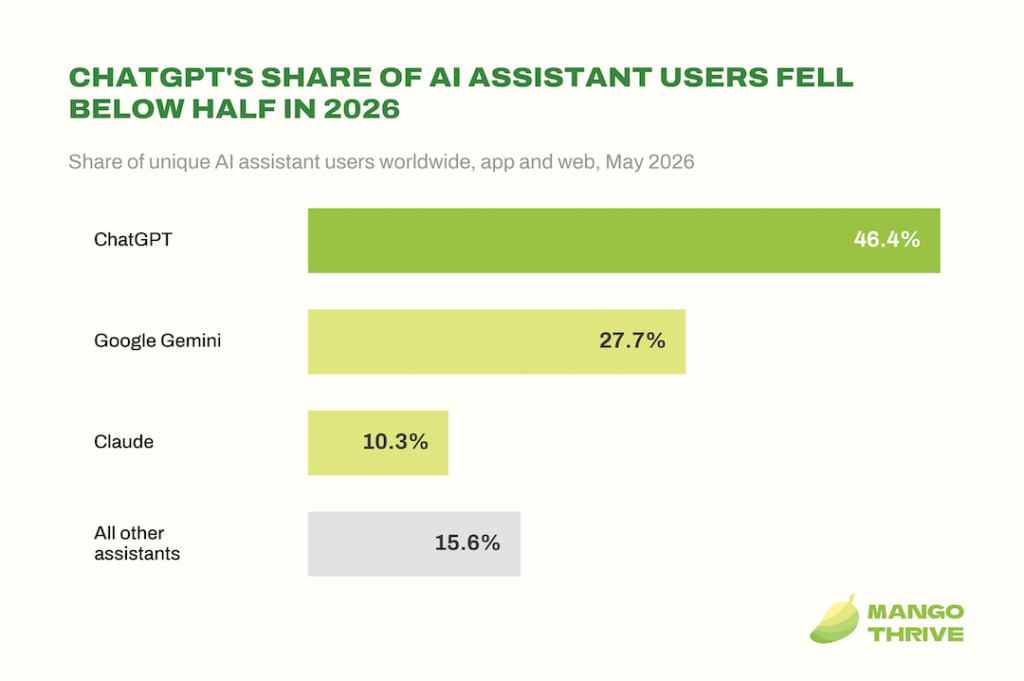
- ChatGPT’s share of AI assistant users fell below 50% for the first time in March 2026, reaching 46.4% by the end of May (Sensor Tower, State of AI 2026).
- chatgpt.com is the fifth most-visited website in the world, with roughly 5.6 billion visits in May 2026 (Similarweb, most-visited websites).
- Only 4.2% of ChatGPT messages are about computer programming, far less than the 10.2% that are tutoring and teaching requests (NBER Working Paper 34255).
- The gender gap has reversed. About 80% of ChatGPT’s earliest active users had typically masculine first names; by March 2026, 53.5% of messages came from users with typically feminine names (OpenAI Signals, data download).
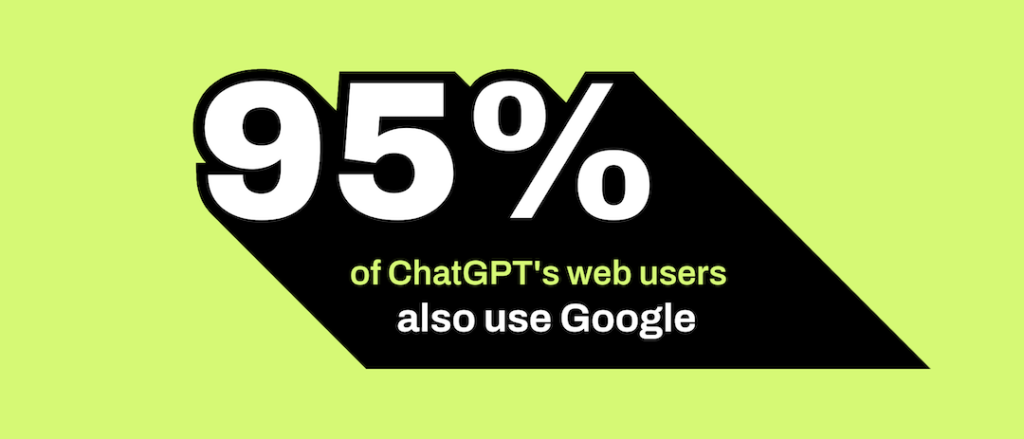
- 95% of ChatGPT’s web users also use Google. Generative AI has added a layer to search, not replaced it (Similarweb, 2026 Generative AI Landscape).
- OpenAI projects 2.6 billion weekly users by 2030, with 220 million of them paying (The Information via Sherwood News).
How Many People Use ChatGPT?
ChatGPT has more than 900 million weekly active users as of February 2026, and crossed 1 billion monthly active users on mobile in May 2026. Those are two different measures from two different sources, which is why the numbers you see quoted for ChatGPT vary so widely. OpenAI reports weekly active users; measurement firms like Sensor Tower report monthly active users.
1. ChatGPT has more than 900 million weekly active users. OpenAI disclosed the figure in February 2026, alongside more than 50 million consumer subscribers (OpenAI, Scaling AI for Everyone).
2. ChatGPT passed 1 billion monthly active users on mobile in May 2026. It is the fastest app in history to reach that mark (Sensor Tower, State of AI 2026 announcement).
ChatGPT User Growth Timeline
ChatGPT went from a research preview in November 2022 to a billion-user product in about three and a half years, or three years counting from the mobile app’s launch, which is the basis for the “fastest app ever” comparison in stat 13. Here is the milestone-by-milestone record, with each figure tied to the announcement or report that produced it.
3. ChatGPT crossed 1 million users five days after launch. Sam Altman announced it on December 5, 2022, for a product released on November 30 (Sam Altman on X, Dec 2022).
4. ChatGPT reached an estimated 100 million monthly users by January 2023, two months after launch, described at the time as the fastest-growing consumer application in history. This was a UBS estimate built on Similarweb data, not an OpenAI disclosure (Reuters).
5. ChatGPT hit 100 million weekly active users in November 2023, announced by Sam Altman at OpenAI’s first DevDay (TechCrunch, 100M WAU (2023)).
6. Weekly users doubled to 200 million by August 2024 (Axios).
7. ChatGPT reached 300 million weekly users and 1 billion messages a day in December 2024 (CNBC, Dec 2024).
8. ChatGPT crossed 400 million weekly users in February 2025. OpenAI COO Brad Lightcap framed it as serving “5% of the world every week” (Brad Lightcap on X, Feb 2025).
9. Weekly users grew from 500 million at the end of March 2025 to 700 million by August 2025, a 4x increase year over year (Nick Turley on X).
10. ChatGPT reached 800 million weekly users by October 2025, announced at DevDay alongside 4 million developers building on OpenAI’s platform (TechCrunch, 800M WAU).
11. In March 2025, ChatGPT added 1 million users in a single hour. Altman contrasted it with the launch: “we added one million users in five days. we added one million users in the last hour” (Sam Altman on X, Mar 2025).
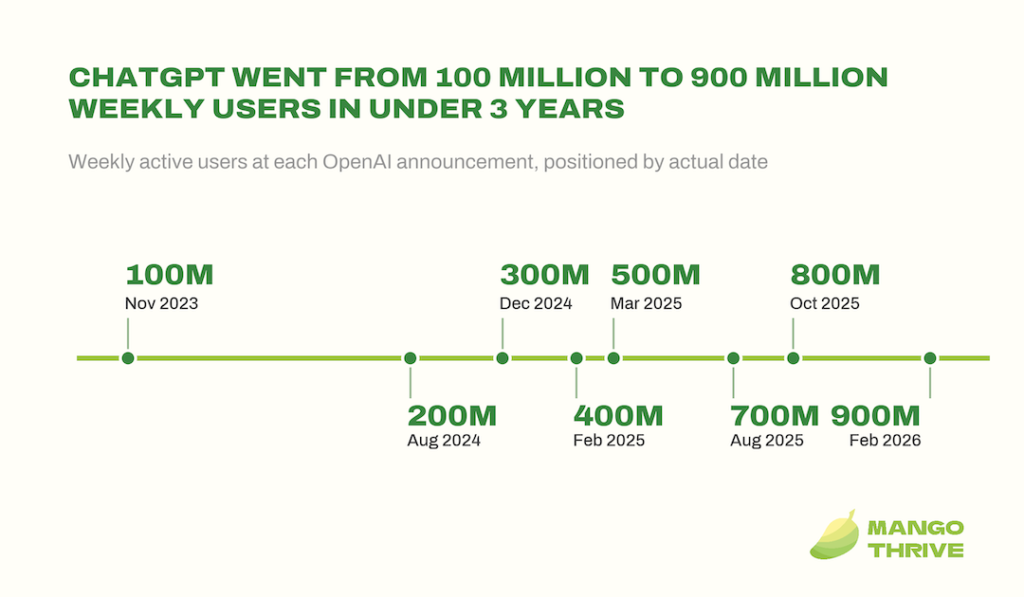
Source: OpenAI announcements, compiled; see stats 1 and 5–10 for each figure. Milestones are positioned by actual announcement date.
12. ChatGPT had more than 100 million logged-in weekly users after one year and almost 350 million after two years, according to OpenAI’s own researchers, slightly higher than the 300 million the company announced publicly in December 2024 (NBER Working Paper 34255, p. 12).
13. ChatGPT’s mobile app took about three years to reach 1 billion monthly active users, measured from its May 2023 iOS launch. Google Maps took roughly five years, TikTok more than five, YouTube just over six, and Facebook and Instagram around eight (Sherwood News, CNBC, June 2026). Some coverage puts the figure at three and a half years by counting from the ChatGPT web launch in November 2022; the three-year figure is the like-for-like one, since the comparison apps are all measured from their own app launches.
14. Counting web and app together, ChatGPT had more than 1.1 billion monthly active users in May 2026 (Sensor Tower via TechCrunch, market share).
15. ChatGPT is approaching 1 billion weekly active users, about seven months later than OpenAI’s own internal target. The company had planned to hit the milestone by the end of 2025 (The Information via PYMNTS).
ChatGPT Users by Country
Which Country Has the Most ChatGPT Users?
The United States generates the largest share of ChatGPT traffic at 15.1%, followed by India at 9.3%. Together the two markets account for roughly a quarter of all visits. Beyond those two, ChatGPT’s user base is unusually dispersed: the top ten countries combine for only about 53% of traffic, leaving nearly half spread across the rest of the world.
16. The United States is ChatGPT’s largest market, generating 15.1% of website traffic in August 2025 (Similarweb via Visual Capitalist).
17. India is second at 9.3% of traffic, followed by Brazil (5.3%), the UK (4.3%) and Indonesia (3.7%) (Similarweb via Visual Capitalist).
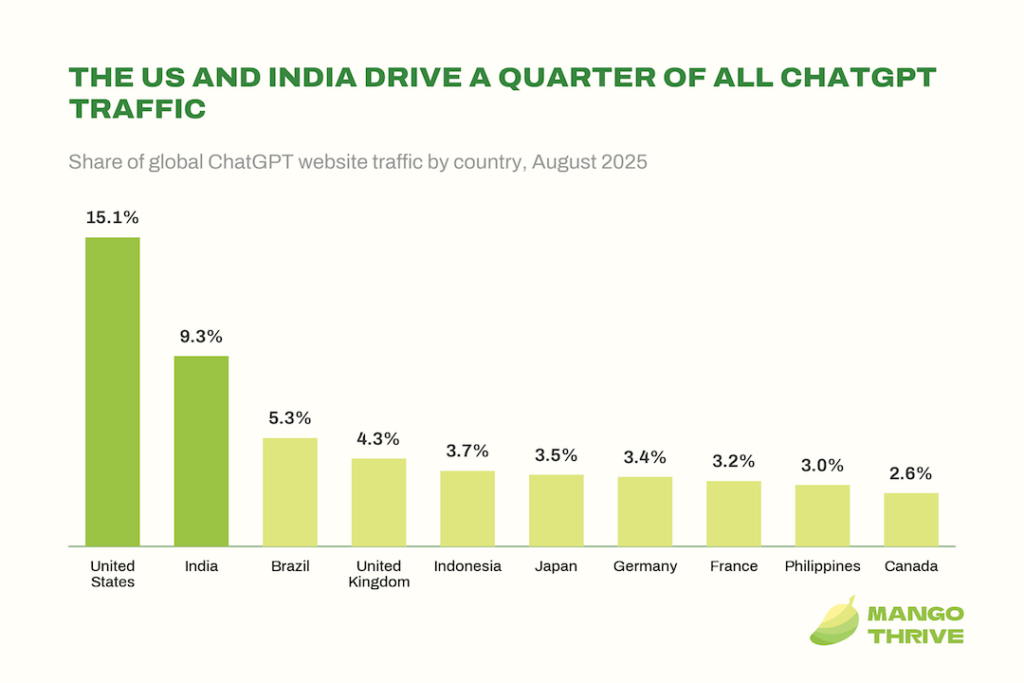
Source: Similarweb via Visual Capitalist, August 2025
| Rank | Country | Share of ChatGPT traffic |
|---|---|---|
| 1 | United States | 15.1% |
| 2 | India | 9.3% |
| 3 | Brazil | 5.3% |
| 4 | United Kingdom | 4.3% |
| 5 | Indonesia | 3.7% |
| 6 | Japan | 3.5% |
| 7 | Germany | 3.4% |
| 8 | France | 3.2% |
| 9 | Philippines | 3.0% |
| 10 | Canada | 2.6% |
Source: Similarweb via Visual Capitalist, August 2025
18. India has 100 million weekly active ChatGPT users and the largest population of student users of any country, Sam Altman said in February 2026 (TechCrunch, India 100M WAU).
19. ChatGPT had 180 million monthly app users in India in January 2026, ahead of Gemini’s 118 million, Perplexity’s 19 million and Meta AI’s 12 million (Sensor Tower via TechCrunch, India downloads).
20. About 330 million of ChatGPT’s 2.5 billion daily prompts come from users in the United States (OpenAI via TechCrunch).
21. Users whose primary language is not English now make up more than half of ChatGPT’s active users. The leading non-English languages are Spanish, Portuguese and Arabic (OpenAI Signals, adoption report).
22. Uzbek, Kazakh and Burmese were the fastest-growing languages on ChatGPT by share of active users between July 2023 and June 2026 (OpenAI Signals, adoption report).
23. The fastest relative growth in ChatGPT adoption has come from Africa and Asia, and from countries with lower Human Development Index scores (OpenAI Signals, adoption report).
24. 17.8% of the world’s working-age population used AI tools in Q1 2026, up from 16.3%. The UAE leads globally at 70.1%, while the United States ranks 21st at 31.3% (Microsoft AI Economy Institute, p. 2 and p. 4).
25. Twelve of the fifteen fastest-growing AI markets since June 2025 are in Asia, led by South Korea (+43.2%), Thailand (+36.4%) and Japan (+34.1%) (Microsoft AI Economy Institute, p. 6).
26. AI adoption in the Global North reached 27.5% in Q1 2026 versus 15.4% in the Global South. The gap widened from 9.8 percentage points in the first half of 2025 to 12.1 points (Microsoft AI Economy Institute, p. 5).
27. 32.7% of people aged 16 to 74 in the EU used generative AI tools in 2025. Denmark led at 48.4%, Romania trailed at 17.8% (Eurostat).
28. Weekly use of AI chatbots for news rose from 7% to 10% globally in a year. Nigeria (32%), Kenya (26%) and India (22%) lead the 48-market survey, while the UK is lowest at 4% (Reuters Institute Digital News Report 2026, p. 15).
29. India is the world’s largest generative AI web market, with more than 13 billion visits between June 2025 and May 2026. The United States is second with over 8 billion. Growth was strongest in Argentina, South Korea, Turkey, Japan and Vietnam (Sensor Tower, State of AI 2026, p. 25).
30. Asia recorded its first decline in AI app downloads after 13 consecutive quarters of growth, with downloads falling 3.3% in Q1 2026. Every other region except the Middle East grew, led by Latin America and Europe (Sensor Tower, State of AI 2026, p. 26).
31. OpenAI’s services are officially supported in 188 countries and territories, according to the company’s own supported-countries list (OpenAI, supported countries list).
Paying Subscribers and Business Users
What Percentage of ChatGPT Users Pay?
About 5% of ChatGPT’s weekly users pay for a subscription. With more than 50 million consumer subscribers against more than 900 million weekly users, the vast majority of ChatGPT’s audience uses it for free, and OpenAI’s own internal projections assume that ratio only climbs to 8.5% by 2030.
32. OpenAI has more than 50 million consumer subscribers, and reported that January and February 2026 were on track to be its largest months ever for new subscribers (OpenAI, Scaling AI for Everyone).
33. Consumer subscribers grew from 35 million to more than 50 million in roughly three months, between November 2025 and February 2026 (The Information via Sherwood News, OpenAI, Scaling AI for Everyone).
34. Roughly 5% of ChatGPT’s weekly users currently pay for a subscription, according to OpenAI’s internal projections (The Information via Sherwood News).
35. More than 9 million people pay to use ChatGPT at work (OpenAI, Scaling AI for Everyone).
36. Paying business users grew from 2 million in February 2025 to more than 9 million by February 2026, passing 3 million in June and 5 million in August. OpenAI separately reported 7 million total ChatGPT for Work seats, a different measure, in November 2025 (Brad Lightcap on X, Aug 2025, OpenAI, 1 Million Businesses).
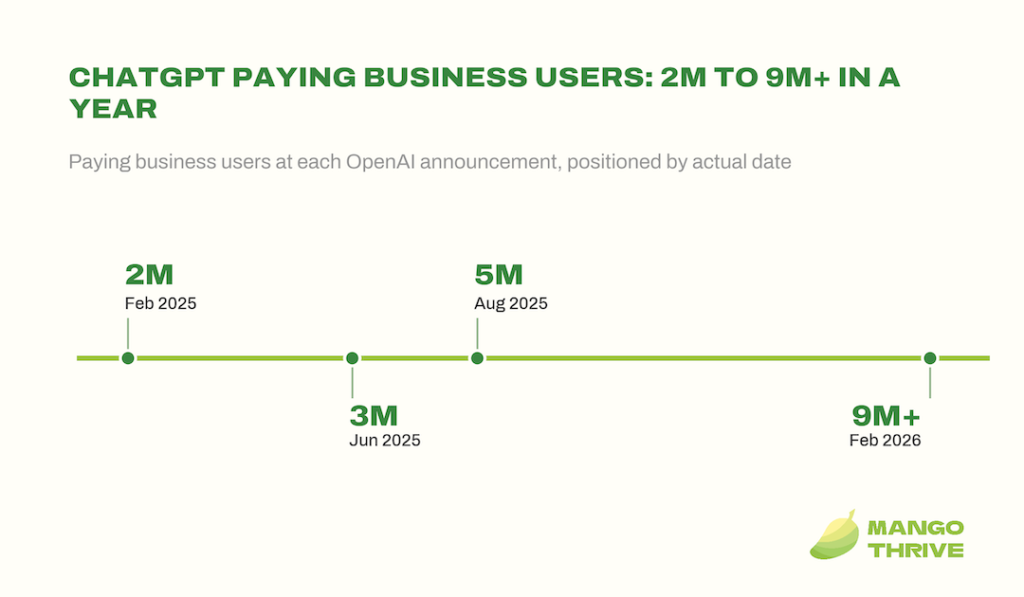
Source: OpenAI, Scaling AI for Everyone; see stat 36. The chart shows paying business users only; the 7 million seats figure from November 2025 is a different measure and is excluded.
37. More than 2 million businesses now use OpenAI’s models, as of July 2026. In November 2025 the company reported more than 1 million business customers for ChatGPT for Work, which it called “the fastest-growing business platform in history.” The two figures are not a clean like-for-like: the 2026 number covers businesses reached by OpenAI’s models across all its products, the 2025 number counted ChatGPT for Work customers specifically (OpenAI, July 2026, OpenAI, November 2025).
38. ChatGPT Enterprise seats grew 9x year over year as of November 2025, with total ChatGPT for Work seats up 40% in just two months (OpenAI, 1 Million Businesses).
39. ChatGPT’s 2026 consumer pricing runs from $0 to $200 a month: Free, Go at $8, Plus at $20 and Pro at $200. Go, launched globally in January 2026, is OpenAI’s fastest-growing plan (OpenAI, Introducing ChatGPT Go).
40. ChatGPT Business costs $25 per user per month billed monthly, or $20 billed annually, with a two-seat minimum (OpenAI Help Center).
41. The largest single ChatGPT deployment on record covers 460,000 students and 63,000 staff across the 23 campuses of the California State University system (OpenAI, CSU announcement).
42. OpenAI generates about $2 billion in revenue per month as of March 2026, up from $1 billion per quarter at the end of 2024 (OpenAI, Accelerating the Next Phase).
43. Enterprise now accounts for more than 40% of OpenAI’s revenue and is on track to reach parity with consumer revenue by the end of 2026 (OpenAI, Next Phase of Enterprise AI).
44. ChatGPT alone generated more than $2.5 billion in mobile in-app purchase revenue in the first half of 2026, out of the $4 billion taken by all generative AI apps combined (Sensor Tower, State of AI 2026, p. 54).
45. Apps mentioning AI-related terms are on track for $12 billion in mobile in-app revenue in H1 2026, up 61% year over year. Strip out the generative AI apps and the rest still grew 40%, to nearly $8 billion (Sensor Tower, State of AI 2026, p. 54).
Website Traffic and App Downloads
46. chatgpt.com is the fifth most-visited website in the world, with roughly 5.6 billion visits in May 2026, up 24% year over year (Similarweb, most-visited websites).
| Rank | Website | Monthly visits (May 2026) |
|---|---|---|
| 1 | google.com | 87.5 billion |
| 2 | youtube.com | 29.9 billion |
| 3 | facebook.com | 11.8 billion |
| 4 | instagram.com | 7.4 billion |
| 5 | chatgpt.com | 5.6 billion |
| 9 | tiktok.com | 3.6 billion |
| 12 | gemini.google.com | 2.9 billion |
Source: Similarweb, most-visited websites, May 2026
47. ChatGPT added more than 60 billion web visits year over year, the single largest gain of any website (Sensor Tower, State of Web 2026).
48. ChatGPT averaged 494 million unique web visitors a month between March and May 2026, more than Gemini (310 million) and Claude (86 million) combined (Similarweb, 2026 Generative AI Landscape, p. 12).
49. The average ChatGPT visit lasts 6 minutes 13 seconds and covers 3.86 pages, with a bounce rate of 31.94% (Similarweb, chatgpt.com profile).
50. 72.26% of ChatGPT’s desktop visits come from direct traffic: people typing the address or using a bookmark rather than arriving from search (Similarweb, chatgpt.com profile).
51. The ChatGPT mobile app has been downloaded an estimated 1.2 billion times and has generated $5.01 billion in consumer spending, about $4.14 per download (Appfigures, $5B milestone report).
52. Annual downloads grew from 107 million in 2023 to 262 million in 2024 and 565 million in 2025 (Appfigures, $5B milestone report).
53. ChatGPT was downloaded 61 million times in May 2026, making it the world’s most-downloaded app, a title it has held since March 2025 (Appfigures, May 2026 top apps).
54. ChatGPT’s mobile apps averaged 245 million daily active users in April 2026, up slightly from 241 million in January (Similarweb via Forbes).
A note on daily active users: OpenAI has never published a ChatGPT DAU figure. The Similarweb mobile estimate in stat 54 is the only DAU figure in this article with a named methodology behind it.
55. ChatGPT users spend about 215 minutes per month in the mobile app, compared with 120 minutes for Claude and 100 for Gemini (Sensor Tower, State of AI 2026 announcement).
56. Generative AI websites received 9.5 billion visits a month on average between June 2025 and May 2026, up 70% year over year, from 655 million unique visitors (Similarweb, 2026 Generative AI Landscape).
57. 58.8% of ChatGPT’s referral traffic lands on a website’s homepage rather than a deeper page (US, desktop), while 41.7% of the URLs ChatGPT cites sit two folders deep (Similarweb, 2026 Generative AI Landscape, p. 30).
58. The share of ChatGPT referrals landing on homepages jumped from around 25% to nearly 60% after OpenAI’s May 7, 2026 search update (Similarweb, 2026 Generative AI Landscape, p. 28).
59. ChatGPT’s US app monthly users grew 87% year over year to May 2026, slower than Meta AI (+435%), Claude (+349%) and Grok (+117%). Microsoft 365 Copilot fell 31% and DeepSeek fell 23% over the same period (Similarweb, 2026 Generative AI Landscape, p. 8).
60. OpenAI increased its advertising spend 800% year over year as competition for AI users intensified; Anthropic raised its spend 1,184%. Generative AI ad spend worldwide reached $424 million in Q1 2026, up 228% (Sensor Tower, State of AI 2026, p. 44).
Who Uses ChatGPT?
How Old Are ChatGPT Users?
About two-thirds of ChatGPT messages come from users under 35. In March 2026, users aged 25–34 sent 35.8% of messages and users aged 18–24 sent 30.3%, while users 55 and older accounted for just 6.1% combined.
61. In the United States, 44% of adults report using ChatGPT, up from 34% in 2025, 23% in 2024 and 18% in 2023 (Pew Research Center, Americans and AI appendix).
62. US adults under 50 use ChatGPT at 57%, versus 28% of those 50 and older (Pew Research Center, Americans and AI report (PDF), p. 9).
63. Message share by age in March 2026: 25–34 year olds sent 35.8%, 18–24 year olds 30.3%, 35–44 year olds 18.6%, 45–54 year olds 9.1%, 55–64 year olds 3.7% and users 65+ just 2.4% (OpenAI Signals, data download).
64. Around 46% of ChatGPT messages from users who report their age come from 18- to 25-year-olds (NBER Working Paper 34255, p. 27).
65. ChatGPT’s gender gap has closed and reversed. About 80% of active users in the months after launch had typically masculine first names; that fell to 48% by June 2025, and by March 2026 users with typically feminine names accounted for 53.5% of all messages (NBER Working Paper 34255 p. 5; OpenAI Signals, data download).
66. Survey data confirms the same trend. In the US, chatbot use went from 39% of men and 28% of women in 2024 to 50% and 47% in 2026, and ChatGPT specifically is used by 44% of each (Pew Research Center, gender gap analysis).
67. Chatbot use rises sharply with income: 66% of upper-income US adults, 49% of middle-income and 41% of lower-income (Pew Research Center, Americans and AI report (PDF), p. 55).
68. ChatGPT use also rises with education. In 2025, 52% of US adults with a postgraduate degree and 51% with a bachelor’s had used it, versus 33% with some college and 18% with a high school education or less (Pew Research Center, June 2025 short read).
69. Half of US generative AI chatbot users are now aged 18–34, down from 61% in May 2024. The audience is ageing as adoption spreads beyond early adopters (Similarweb, 2026 Generative AI Landscape, p. 16).
70. Every age group over 35 gained share of US chatbot usage between 2024 and 2026, while both younger groups lost it (Similarweb, 2026 Generative AI Landscape, p. 16):
| Age group | May 2024 | May 2025 | May 2026 |
|---|---|---|---|
| 18–24 | 28% | 24% | 22% |
| 25–34 | 33% | 29% | 28% |
| 35–44 | 16% | 17% | 18% |
| 45–54 | 12% | 14% | 16% |
| 55+ | 12% | 16% | 18% |
Source: Similarweb, 2026 Generative AI Landscape, p. 16; US, desktop and mobile web. Figures are rounded by the source and do not always sum to 100%.
71. ChatGPT attracts everyday consumers; Claude attracts professionals and students. Compared with Google’s visitors, ChatGPT users are 2.4x more likely to visit restaurant and delivery sites, 2.3x more likely to visit health sites and 2.1x more likely to visit fashion sites. Claude users are 25x more likely to visit university websites (Similarweb, 2026 Generative AI Landscape, p. 20).
72. ChatGPT and Claude users write the longest prompts and have the most back-and-forth per session. Gemini and Microsoft Copilot sit at the opposite end, used for short prompts and quick answers (Similarweb, 2026 Generative AI Landscape, p. 19).
What Do People Use ChatGPT For?
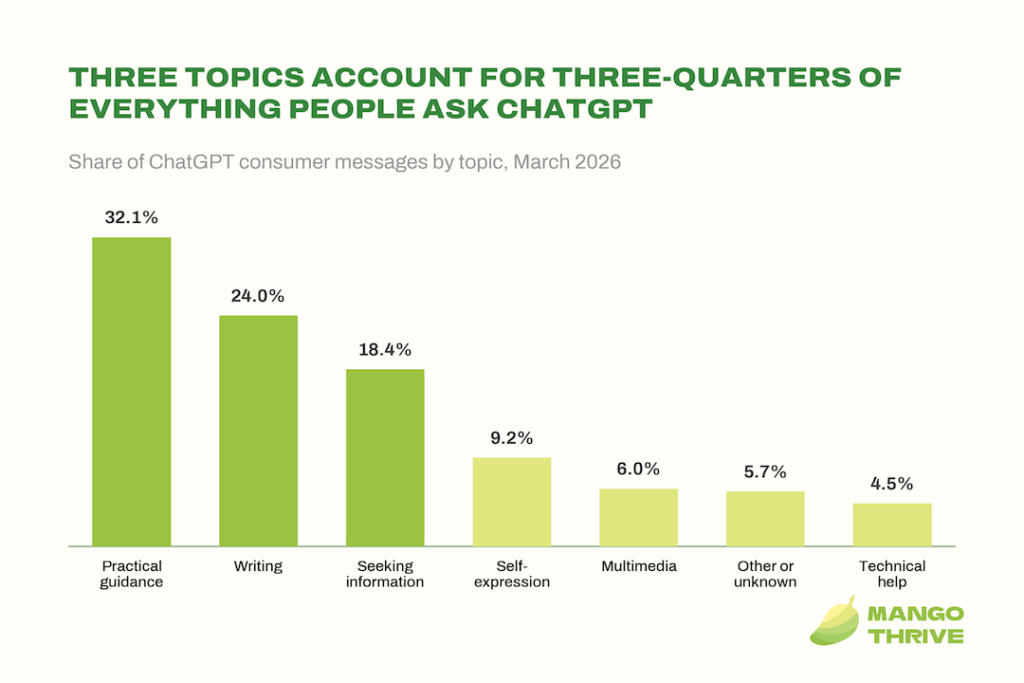
Practical guidance, writing and seeking information account for about three-quarters of everything sent to ChatGPT. Coding, the use case most associated with the product in public debate, makes up a small fraction of consumer messages.
73. Topic breakdown as of March 2026: practical guidance 32.1%, writing 24.0%, seeking information 18.4%, self-expression 9.2%, multimedia 6.0%, other 5.7% and technical help 4.5% (OpenAI Signals, data download).
Source: OpenAI Signals, data download, March 2026
74. Tutoring and teaching requests make up 10.2% of all ChatGPT messages, against the 4.2% that are computer programming. Mathematical calculation accounts for 3%, relationships and personal reflection 1.9%, and games and role play 0.4% (NBER Working Paper 34255, p. 18).
75. Most ChatGPT use is personal, not professional. In March 2026, 68.9% of messages were non-work; a separate three-way classifier split messages into 64.5% other, 19.2% work and 16.3% schoolwork (OpenAI Signals, data download).
76. Work-related use varies sharply by occupation. Work accounts for 57% of messages from people in computer-related jobs, 50% in management and business, 48% in engineering and science, and 40% among non-professional occupations (NBER Working Paper 34255, p. 33).
77. Just three work activities account for 45.2% of all ChatGPT messages: getting information (19.3%), interpreting the meaning of information for others (13.1%) and documenting or recording information (12.8%) (NBER Working Paper 34255, p. 22).
Whatever the topic, the volume behind those shares is enormous.
78. ChatGPT users send roughly 2.5 billion messages a day, or about 29,000 messages every second (NBER Working Paper 34255, p. 38).
Source: How People Use ChatGPT, NBER Working Paper 34255, p. 38
79. By July 2025, 18 billion ChatGPT messages were being sent each week by 700 million users, about 10% of the world’s adult population (NBER Working Paper 34255, p. 3).
80. Daily message volume grew from 451 million messages a day in June 2024 to 2,627 million in June 2025 (NBER Working Paper 34255, p. 4).
81. OpenAI’s weekly user figure (stat 1) counts logged-in users only. ChatGPT has been usable without an account since April 2024, and OpenAI’s own researchers describe logged-out users as “a minority share,” meaning total reach is higher than the reported number (NBER Working Paper 34255, p. 8).
82. As of January 2025, more than one-third of US 18- to 24-year-olds used ChatGPT, and over a quarter of their messages related to learning, tutoring or schoolwork. More recent Pew data puts usage among 18- to 29-year-olds far higher (OpenAI, AI-Ready Workforce (PDF), p. 2).
83. 95% of UK university students now use AI in some form, and 12% include AI-generated text directly in assessed work, up from 8% in 2025 and 3% in 2024 (HEPI / Kortext).
Inside ChatGPT: Citations and Ads
Two things changed inside the ChatGPT experience during 2026: it began searching the live web far more often, and it began showing ads.
84. 6.8% of ChatGPT answers included a web citation in May 2026, more than five times the share a year earlier (US, desktop) (Similarweb, 2026 Generative AI Landscape, p. 25).
85. 26% of US desktop ChatGPT conversations contained an ad in June 2026, up from 14% just a month earlier (Similarweb, 2026 Generative AI Landscape, p. 2).
86. 66.3% of ChatGPT ads appear only after the second prompt, once the conversation has built enough context to target against (US, desktop) (Similarweb, 2026 Generative AI Landscape, p. 32).
87. 65.3% of ChatGPT sessions continue after an ad appears, and ChatGPT ads have a click-through rate of about 0.50% (US, desktop) (Similarweb, 2026 Generative AI Landscape, p. 32).
ChatGPT vs Other AI Chatbots
Is ChatGPT Still the Most Used AI Chatbot?
Yes, but by a shrinking margin. ChatGPT’s share of AI assistant users fell below 50% for the first time in March 2026, landing at 46.4% by the end of May. Its mobile app still has more users than every rival’s combined, but Gemini and Claude are growing faster.
88. ChatGPT’s share of AI assistant users fell below 50% for the first time in March 2026, and stood at 46.4% by the end of May. Gemini reached 27.7% and Claude 10.3%; every other assistant sat below 5%. The measure is Sensor Tower’s “True Audience”: unique monthly users across web and mobile app, covering 25 markets (Sensor Tower, State of AI 2026, p. 9; Sensor Tower via TechCrunch, market share).
Source: Sensor Tower, State of AI 2026, p. 9. “All other assistants” is the remainder of the three published shares.
89. By monthly active users across app and web, ChatGPT had more than 1.1 billion in May 2026, Gemini 662 million and Claude 245 million (Sensor Tower via TechCrunch, market share).
90. ChatGPT’s share of generative AI web traffic fell from 76.4% in June 2025 to 52.7% in May 2026, while Gemini rose from 8.9% to 27.3% and Claude from 1.6% to 8.9%. ChatGPT lost share while its own traffic still grew: visits to chatgpt.com were up 24% year over year over a comparable period (see stat 46) (Similarweb, most-visited websites).
91. ChatGPT’s share of AI app downloads fell from 67% in Q2 2025 to 47% in Q2 2026. Gemini took 22% and Claude 14%, up from 1% a year earlier (Sensor Tower via Forbes).
92. ChatGPT’s global mobile app monthly users grew 67% year over year in Q2 2026; Claude’s grew 627%. This is a different measure from the US-only figure in stat 59, which comes from a different vendor (Sensor Tower via Forbes).
93. ChatGPT’s mobile app has more monthly users than Claude, Gemini, Doubao, DeepSeek, Meta AI, Grok, Perplexity and Copilot combined (Sensor Tower via Sherwood News).
94. Rival user counts, as most recently disclosed by each company:
| Assistant | Users | Metric | As of | Source |
|---|---|---|---|---|
| ChatGPT | 900 million+ | Weekly active | Feb 2026 | OpenAI, Scaling AI for Everyone |
| Google Gemini (app) | 950 million | Monthly active | Q2 2026 | Alphabet |
| Meta AI | 1 billion | Monthly active | May 2025 | CNBC, May 2025 |
| Microsoft Copilot | 150 million+ | Monthly active | Oct 2025 | TechCrunch, Copilot usage |
| Grok | 117 million | Monthly active | Mar 2026 | SpaceX Form S-1/A |
These are not directly comparable: OpenAI reports weekly users, everyone else reports monthly, and each company defines an “active user” differently.
95. 95% of ChatGPT users also use Google. Of ChatGPT’s 494 million unique web visitors between March and May 2026, 461 million also visited Google, which had 3.3 billion (Similarweb, 2026 Generative AI Landscape, p. 12).
Source: Similarweb, 2026 Generative AI Landscape, p. 12
96. 29 million people use all three of ChatGPT, Gemini and Claude. ChatGPT had 494 million unique web visitors over the period, against Gemini’s 310 million and Claude’s 86 million (Similarweb, 2026 Generative AI Landscape, p. 12).
97. ChatGPT remains the leading AI assistant by monthly active users across most major markets. Gemini posted the strongest MAU growth across much of Europe, the US, Japan and South Korea, while Doubao leads in mainland China (Sensor Tower, State of AI 2026, p. 30).
98. 31.2% of online adults aged 16 and over say they used ChatGPT in the past month, a universe of roughly 1.03 billion people across 54 surveyed markets (GWI via DataReportal).
99. About 2.42 billion people, 40% of the world’s internet users, now use a standalone generative AI platform (DataReportal).
ChatGPT User Forecasts
100. OpenAI projects 2.6 billion weekly active users by 2030 (The Information via Sherwood News).
101. OpenAI expects 220 million paying subscribers by 2030, or 8.5% of that projected user base, up from about 5% today (The Information via Sherwood News).
102. Consumers are on pace to download nearly 2.3 billion AI apps in the first half of 2026 and spend more than $4.2 billion on them, versus $1.83 billion in the same period of 2025 (Sensor Tower via TechCrunch, market share).
Conclusion
ChatGPT reached a billion-user scale faster than any consumer software product measured before it. The more interesting story is what’s underneath: growth is now coming from outside the English-speaking world, most usage is personal rather than professional, and ChatGPT’s dominance of the category, though still enormous, is no longer absolute.
We update this page as new figures are published. If you cite a statistic from it, please link back so readers can trace it to the original source.