Large language models, or LLMs, are the AI systems behind chatbots like ChatGPT, Gemini, and Claude. People now use them at work, at school, and at home. Companies also build them into their own apps and services. Here are the latest statistics on how many people use LLMs, which ones they choose, and what they use them for.
Top LLM Usage Statistics
- 18.8% of the world’s working-age population used generative AI in June 2026 (Microsoft AI Economy Institute, Global AI Diffusion Q2 2026).
- 49% of US adults say they use AI chatbots, up from 33% in summer 2024 (Pew Research Center, Americans and AI 2026).
- Over 1 billion people use OpenAI’s products each week, OpenAI said in September 2026 (OpenAI, Rapidly scaling online storage to serve over 1 billion ChatGPT users).
- Google processed over 3.2 quadrillion tokens a month across its products in May 2026 (Google, I/O 2026 keynote).
- 73% of ChatGPT consumer messages were not related to work in June 2025, up from 53% a year earlier (NBER, How People Use ChatGPT).
- Anthropic held 40% of enterprise LLM API market share by usage in 2025 (Menlo Ventures, 2025 State of Generative AI in the Enterprise).
- 84% of developers used or planned to use AI tools in their development process in 2025, up from 76% in 2024 (Stack Overflow, 2025 Developer Survey).
- 95% of UK undergraduates said they use AI in at least one way, in a survey from December 2025 (HEPI and Kortext, Student Generative AI Survey 2026).
How Many People Use LLMs Worldwide?
1. 18.8% of the world’s working-age population used generative AI in June 2026 (Microsoft AI Economy Institute, Global AI Diffusion Q2 2026). Microsoft counts people aged 15 to 64, using its own usage data adjusted for device share, internet access, and population.
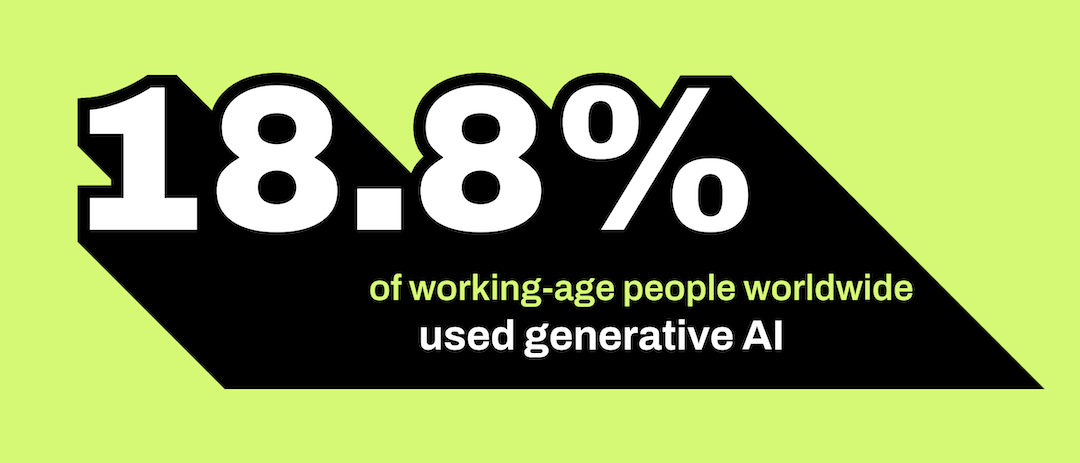
18.8% of working-age people worldwide used generative AI in June 2026
Source: Microsoft AI Economy Institute, Global AI Diffusion Q2 2026, p. 2
2. 28.8% of people in the Global North used generative AI in Q2 2026, versus 16.2% in the Global South (Microsoft AI Economy Institute, Global AI Diffusion Q2 2026).
How Many Americans Use AI Chatbots?
3. 49% of US adults say they use AI chatbots, up from 33% in summer 2024 (Pew Research Center, Americans and AI 2026). The survey of 5,119 US adults ran February 17–23, 2026.
4. 44% of US adults said in 2026 they have used ChatGPT, up from 34% in 2025 (Pew Research Center, Americans and AI 2026).
| AI chatbot | % of US adults who say they have used it, February 2026 |
|---|---|
| ChatGPT | 44% |
| Gemini | 24% |
| Copilot | 17% |
| Meta AI | 14% |
| Grok | 8% |
| Claude | 6% |
| Character.ai | 3% |
Source: Pew Research Center, Americans and AI 2026
5. About a quarter of US adults say they use AI chatbots daily, Pew found in 2026 (Pew Research Center, Americans and AI 2026). That includes 12% who do so several times a day and 4% almost constantly.
6. 61% of US adults ages 18 to 29 have used ChatGPT, as of 2026 (Pew Research Center, ChatGPT use by age). Pew notes that its 2026 question also asked about other chatbots, unlike earlier years.
| % of US adults who have used ChatGPT, by age | 2023 | 2024 | 2025 | 2026 |
|---|---|---|---|---|
| 18-29 | 33% | 43% | 58% | 61% |
| 30-49 | 21% | 27% | 41% | 55% |
| 50-64 | 13% | 17% | 25% | 37% |
| 65+ | 4% | 6% | 10% | 19% |
| All US adults | 18% | 23% | 34% | 44% |
Source: Pew Research Center, ChatGPT use by age. The 2026 question also asked about other chatbots.
7. 51% of US adults whose highest degree is a bachelor’s said they had used ChatGPT in early 2025 (Pew Research Center, 34% of US adults have used ChatGPT). Among adults with a high school degree or less, the share was 18%.
LLM Use by Country
These figures compare generative AI use across countries and regions.
8. 73.3% of the UAE’s working-age population used generative AI in Q2 2026, the top share in Microsoft’s ranking (Microsoft AI Economy Institute, Global AI Diffusion Q2 2026). Singapore ranked second at 64.3%.
| Rank | Economy | % of working-age population using generative AI, Q2 2026 |
|---|---|---|
| 1 | United Arab Emirates | 73.3% |
| 2 | Singapore | 64.3% |
| 3 | Ireland | 49.9% |
| 4 | France | 49.6% |
| 5 | Norway | 49.4% |
| 6 | Spain | 45.1% |
| 7 | New Zealand | 44.1% |
| 8 | United Kingdom | 43.7% |
| 9 | Netherlands | 43.5% |
| 10 | Qatar | 43.5% |
| 11 | Australia | 40.7% |
| 12 | South Korea | 40.6% |
| 13 | Belgium | 40.3% |
| 14 | Switzerland | 39.1% |
| 15 | Israel | 38.7% |
| 16 | Canada | 38.5% |
| 17 | Sweden | 37.3% |
| 18 | Austria | 35.4% |
| 19 | Taiwan | 33.8% |
| 20 | Hungary | 33.3% |
| 21 | United States | 33.0% |
| 22 | Denmark | 32.4% |
| 23 | Germany | 32.3% |
| 24 | Poland | 32.3% |
| 25 | Saudi Arabia | 31.4% |
Source: Microsoft AI Economy Institute, Global AI Diffusion Q2 2026, p. 4
9. South Korea’s AI user share rose 3.5 percentage points in Q2 2026, the largest absolute change measured (Microsoft AI Economy Institute, Global AI Diffusion Q2 2026).
10. 32.7% of people aged 16 to 74 in the EU used generative AI tools in 2025 (Eurostat, Generative AI use in 2025). The survey asked about use in the three months before it was taken.
11. 63.8% of people aged 16 to 24 in the EU used generative AI tools in 2025 (Eurostat, Young people and generative AI).
12. 10% of people across 48 markets used AI chatbots for news weekly in 2026, up from 7% a year earlier (Reuters Institute, Digital News Report 2026).
13. 16% of people under 35 reported using AI chatbots for news in 2026 (Reuters Institute, Digital News Report 2026).
How Many People Use ChatGPT, Gemini, and Other LLM Chatbots?
Companies count their users in different ways. Weekly active users are people who used a product at least once in a given week. Monthly active users are counted over a month.
14. ChatGPT had more than 900 million weekly active users in February 2026 (OpenAI, Scaling AI for everyone).
15. Over 1 billion people use OpenAI’s products each week, OpenAI said in September 2026 (OpenAI, Rapidly scaling online storage to serve over 1 billion ChatGPT users).
16. 700 million people were sending 18 billion ChatGPT messages a week by July 2025 (NBER, How People Use ChatGPT). The authors say that is around 10% of the world’s adult population.
17. The Gemini app had 950 million monthly active users in July 2026 (Alphabet, Q2 2026 earnings remarks).
18. Meta AI had 1 billion monthly active users across Meta’s apps in May 2025, Mark Zuckerberg said (Meta via CNBC).
19. Microsoft 365 Copilot had over 20 million paid seats in April 2026, Satya Nadella said (Microsoft, FY26 Q3 earnings call). A seat is one paid user license.
In StatCounter’s data, “AI chatbot market share” is based on over 3 billion monthly page views across the websites that use StatCounter’s tracking.
20. 79.4% of AI chatbot market share worldwide went to ChatGPT in August 2026, by StatCounter’s measure (StatCounter, AI Chatbot Market Share Worldwide). Gemini had 10.9%, Perplexity 4.31%, Microsoft Copilot 2.79%, Claude 2.57%, and DeepSeek 0.02%.
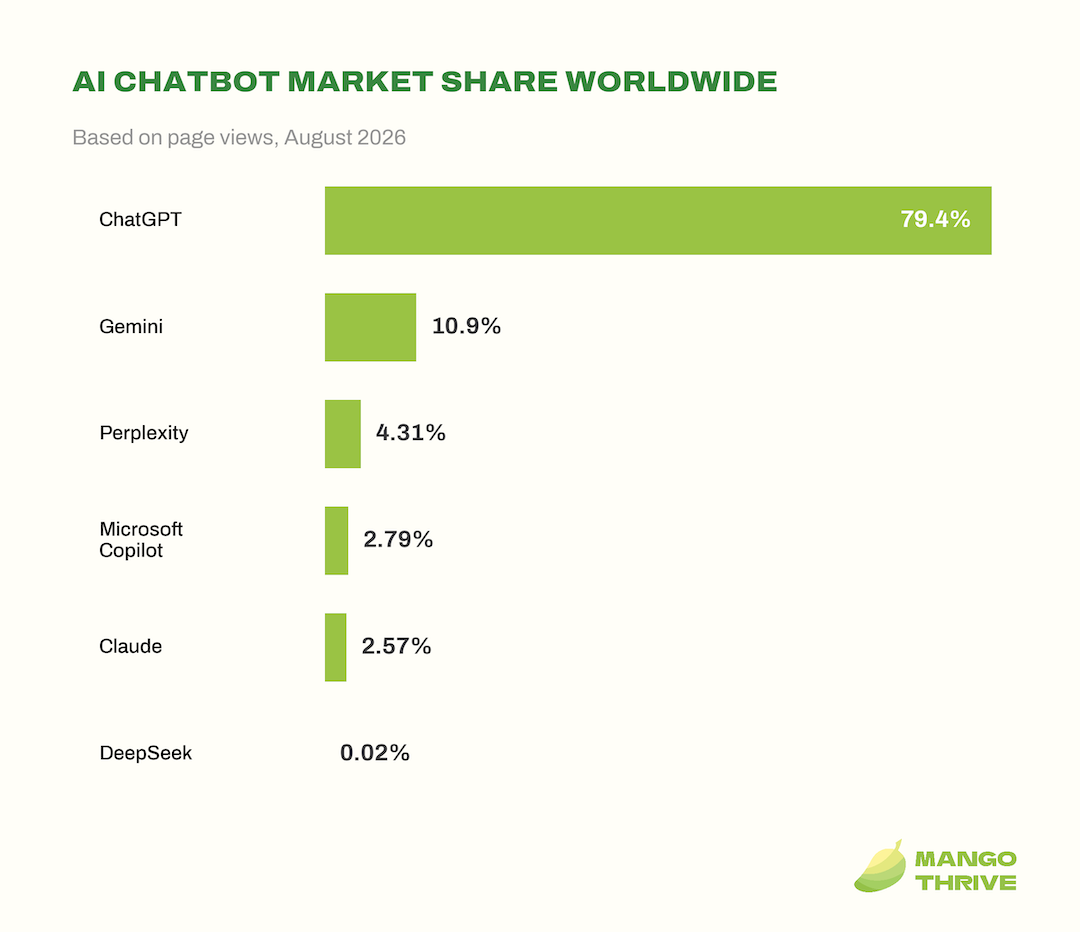
AI chatbot market share worldwide, August 2026
Source: StatCounter, AI Chatbot Market Share Worldwide
How Much Are LLMs Used?
Tokens are small chunks of text, such as words or parts of words, that AI models read and write. Companies often measure AI use in tokens.
21. Google processed over 3.2 quadrillion tokens a month across its products in May 2026 (Google, I/O 2026 keynote). It reported roughly 480 trillion a year earlier and 9.7 trillion two years earlier.
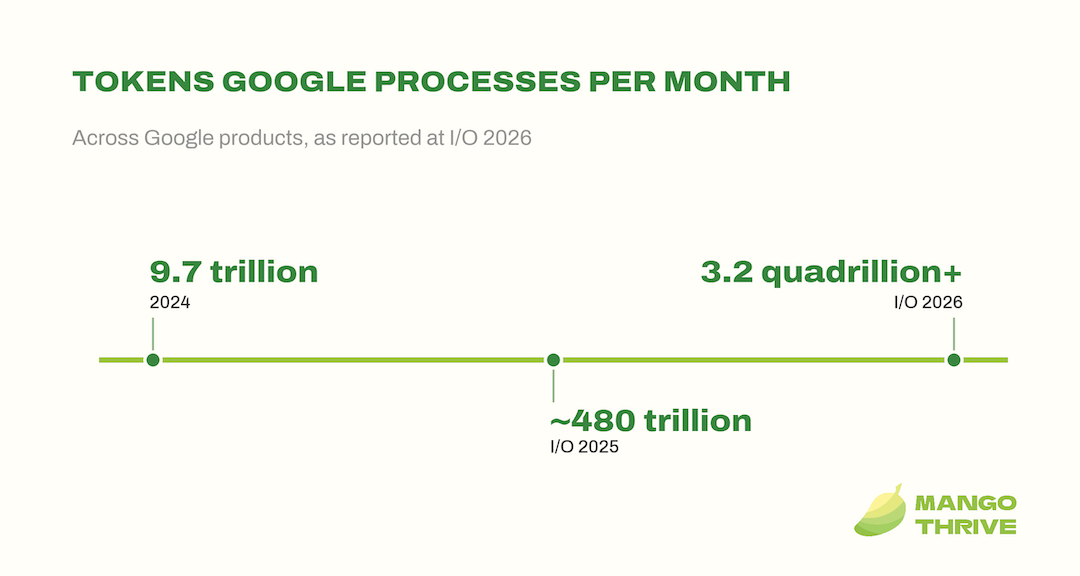
Tokens Google processes per month across its products, 2024 to 2026
Source: Google, I/O 2026 keynote
An API is the connection developers use to plug an AI model into their own apps and services.
22. Google’s model APIs processed about 22 billion tokens per minute in Q2 2026 (Alphabet, Q2 2026 earnings remarks). That was up from 16 billion a quarter earlier.
23. More than 9 million developers build with Google’s AI models each month, Alphabet said in its Q2 2026 results (Alphabet, Q2 2026 earnings remarks).
24. ChatGPT users sent more than 2.5 billion messages a day by July 2025 (NBER, How People Use ChatGPT). That is about 29,000 messages per second.
25. OpenAI’s API processed over 6 billion tokens per minute in October 2025, Sam Altman said (OpenAI DevDay 2025 via TechCrunch). He also said 4 million developers had built with OpenAI.
OpenRouter is a service that lets developers reach many different AI models through one connection. Reasoning models work through a problem step by step before they answer. Open-source models can be downloaded and run by anyone.
26. Over 100 trillion tokens of real-world LLM use on OpenRouter were analyzed for its State of AI study (OpenRouter, State of AI). The data covers 13 months ending in November 2025.
27. More than half of the tokens on OpenRouter went to reasoning models by late 2025 (OpenRouter, State of AI).
28. Open-source models reached about one-third of token usage on OpenRouter by late 2025 (OpenRouter, State of AI).
Which LLMs Do Businesses Pay For?
29. Anthropic held 40% of enterprise LLM API market share by usage in 2025 (Menlo Ventures, 2025 State of Generative AI in the Enterprise). OpenAI had 27%, Google 21%, and other providers the remaining 12%, based on a survey of 495 US enterprise AI decision-makers.
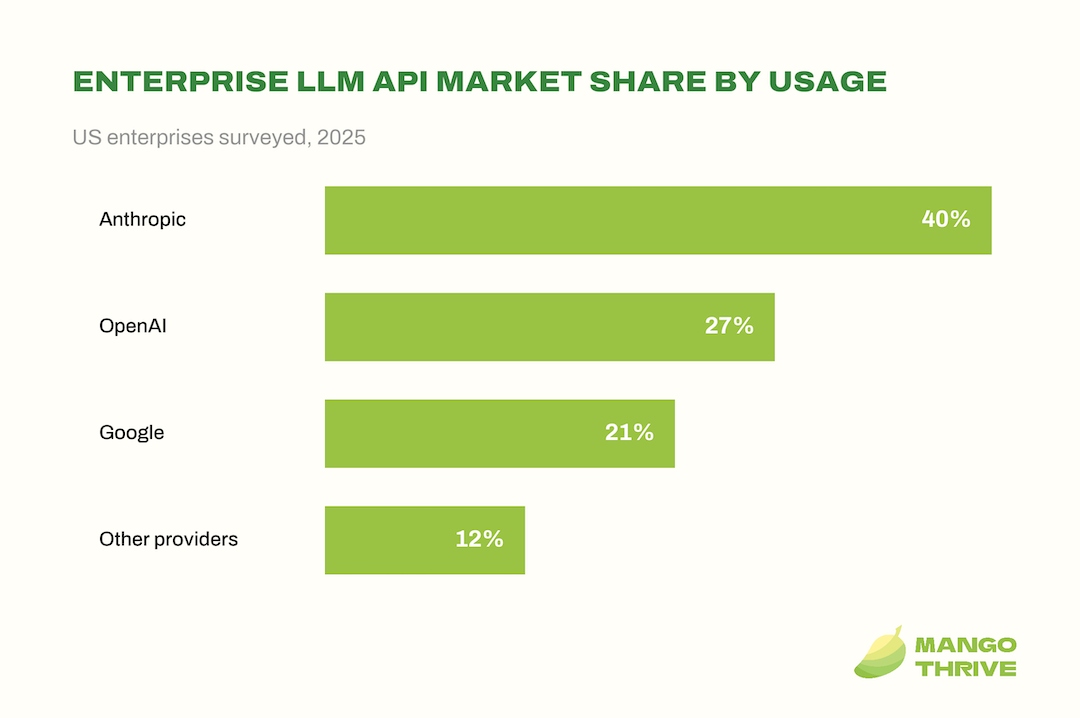
Enterprise LLM API market share by usage, 2025
Source: Menlo Ventures, 2025 State of Generative AI in the Enterprise
30. 43.8% of US businesses on Ramp paid Anthropic for AI in August 2026, versus 39.8% for OpenAI (Ramp, AI Index September 2026).
31. Nearly 500 Google Cloud customers each processed more than 1 trillion tokens over the prior year, Alphabet said in its Q2 2026 results (Alphabet, Q2 2026 earnings remarks).
What Do People Use LLMs For?
Most figures below come from “How People Use ChatGPT,” a study of ChatGPT messages published by the National Bureau of Economic Research (NBER).
32. 73% of ChatGPT consumer messages were not related to work in June 2025, up from 53% a year earlier (NBER, How People Use ChatGPT). The study covers messages on consumer plans, not business or education accounts.
33. Nearly 80% of ChatGPT use fell into three categories in a 2025 study: practical guidance, seeking information, and writing (NBER, How People Use ChatGPT).
34. 24% of ChatGPT messages were about seeking information in July 2025, up from 14% a year earlier (NBER, How People Use ChatGPT). Over the same year, writing fell from 36% to 24% of messages.
35. 40% of work-related ChatGPT messages were about writing in June 2025, the most common work use (NBER, How People Use ChatGPT).
36. About two-thirds of ChatGPT writing requests ask it to edit, critique, or translate the user’s own text, a 2025 study found (NBER, How People Use ChatGPT).
37. 4.2% of ChatGPT messages were about computer programming, a 2025 study found (NBER, How People Use ChatGPT).
In the NBER “How People Use ChatGPT” study, “Asking” means seeking information or clarification to inform a decision, “Doing” means asking ChatGPT to produce an output or perform a task, and “Expressing” means sharing views or feelings without seeking information or action.
38. About 49% of ChatGPT messages were “Asking,” 40% “Doing,” and 11% “Expressing,” a 2025 study estimated (NBER, How People Use ChatGPT).
39. About 56% of work-related ChatGPT messages were “Doing” requests as of July 2025 (NBER, How People Use ChatGPT). Nearly three-quarters of those were writing tasks.
Pew Research Center also asked US adults what they use chatbots for.
40. About four in ten US adults said in 2026 they use AI chatbots to search for information (Pew Research Center, Americans and AI 2026).
How Are LLMs Used at Work?
41. 38% of employed US adults said in 2026 they use AI chatbots for tasks at work (Pew Research Center, Americans and AI 2026).
42. 52% of US employees used AI at work at least a few times a year in May 2026 (Gallup, AI indicator). Gallup found 30% used it a few times a week or more.
43. 45.2% of employed US adults ages 18 to 64 used generative AI for work in Q2 2026 (St. Louis Fed, Real-Time Population Survey).
44. 22% of Canadian workers said they had used generative AI at work in the previous 12 months (Statistics Canada, Workplace AI use). The survey ran from September 2024 to July 2025.
45. 44% of Canadian workers in jobs usually requiring a bachelor’s degree or higher used generative AI at work in 2024–2025 (Statistics Canada, Workplace AI use). In jobs usually requiring a high school diploma or less, the share was 10%.
46. 19.2% of Canadian businesses used AI to produce goods or deliver services in the year to Q2 2026 (Statistics Canada, AI use by businesses, Q2 2026). That was up from 6.1% in Q2 2024.
47. 8.76% of EU enterprises used AI to generate written or spoken language or programming code in 2025 (Eurostat, AI use in enterprises). The survey covers enterprises with at least 10 employees and self-employed persons.
How Do Developers Use LLMs?
48. 84% of developers used or planned to use AI tools in their development process in 2025, up from 76% in 2024 (Stack Overflow, 2025 Developer Survey).
49. 51% of professional developers used AI tools daily in 2025 (Stack Overflow, 2025 Developer Survey).
50. 46% of developers distrusted the accuracy of AI tools in 2025, while 33% trusted it (Stack Overflow, 2025 Developer Survey). Only 3% said they highly trust AI output.
51. 85% of developers regularly used AI tools for coding and development in 2025 (JetBrains, State of Developer Ecosystem 2025). JetBrains surveyed 24,534 developers in 194 countries from April to June 2025.
How Do Students and Researchers Use LLMs?
52. 95% of UK undergraduates said they use AI in at least one way, in a survey from December 2025 (HEPI and Kortext, Student Generative AI Survey 2026). The survey covered 1,054 full-time undergraduates.
53. 94% of UK undergraduates said they use generative AI to help with assessed work, in December 2025 (HEPI and Kortext, Student Generative AI Survey 2026). Only 12% said they put AI-generated text directly into their submissions, up from 8% a year earlier.
54. 54% of US teens said they had used chatbots to get help with schoolwork, in a fall 2025 survey (Pew Research Center, How Teens Use and View AI). The survey of 1,458 teens ages 13 to 17 ran September 25 to October 9, 2025.
55. One in ten US teens said they do all or most of their schoolwork with chatbot help, in 2025 (Pew Research Center, How Teens Use and View AI).
arXiv is a public website where researchers share papers, often before formal peer review.
56. An estimated 22.5% of computer science paper abstracts on arXiv contained LLM-modified text by September 2024 (Liang et al., Nature Human Behaviour). The estimate for mathematics abstracts on arXiv was 7.7%.
Conclusion
Generative AI use keeps spreading, but not evenly. It is higher in the Global North, among younger people, and among people with more schooling. ChatGPT still leads among consumers, while businesses spread their spending across several model makers. We’ll update this page as new data comes out.