The creator economy pays people to make videos, posts, podcasts and newsletters. The money comes from platforms, brands and fans. Sources count creators in different ways, so many figures below come with the source’s own definition. Here are the latest statistics on the size of the creator economy, the people in it, what they earn and who pays them.
Top Creator Economy Statistics
- About 67 million people worldwide identified as creators in 2025, Goldman Sachs estimated (Goldman Sachs via Net Influencer).
- $250 billion was the creator economy’s total addressable market in 2023, Goldman Sachs Research estimated (Goldman Sachs, The creator economy could approach half-a-trillion dollars by 2027).
- Over $100 billion was paid by YouTube to creators, artists, and media companies from 2022 to 2025 (YouTube, 2025 U.S. YouTube Impact Report).
- Brands were projected to spend $37.1 billion on US creator advertising in 2025 (IAB, 2025 Creator Economy Ad Spend & Strategy Report).
- 21% of creator payments made through CreatorIQ in 2025 went to the top 1% of creators paid (CreatorIQ).
- 11% of surveyed creators had a six-figure annual income in a July 2025 survey (CreatorIQ, The State of Creator Compensation).
- 86% of creators in eight countries were using creative generative AI in 2025 (Adobe, Creators’ Toolkit Report 2025).
- 67% of social media users in the US, UK and Australia bought something because of an influencer’s recommendation in the past year, a May 2026 survey found (Sprout Social, Q2 2026 Pulse Survey).
How Big Is the Creator Economy?
These figures from Goldman Sachs Research size the creator economy as a whole.
1. $250 billion was the creator economy’s total addressable market in 2023, Goldman Sachs Research estimated (Goldman Sachs, The creator economy could approach half-a-trillion dollars by 2027).
2. $480 billion could be the creator economy’s total addressable market by 2027, Goldman Sachs Research projected in 2023 (Goldman Sachs, The creator economy could approach half-a-trillion dollars by 2027). Goldman said the market could roughly double in size over five years.
Other Estimates of the Creator Economy’s Size
Market research firms publish their own estimates of the creator economy’s size. Each firm uses its own method and base year.
3. $252.3 billion was Grand View Research’s estimate of the global creator economy market in 2025 (Grand View Research, Creator Economy Market Report). The firm projects $1,345.5 billion by 2033.
4. $254.4 billion was Precedence Research’s estimate of the global creator economy market in 2025 (Precedence Research, Creator Economy Market).
5. $66.78 billion was Precedence Research’s estimate of the US creator economy market in 2025 (Precedence Research, Creator Economy Market).
6. $149.4 billion was Market.us’s estimate of the global creator economy market in 2024 (Market.us, Creator Economy Market).
How Many Content Creators Are There?
These figures estimate how many people worldwide are creators. Each source defines a creator in its own way.
7. About 67 million people worldwide identified as creators in 2025, Goldman Sachs estimated (Goldman Sachs via Net Influencer).
8. The number of creators worldwide could reach 107 million by 2030, Goldman Sachs projected in 2025 (Goldman Sachs via Net Influencer). That assumes about 10% growth a year.
In Adobe’s 2022 Future of Creativity study, “creators” are people who post or share creative work online at least monthly to grow their social presence.
9. Adobe estimated there were 303 million creators globally in 2022, up more than 165 million in two years (Adobe, Future of Creativity study). The study surveyed about 9,000 online creators in nine markets in May 2022.
In Linktree’s 2022 Creator Report, “creators” are people who use their influence, creativity or skills to aggregate and monetize an audience.
10. Linktree put the creator economy’s total addressable market at about 200 million creators in its 2022 Creator Report, a modeled estimate rather than a headcount (Linktree, The 2022 Creator Report).
How Many Content Creators Are There in the US?
These figures count creators in the US, from people who earn money from content to anyone who posts it.
In MBO Partners’ State of Independence study, “independent content creators” are people who produce and monetize digital content.
11. 10.1 million Americans were independent content creators in 2025, up 13% in a year (MBO Partners, State of Independence 2025). The survey was fielded in April 2025 and weighted to US demographics.
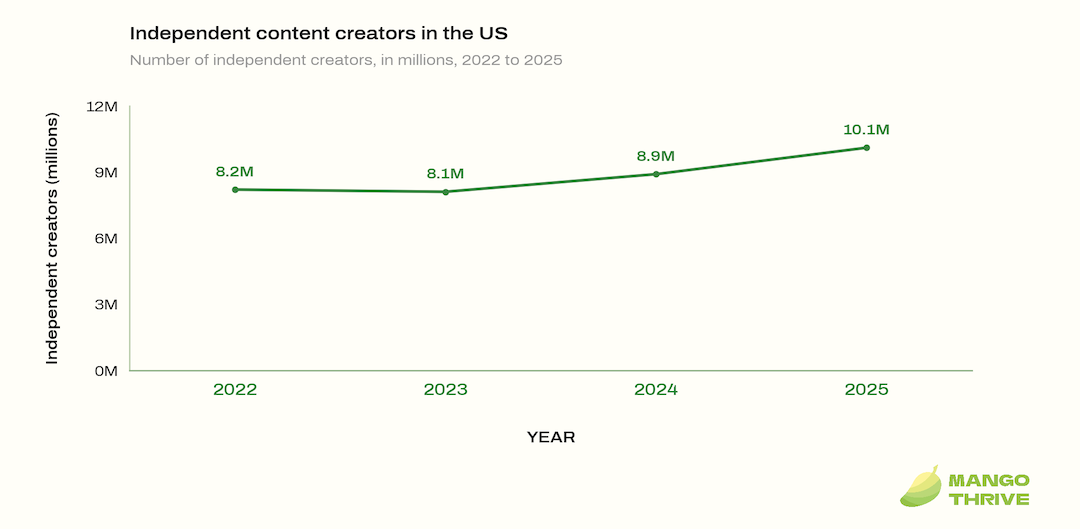
Number of independent content creators in the US, 2022 to 2025
Source: MBO Partners, State of Independence 2025, p. 18.
In IAB’s digital economy study, one “full-time-equivalent creator” stands for $66,622 of creator income a year, the US average wage at the time, rather than one person.
12. IAB estimated the US had about 1.5 million full-time-equivalent creators in its 2025 study (IAB, Measuring the Digital Economy 2025). Its earlier study put the 2020 figure at about 200,000.
In Edison Research’s survey, a “digital content creator” is anyone currently involved in creating original content that is shared publicly online.
13. 18% of Americans aged 13 and older said they create original content shared publicly online in May 2025 (Edison Research at SSRS). The data comes from a national online survey.
14. 30% of Americans aged 13–24 said they were digital content creators in May 2025 (Edison Research at SSRS). The share was 28% for ages 25–44 and 7% for ages 45 and older.
How Many Creators Work Full-Time?
These surveys show how many creators make content full-time.
15. 36% of US independent content creators did it full-time in 2025, and 64% part-time (MBO Partners, State of Independence 2025). The survey covered 6,474 US adults in April 2025.
In Kolsquare’s 2025 European survey, “creators” had at least 5,000 followers and at least one brand collaboration in the past 12 months.
16. Only 28% of European creators surveyed in 2025 worked full-time as creators (Kolsquare and NewtonX, Voices of the Creator Economy 2025). The survey covered 783 verified creators in six European markets.
Who Are Content Creators?
These figures describe who creators are and how they run their work.
17. 71% of US independent content creators were under 40 in 2025, and 53% were male (MBO Partners, State of Independence 2025).
18. 68% of creators surveyed for Visa in 2025 said they consider themselves small business owners (Visa, Monetized: Visa 2025 Creator Report). Morning Consult surveyed 1,067 creators in five countries.
19. 73% of women creators surveyed in Europe said they “manage everything themselves” in 2025, compared with 53% of men (Kolsquare and NewtonX, Voices of the Creator Economy 2025).
20. 62% of surveyed creators worked with operational support such as teams or outsourced help in 2025 (CreatorIQ, The State of Creator Compensation). The other 38% worked solo without that support.
21. Only 1 in 4 surveyed creators said they had formal management in 2025 (Influencer Marketing Hub & NeoReach, Creator Earnings Report 2025).
Do Young People Want to Be Creators?
These surveys asked young people about becoming creators or influencers.
22. 60% of 13- to 24-year-olds agreed “I would like to be an online celebrity” in YPulse’s 2025 survey (YPulse).
23. 57% of US Gen Zers who use social media said in 2023 they would become an influencer if given the chance (Morning Consult). The survey covered 1,000 people aged 13–26.
24. 15% of US Gen Zers aged 13 to 26 who use social media identified themselves as influencers in 2023 (Morning Consult).
How Much Do Content Creators Earn?
These figures cover how much creators earn, mostly from creator surveys.
25. $44,293 was the average income creators reported for the past year in a July 2025 survey (CreatorIQ, The State of Creator Compensation). The survey covered 300 creators.
26. 11% of surveyed creators had a six-figure annual income in a July 2025 survey (CreatorIQ, The State of Creator Compensation). Sapio Research surveyed 300 creators about their earnings over the past year.
27. 18% of surveyed creators earned under $10,000 a year in a July 2025 survey (CreatorIQ, The State of Creator Compensation).
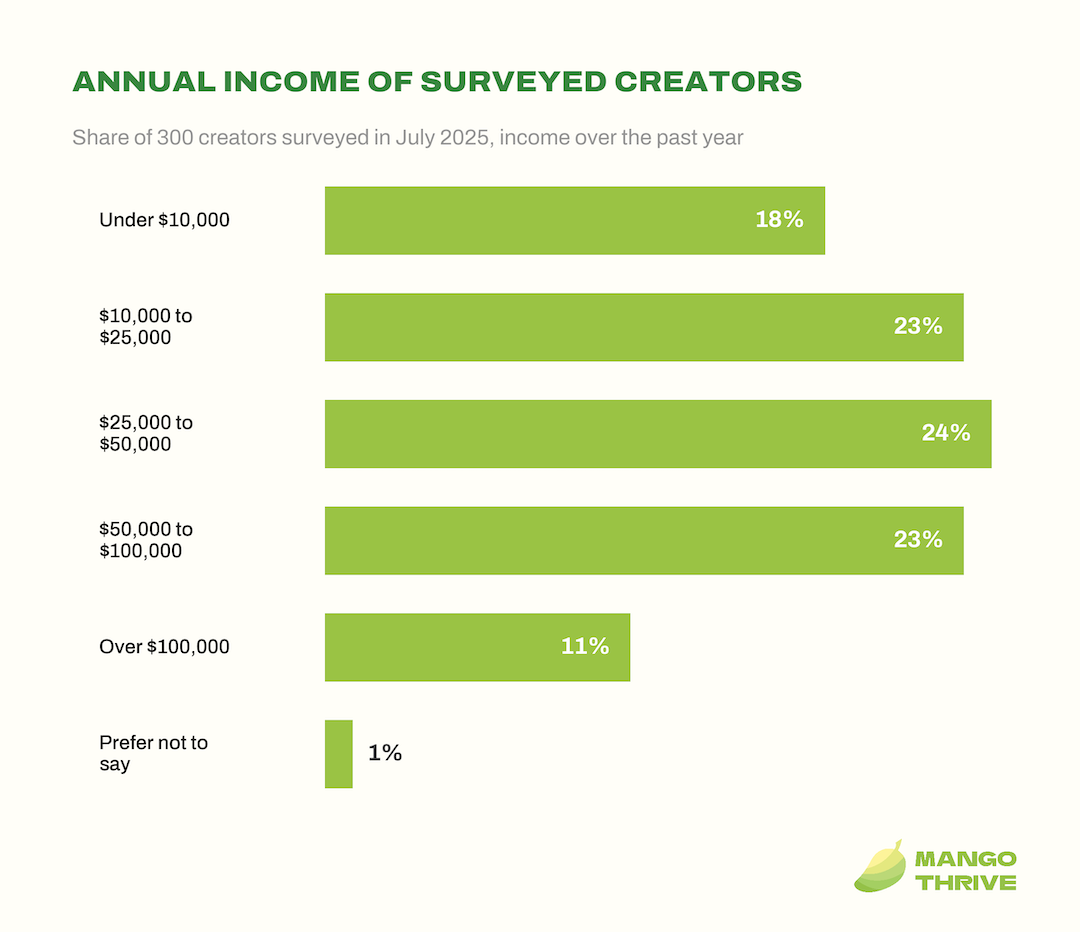
Annual income of 300 creators surveyed by CreatorIQ in July 2025
Source: CreatorIQ, The State of Creator Compensation, p. 2.
28. More than half of surveyed creators earned under $15,000 a year in 2025 (Influencer Marketing Hub & NeoReach, Creator Earnings Report 2025). The survey covered over 3,000 creators.
29. Nearly 57% of surveyed full-time creators earned less than $44,000 a year from content in 2025 (Influencer Marketing Hub & NeoReach, Creator Earnings Report 2025). The report uses $44,000 as the US “living wage”.
30. 70% of surveyed Linktree creators made less than $49,000 from content in the past year, in Linktree’s 2024 report (Linktree, Creator Commerce Report 2024). The survey covered 1,562 Linktree users.
31. About 4% of creators worldwide earned more than $100,000 a year in 2023, according to Goldman Sachs Research (Goldman Sachs, The creator economy could approach half-a-trillion dollars by 2027). Goldman called these creators “professionals.”
32. Over 49% of surveyed creators said they earned most of their revenue from brand deals in 2025 (Influencer Marketing Hub & NeoReach, Creator Earnings Report 2025).
How Concentrated Are Creator Earnings?
These figures come from payment records, not surveys. They show how creator pay is split.
In CreatorIQ’s report, payment figures cover creators who received direct payments through CreatorIQ.
33. 62% of creator payments made through CreatorIQ in 2025 went to the top 10% of creators paid (CreatorIQ). That was up from 53% in 2023.
34. 21% of creator payments made through CreatorIQ in 2025 went to the top 1% of creators paid (CreatorIQ). That was up from 15% in 2023.
The median is the middle value: half of creators earned more and half earned less.
35. $3,000 was what the median creator earned across CreatorIQ campaigns with direct payments in 2025 (CreatorIQ, The State of Creator Compensation). The average was $11,400.
What Challenges Do Creators Face?
These surveys asked creators what makes growing a creator business, or earning money from it, hard.
36. 88% of surveyed creators said they face barriers to growing their business in 2025 (CreatorIQ, The State of Creator Compensation). Platform algorithm changes or volatility was the most common answer for biggest barrier, at 18%.
37. Finding it hard to produce content consistently (59%) and uncertainty around social media algorithms (55%) were the top two reasons surveyed Linktree creators gave in Linktree’s 2024 report for why making money is difficult (Linktree, Creator Commerce Report 2024).
How Much Does YouTube Pay Creators?
These figures cover YouTube’s payouts, programs, economic impact and revenue, from YouTube and its parent company, Alphabet.
38. Over $100 billion was paid by YouTube to creators, artists, and media companies from 2022 to 2025 (YouTube, 2025 U.S. YouTube Impact Report). The figure is YouTube’s own global data.
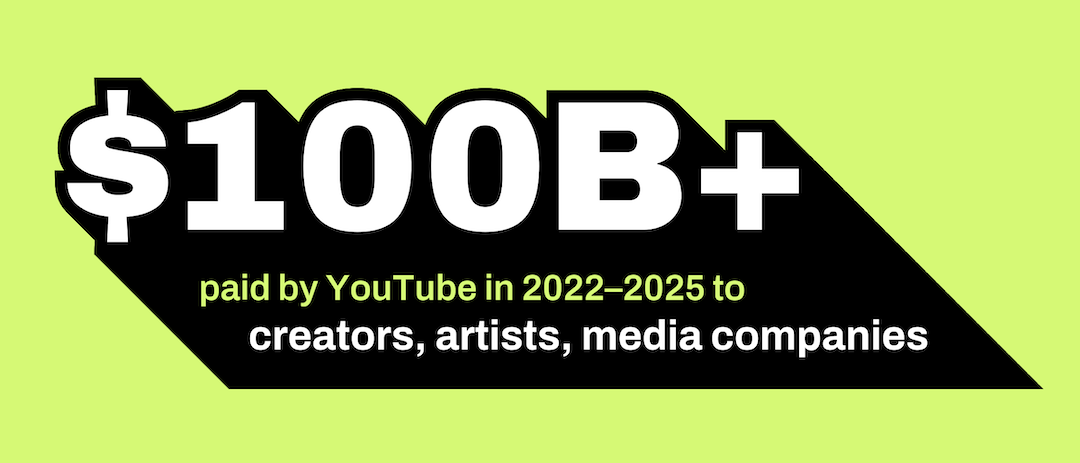
YouTube paid over $100 billion to creators, artists and media companies from 2022 to 2025
Source: YouTube, 2025 U.S. YouTube Impact Report. The total covers creators, artists and media companies worldwide.
In YouTube’s terms, the “YouTube Partner Program” (YPP) is the program through which creators share in ad and subscription revenue and access fan funding and shopping features (YouTube, YouTube Partner Program, Explained).
39. Over 3 million creators were in the YouTube Partner Program as of August 2026 (YouTube Blog, New opportunities to earn).
40. The number of YouTube channels earning six figures or more (USD) rose more than 7% in 2025 from a year earlier (YouTube, 2025 U.S. YouTube Impact Report (PDF)). The figure is YouTube’s own global data.
41. 55% of ad revenue goes to creators on long-form YouTube videos, and 45% on Shorts, according to YouTube in 2025 (YouTube, YouTube Partner Program, Explained).
42. 8,000 qualified watch hours in 365 days will be needed to qualify for YouTube’s ad and Premium revenue sharing under terms starting February 1, 2027 (YouTube Blog, New opportunities to earn). The alternative is 20 million qualified Shorts views in 90 days, and the change applies only to new applicants.
43. Over 500,000 creators were in YouTube Shopping as of January 2026 (YouTube, CEO Neal Mohan’s 2026 letter).
44. Over $60 billion was contributed to US GDP by YouTube’s creative ecosystem in 2025, according to Oxford Economics research (YouTube Blog, 2025 US YouTube Impact Report). The research was supported by YouTube internal data.
Full-time-equivalent jobs count part-time work as a share of one full-time job.
45. More than 540,000 full-time-equivalent US jobs were supported by YouTube’s creative ecosystem in 2025, according to Oxford Economics (YouTube Blog, 2025 US YouTube Impact Report).
46. Over $60 billion in YouTube revenue came from ads and subscriptions in 2025 (Alphabet, Q4 2025 earnings release).
47. YouTube ad revenue was $11.055 billion in Q2 2026, up from $9.796 billion in Q2 2025 (Alphabet, Q2 2026 earnings release). Alphabet put the growth at 13%.
How Much Do Facebook and Snapchat Pay Creators?
These figures come from Meta, which owns Facebook, and Snap, which owns Snapchat.
48. Nearly $3 billion was paid to content creators by Facebook’s creator monetization programs in 2025, up 35% from 2024 (Meta Newsroom). Meta called it Facebook’s highest annual total ever.
49. 60% of Facebook’s 2025 creator payouts went to Reels, with the rest going to Stories, photos, and text posts (Meta Newsroom).
50. The number of creators earning over $10,000 a year on Facebook grew over 30% year over year, Meta said in March 2026 (Meta Newsroom).
51. The number of people posting to Spotlight in the US grew more than 115% year over year in Q2 2026, Snap reported (Snap Inc., Q2 2026 Prepared Remarks). US Spotlight daily active viewers grew more than 20%.
How Much Do Other Platforms Pay Creators?
These figures come from each platform’s own reports, filings and statements.
52. Spotify paid more than $100 million to podcast publishers and podcasters worldwide in Q1 2025 (Spotify Newsroom).
53. Spotify hosts more than 530,000 video podcast shows, co-CEO Alex Norström said in February 2026 (Spotify Q4 2025 earnings call).
54. More than 13,800 artists generated at least $100,000 from Spotify alone in 2025 (Spotify, Loud & Clear).
In Roblox’s 10-K, the “Developer Exchange Program” lets eligible creators convert the Robux they earn into cash. Since September 5, 2025, Roblox pays $0.0038 per earned Robux.
55. Roblox creators earned $1,503.1 million (about $1.5 billion) in 2025 (Roblox, 2025 Form 10-K). They earned $922.8 million in 2024.
56. Over 23,500 creators were paid cash through Roblox’s Developer Exchange Program in 2025 (Roblox, 2025 Form 10-K).
57. Creators have earned more than $10 billion on Patreon since 2013, according to Patreon’s About page in 2026 (Patreon, About).
58. More than 300,000 creators use Patreon, according to the company in 2026 (Patreon, About).
59. Substack readers pay for 5 million subscriptions “and counting,” according to the company in 2026 (Substack, About).
60. Over 30% of Substack paid subscriptions come from within Substack’s own network, according to Substack’s About page in 2026 (Substack, About).
61. Paid subscription revenue on beehiiv reached $19 million in 2025, up 138% from 2024 (beehiiv, The State of Paid Newsletters 2026).
62. Experts have earned more than $12 billion on Kajabi, according to Kajabi’s homepage in 2026 (Kajabi).
63. Nearly 1,800 Kajabi creators had reached “millionaire status,” Kajabi said in August 2025 (Kajabi via Business Wire). More than 70 creators had crossed the $10 million threshold.
How Much Do Brands Spend on Creator Marketing?
These figures cover what brands spend on creators and how ad buyers plan their budgets. The sources measure different things, so definitions are given where a source sets its own.
In IAB’s report, “Creator Economy ad spend” means money brands intentionally put into creators: direct sponsored-content deals, paid amplification of that content, and ads deliberately placed next to creators. It excludes affiliate links, subscriptions, tips and merchandise.
64. Brands were projected to spend $37.1 billion on US creator advertising in 2025 (IAB, 2025 Creator Economy Ad Spend & Strategy Report). That was a projected 26% rise from 2024.
65. US creator ad spend more than doubled from $13.9 billion in 2021 to $29.5 billion in 2024 (IAB).
66. US creator ad spend is estimated to reach $43.9 billion in 2026 (IAB). That would be an 18% increase on 2025.
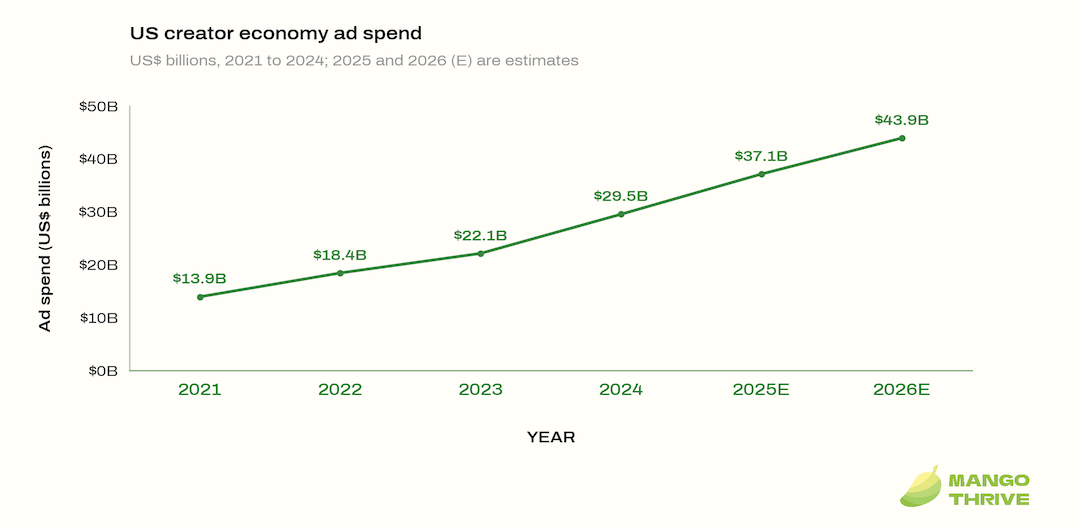
US creator economy ad spend, 2021 to 2026 (2025 and 2026 estimated)
Source: IAB, 2025 Creator Economy Ad Spend & Strategy Report, p. 7. Figures for 2025 and 2026 are estimates.
67. US creator ad spend was projected to grow four times faster than the overall media industry in 2025 (IAB). IAB put total media growth at 5.7%.
68. Retail brands were estimated to spend $12.3 billion on US creator advertising in 2025, more than any other category (IAB). Consumer packaged goods (CPG) brands were second at $5.5 billion.
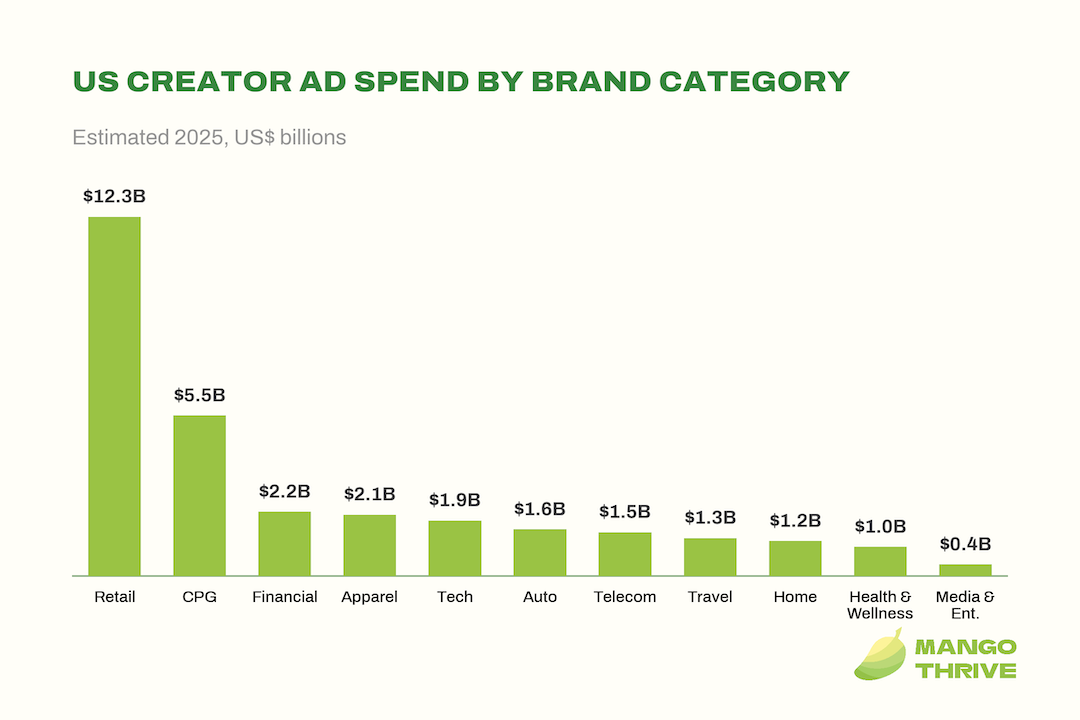
Estimated US creator ad spend by brand category, 2025
Source: IAB, 2025 Creator Economy Ad Spend & Strategy Report, p. 9. Categories as shown by IAB.
69. 48% of US ad decision-makers at brands and agencies who spend on creator marketing consider creators a “must buy” for their media plans, as of 2025 (IAB). Only social media and paid search ranked higher.
70. 39% of US ad decision-makers at brands and agencies who spend on creator marketing named proving return on investment (ROI) as a top-three creator measurement challenge in 2025 (IAB). It ranked first among measurement challenges.
71. 3 in 4 US ad decision-makers at brands and agencies who spend on creator marketing said they pay creators flat fees, as of 2025 (IAB). 49% use performance-based pay.
72. 54% of US brand and agency ad decision-makers said creator and influencer partnerships were getting more of their focus, IAB reported in September 2026 (IAB, 2026 Outlook Study: September Update). It topped IAB’s list of ad types.
73. $10 billion was the annual revenue pace (run-rate) of Meta’s partnership ads in Q1 2026, more than doubling year-over-year (Meta, Q1 2026 earnings call). Meta said brands are increasingly turning to creators to promote products.
In EMARKETER’s forecast, “influencer marketing spending” means payments brands make to US-based creators to promote products on social and video platforms. It excludes paid media and non-social channels.
74. US influencer marketing spending was forecast to reach $10.52 billion in 2025 (EMARKETER). EMARKETER expected growth of 15.7% in 2026.
75. “Creator-generated” ad revenue was forecast to reach $184.9 billion globally in 2025, WPP Media said in its advertising forecast (WPP Media, This Year Next Year 2025 Mid-Year). WPP Media said more than half of content-driven ad revenue in 2025 would come from platforms like TikTok, YouTube, Kuaishou and Instagram Reels.
76. 71% of organizations increased their influencer marketing investment year over year, according to a 2025 survey (CreatorIQ, State of Creator Marketing 2025–2026). Brand respondents said they spent $2.9 million a year on average.
77. 62% of enterprise marketers planned to increase influencer budgets in 2026 (Linqia, 2026 State of Influencer Marketing). The survey covered over 200 enterprise marketers.
78. 54% of multinational brand marketers surveyed planned to increase influencer marketing spending in 2025 (WFA). The survey had 73 responses from 59 companies.
How Are Creators Using AI?
These figures cover how creators use AI tools and how they feel about them.
In Adobe’s 2025 Creators’ Toolkit Report, “creators” means people who publish digital content at least a few times a month to engage an audience on social platforms, mostly emerging and semi-professional creators.
79. 86% of creators in eight countries were using creative generative AI in 2025 (Adobe, Creators’ Toolkit Report 2025). Adobe and The Harris Poll surveyed over 16,000 creators in September 2025.
80. 69% of creators said they were concerned about their content being used to train AI without permission in 2025 (Adobe, Creators’ Toolkit Report 2025). The survey covered over 16,000 creators in eight countries.
81. 60% of creators used more than one creative generative AI tool in the past three months, in a 2025 survey (Adobe, Creators’ Toolkit Report 2025).
In Adobe’s 2026 Creators’ Toolkit Report, “creators” means people who publish digital content several times a month and earn income from it, comprising emerging and professional social-first creators.
82. 87% of creators who use creative AI say it has accelerated their business or audience growth, per a 2026 survey (Adobe, Creators’ Toolkit Report 2026). 75% describe it as integrated or essential to how they work.
83. 57% of creators in Adobe’s 2026 survey say their creative AI outputs typically need moderate or extensive editing before sharing (Adobe, Creators’ Toolkit Report 2026).
84. 49% of creators in Adobe’s 2026 survey say they always or often disclose AI use (Adobe, Creators’ Toolkit Report 2026). Another 18% say they rarely or never disclose it.
85. More than 1 million YouTube channels used YouTube’s AI creation tools daily, on average, in December 2025 (YouTube, CEO Neal Mohan’s 2026 letter).
86. Over 6 million viewers a day watched at least 10 minutes of auto-dubbed YouTube content in December 2025 (YouTube Blog, How YouTube auto dubbing helps creators reach global audiences).
How Do Audiences Engage With Creators?
These figures cover how audiences buy from, trust and watch creators.
87. 67% of social media users in the US, UK and Australia bought something because of an influencer’s recommendation in the past year, a May 2026 survey found (Sprout Social, Q2 2026 Pulse Survey). The share was 81% among Gen Z respondents.
88. Asked whom they trust for product recommendations, 57% of social media users in the US, UK and Australia picked everyday users, in a May 2026 survey (Sprout Social, Q2 2026 Pulse Survey). Subject matter experts got 26%, mega-influencers 9% and brand employees 8%.
89. 44% of social media users in the US, UK and Australia are uncomfortable with brands using AI influencers, a May 2026 survey found (Sprout Social, Q2 2026 Pulse Survey). Only 25% say they are comfortable with it.
90. Over 700 million hours of podcasts were watched on YouTube on living room devices in October 2025 (YouTube Official Blog). That was up from 400 million hours a year earlier.
Conclusion
Brand spending on creators is projected to keep rising, and Facebook and Roblox reported higher creator payouts. Pay is uneven: in CreatorIQ’s payment records, a small group of creators takes a large share. AI tools are already part of the work for many creators. We’ll update this page as new data comes out.