
Every AI answer runs on chips that get hot. Many data centers cool those chips with water. Power plants also use water to make the electricity those chips need. Here are the numbers on AI’s water use, from a single prompt to a whole data center.
Top AI Water Usage Statistics
-
312.5 to 764.6 billion liters could be global AI systems' water footprint (2025).
-
4.2 to 6.6 billion cubic meters of water is global AI's projected withdrawal (2027).
-
An estimated 0.26 milliliters of water is consumed per median Gemini Apps text prompt (2025).
-
About 1,430 million cubic meters could be US AI servers' mid-case water footprint (2030).
-
About 11.5 million gallons of water went into Microsoft's Iowa data centers in July 2022.
-
Around 560 billion liters of water a year is data centers' estimated worldwide consumption, including energy supply (2023).
How Much Water Does AI Use?
This estimate counts water used to cool AI hardware and to make its electricity.
1. AI systems’ water footprint could reach 312.5 to 764.6 billion liters in 2025 (de Vries-Gao, Patterns). The author compares it with global yearly bottled water use, 446 billion liters.
How Much Water Does One AI Prompt Use?
A prompt is a question or request you type into an AI chatbot. These estimates show the water behind one answer.
In Google’s estimate, water per prompt is the prompt’s energy use times Google’s 2024 average data center water use per kWh.
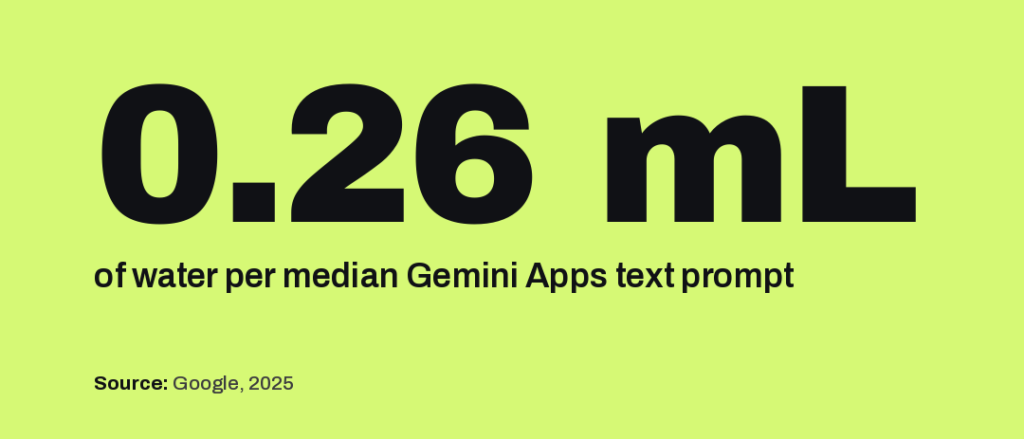
2. The median Gemini Apps text prompt consumes an estimated 0.26 milliliters of water (Google Cloud). Google says that is about five drops, based on May 2025 data. Google applied its data center water use per kWh, so power-plant water is not counted.
Source: Google Cloud
3. A median Gemini text prompt consumes an estimated 0.12 mL of water when counting only active AI chips (Google Cloud). Google’s August 2025 post says this narrower count substantially underestimates the real operational footprint.
4. OpenAI CEO Sam Altman says the average ChatGPT query uses about 0.000085 gallons of water (Sam Altman). In the June 2025 post, he puts it at roughly one fifteenth of a teaspoon.
5. One 400-token response from Mistral’s Le Chat uses an estimated 45 mL of water (Mistral AI). Mistral’s July 2025 figure is a marginal impact that includes making the servers but not users’ own devices.
6. GPT-3 consumes a 500 ml bottle of water for roughly 10–50 medium-length responses, by the study’s estimate (Li et al., Communications of the ACM). The 2025 study says the range depends on when and where the model runs.
7. One medium-length GPT-3 request uses an estimated 16.9 mL of water under US average conditions (Li et al., Communications of the ACM). In the 2025 study, 14.7 mL of that is water used by power plants to make the electricity.
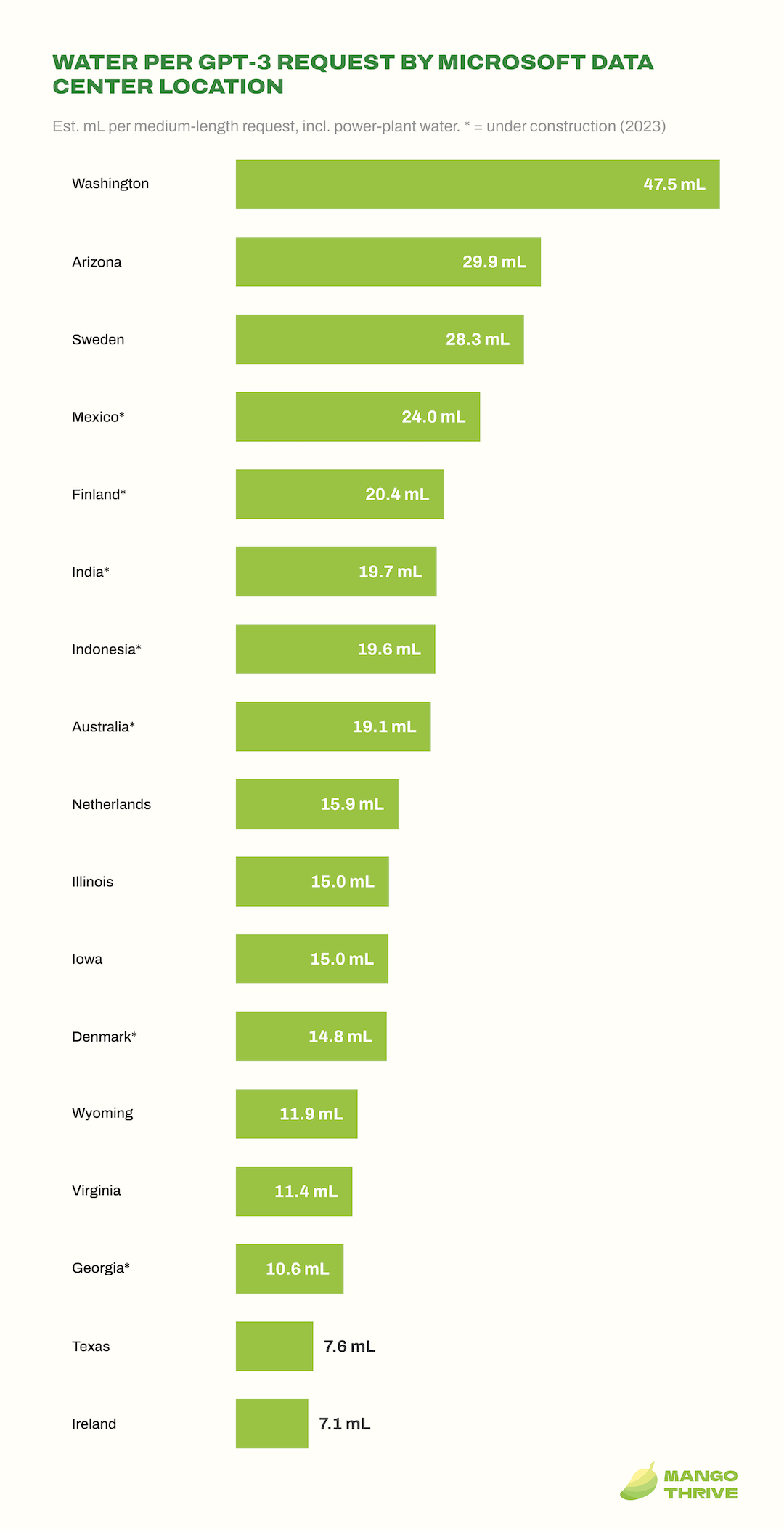
Li et al., Communications of the ACM, Table 1. Starred locations were under construction in July 2023; Microsoft projected their efficiency.
8. One medium-length GPT-3 request run in Microsoft’s Washington data centers uses an estimated 47.5 mL of water (Li et al., Communications of the ACM). Most of it, 43.7 mL, is power-plant water. Figures use Microsoft efficiency data reported by 2023.
9. One medium-length GPT-3 request run in Microsoft’s Ireland data centers uses an estimated 7.1 mL of water (Li et al., Communications of the ACM). That works out to about 70 requests per 500 ml bottle. Figures use Microsoft efficiency data reported by 2023.
10. Writing one 500-word page with Llama-3-70B uses about 140 ml of water, counting hardware manufacturing (Ren et al., Scientific Reports). The 2024 study doubled the water used to run the model to cover making the chips and their supply chains.
11. A small model, Gemma-2B-it, uses about 1.69 ml of water to write a 500-word page (Ren et al., Scientific Reports). The 2024 study assumes the same modern US data center as for Llama-3-70B.
How Much Water Do AI Images and Videos Use?
These figures come from the United Nations University’s water institute (UNU-INWEH). They cover the water behind the electricity that makes AI images and videos.
12. Generating one AI image carries a water footprint of about 29 mL from its electricity (UNU-INWEH). The 2026 report likens it to about two tablespoons.
13. A complex AI-generated video carries a water footprint of 4.1 liters from its electricity (UNU-INWEH). The 2026 report says that is almost two days of drinking water for one person.
How Much Water Does It Take to Train an AI Model?
Training teaches a model from huge amounts of text before anyone uses it. Inference is the model answering people afterward. These figures show the water that work took.
14. Training GPT-3 in Microsoft’s US data centers can consume an estimated 5.4 million liters of water (Li et al., Communications of the ACM). The total counts cooling water on site plus water used to make the electricity. Figures use Microsoft efficiency data reported by 2023.
15. Training GPT-3 in Microsoft’s US data centers can consume an estimated 700,000 liters of water on site (Li et al., Communications of the ACM). The estimate uses Microsoft efficiency data reported by 2023.
16. Training GPT-4 had an estimated water footprint of 592 million liters from its electricity (UNU-INWEH). The 2026 report assumed training used 60 GWh, the midpoint of outside estimates.
17. Training a model like GPT-5 could have a water footprint of about 1 billion liters from its electricity, UNU-INWEH estimates (UNU-INWEH). No GPT-5 training energy data are publicly available yet, so the report scales up to about 100 GWh.
18. Microsoft pumped about 11.5 million gallons of water into its Iowa data centers in July 2022, according to the West Des Moines Water Works (AP). That was about 6% of all water used in the district. That July was the month before OpenAI says it finished training GPT-4.
19. Mistral Large 2’s lifecycle water consumption reached 281,000 cubic meters by January 2025, Mistral says (Mistral AI). That covers training, 18 months of use, and impacts such as making the servers.
20. Model training and inference make up 91% of Mistral Large 2’s lifecycle water use (Mistral AI). That share covers the power and water used by servers and their support gear, as of January 2025.
21. Building Ai2’s OLMo model series consumed at least 2.769 million liters of water, by one estimate (Morrison et al., ICLR 2025). That covers hardware manufacturing, model development and final training.
22. Final training runs of the OLMo models consumed an estimated 1,921 kiloliters of water (Morrison et al., ICLR 2025). That is about 1.9 million liters for models of 20 million to 13 billion parameters.
23. Training OLMo 2 13B consumed an estimated 892 kiloliters of water (Morrison et al., ICLR 2025). The paper equates it to one US person’s water use for 7 years, 10 months.
How Much Water Will US AI Servers Use?
A study in Nature Sustainability modeled how much water US AI servers could need through the end of the decade.
In Xiao et al.’s paper, “water footprint” means on-site cooling water plus power-plant water, not water used to manufacture facilities and hardware.
24. US AI servers could have a water footprint of about 1,430 million cubic meters in 2030 under the mid-case scenario (Xiao et al., Nature Sustainability source data). The mid-case is the study’s base scenario, one of five.
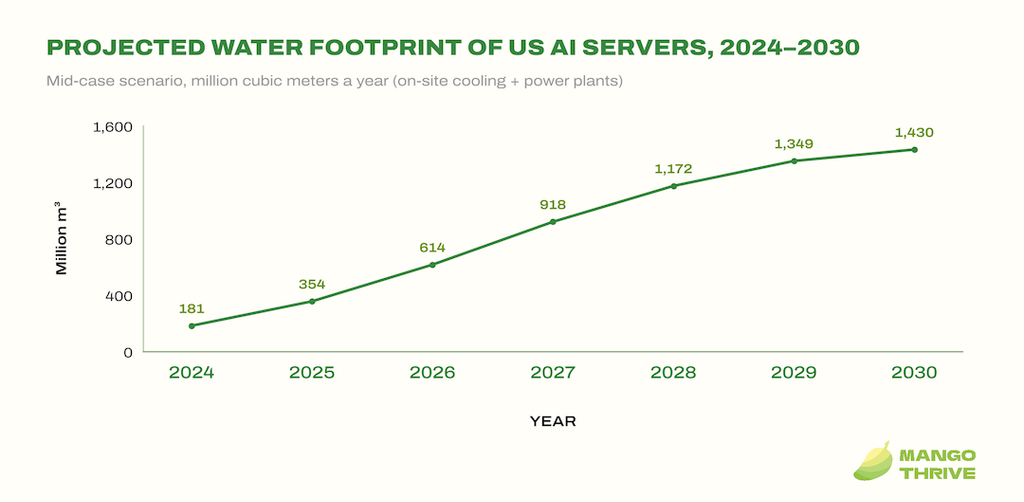
Source: Xiao et al., Nature Sustainability source data, Fig. 1f
25. US AI servers had an estimated water footprint of about 181 million cubic meters in 2024 (Xiao et al., Nature Sustainability source data). The figure is the model’s mid-case starting point.
26. In a high-demand scenario, US AI servers’ water footprint could reach about 2,303 million cubic meters in 2030 (Xiao et al., Nature Sustainability source data). High demand assumes more AI chip packaging capacity, more power-hungry servers and higher adoption of new servers.
27. US AI servers’ water footprint could average 731 to 1,125 million cubic meters a year over 2024–2030 (Xiao et al., Nature Sustainability). The range depends on the scale of AI server expansion.
28. Power plants account for 71% of US AI servers’ projected 2024–2030 water footprint (Xiao et al., Nature Sustainability). On-site use makes up the other 29%.
29. Where AI servers are built could raise their US water footprint by 354% in the worst case, or cut it 52% (Xiao et al., Nature Sustainability). That compares the best and worst 25% of US locations with the base case, over 2024 to 2030.
30. Best practices could cut US AI servers’ water footprint by up to 86% (Xiao et al., Nature Sustainability). The study covers 2024 to 2030, and the authors say today’s energy infrastructure limits how much of this is reachable.
31. If cheap renewables fill more of the grid, US AI servers’ water footprint could fall 2.5% from the base case (Xiao et al., Nature Sustainability). The same grid shift could cut their carbon by over 15% in the 2024–2030 projection.
Other Estimates of AI’s Water Use
Other researchers have estimated AI’s water use with different methods and time frames.
32. The electricity used by AI workloads in 2025 carried an estimated water footprint of over 900 billion liters (UNU-INWEH). UNU-INWEH applied global average water per kWh to about 93 TWh of AI electricity.
In Li et al.’s paper, “withdrawal” is freshwater taken from surface water or the ground; “consumption” is withdrawal minus water returned.
33. Global AI is projected to withdraw 4.2 to 6.6 billion cubic meters of water in 2027 (Li et al., Communications of the ACM). That counts on-site cooling plus power plants. The authors say it is more than four to six times Denmark’s yearly water withdrawal.
34. Global AI could consume 0.38 to 0.60 billion cubic meters of water in 2027 (Li et al., Communications of the ACM). Consumption here means water evaporated and lost, not just withdrawn.
35. AI’s electricity could carry a water footprint of 3.7 trillion liters in 2030 if AI reaches 40% of data center demand (UNU-INWEH). That share would mean about 378 TWh of electricity worldwide.
36. Global water consumption by AI-driven data centers could grow more than seven times by 2050 without action (Herrera et al., Journal of Cleaner Production). Cooling on site would make up most of that demand.
How Is AI Changing Big Tech’s Water Use?
Tech companies are changing how they build and cool data centers for AI. Here is what they and researchers report.
37. Google’s freshwater consumption rose 37% in 2025 (Google 2026 Environmental Report). Google ties the rise to data center growth for AI and other digital services.
38. None of 11 tech companies reviewed reported water use for their AI workloads as of October 2025 (de Vries-Gao, Patterns). They include Amazon, Google, Meta and Microsoft.
In Microsoft’s posts, “zero water” AI data centers evaporate no cooling water, but still use water for restrooms and kitchens.
39. Since August 2024, all new Microsoft data center designs use a cooling method for AI workloads that evaporates zero water (Microsoft, zero-water data centers). Microsoft said these new sites would begin coming online in late 2027, after pilots in 2026.
40. Microsoft says its zero-water cooling design will avoid more than 125 million liters of water per data center a year (Microsoft, zero-water datacenters). The estimate assumes Microsoft’s fiscal 2024 average water withdrawal per kWh.
41. Filling Microsoft’s Fairwater AI data center in Atlanta took water equal to what 20 homes use in a year (Microsoft, AI superfactory). The closed loop is refilled only if water chemistry calls for it, Microsoft said in November 2025.
42. Over 90% of capacity at Microsoft’s Fairwater AI data center in Wisconsin uses closed-loop liquid cooling (Microsoft, Fairwater). The water is filled once during construction, then reused, Microsoft said in September 2025.
43. Amazon expects a 9% water cut as it adds AI racks with its In-Row Heat Exchanger, versus evaporative air-cooled data centers (Amazon 2025 Sustainability Report). The comparison applies once fully operational.
44. AWS’s Project Rainier AI data centers in St. Joseph County, Indiana, will use no water for cooling from October to March (Amazon, Project Rainier). Amazon’s June 2025 post says those data centers will use cooling water a few hours on an average day, April to September.
45. NVIDIA says its liquid-cooled GB200 NVL72 AI rack is 300x more water efficient than air-cooled designs (NVIDIA). It is the chipmaker’s own claim, made in April 2025.
How Much Water Do AI Data Centers Use?
Companies and local officials have shared water figures for specific AI data centers.
46. Meta says its Richland Parish, Louisiana, AI data center will use 500 to 600 million gallons a year from 2028 (Meta, via The Advocate). Meta puts the average water use at 1.5 million gallons a day.
In Crusoe’s Abilene description, a “closed loop” recirculates the same water and sheds heat through air-cooled chillers, without evaporating it.
47. Each Abilene AI data center building needs one million gallons of water to fill its closed cooling loop, Crusoe says (Crusoe, Abilene). The site has eight buildings, and the water comes from the city supply, Crusoe wrote in 2025.
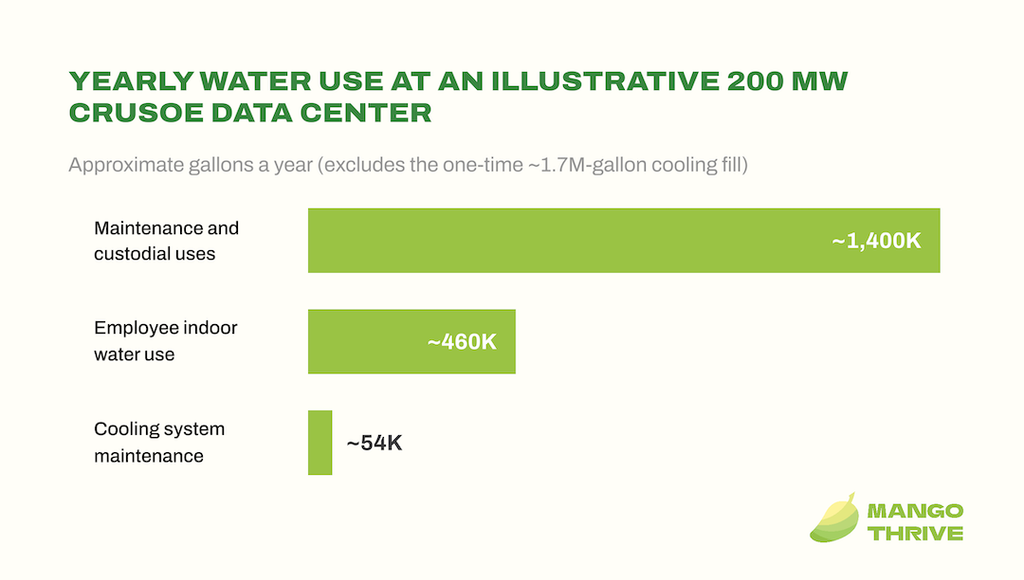
48. Crusoe expects cooling-system upkeep at its Abilene AI data center to use about 50,000 gallons per building a year (Crusoe, Abilene). In a 2025 post, Crusoe says that is less than an average American household uses yearly.
49. OpenAI’s Abilene site will use half as much water a year as the city uses in a day, per Abilene’s mayor (OpenAI). OpenAI’s January 2026 post cites the mayor about its Stargate AI site in Texas.
50. An illustrative 200 MW Crusoe data center would use about 2 million gallons of water a year, Crusoe estimates (Crusoe, water stewardship). In a 2026 post, it puts yearly cooling water at zero, apart from about 54,000 gallons for system maintenance.
Source: Crusoe, water stewardship. Figures are approximate, as printed by Crusoe.
The Data Centers Behind AI
AI runs inside data centers that also serve email, video and cloud apps. These numbers cover all data centers, not just AI. Some company totals also include offices.
51. Data centers worldwide consume around 560 billion liters of water a year, the IEA estimates (IEA). That 2023 figure includes water for energy supply and power generation, not just cooling.
52. Data centers’ water consumption worldwide could rise to around 1,200 billion liters a year in 2030, the IEA estimates (IEA). That is its Base Case projection.
53. About two-thirds of data centers’ water consumption worldwide in 2023 came from energy supply and power generation (IEA). Direct cooling took about one-quarter; chip making took the rest.
54. US data centers consumed an estimated 66 billion liters of water on-site in 2023 (LBNL). This is water used at the sites, mostly for cooling, not water used to make their electricity.
55. Generating the electricity US data centers used in 2023 consumed an estimated nearly 800 billion liters of water (LBNL). LBNL based this on each region’s power plant mix.
In LBNL’s report, “WUE” means a data center’s total water consumption divided by its IT equipment’s electricity use, in liters per kWh.
56. US data centers used an estimated just over 0.36 liters of water on-site per kWh of IT energy through 2023 (LBNL). This is the average WUE across all US data centers.
57. Google consumed 10.9 billion gallons of water across its data centers and offices in 2025 (Google 2026 Environmental Report). That equals 41 billion liters, by Google’s own conversion.
58. Microsoft withdrew 13,266 megaliters of water in fiscal 2025 (Microsoft 2026 Environmental Data Fact Sheet). That covers offices, data centers and labs under Microsoft’s control worldwide. One megaliter is one million liters.
59. Amazon’s data centers withdrew 9.4 billion liters of water in 2025 (Amazon 2025 Sustainability Report). The total covers leased, owned and shared data centers worldwide.
60. Meta’s data centers withdrew 4,145 megaliters of water in 2024 (Meta).
61. 25% of data centers worldwide are in areas where water demand exceeds supply at least one month a year, based on 2001–2010 water conditions (Rosa et al., ES&T). The study covered 9,347 data centers worldwide.
In S&P Global’s analysis, “high water stress” means a score of 40 or more on its 1-to-100 water stress index.
62. 43% of data centers worldwide are exposed to high water stress in the 2020s, S&P Global estimates (S&P Global). That share is about 60% in China and 38% in the US.
63. US data centers’ water withdrawals today equal less than 10% of annual municipal water withdrawals, the IEA said in 2025 (IEA).
64. US data centers’ direct and indirect water consumption adds up to less than 1% of total US water consumption, ITIF estimates (ITIF). ITIF compared LBNL’s 2023 numbers with the latest USGS national assessment.
Conclusion
Much of AI’s water use happens far from the chat window, in cooling towers and power plants. Several new AI sites, such as Microsoft’s Fairwater and Crusoe’s Abilene campus, use closed-loop cooling that reuses the same water. One study of big tech reports found none that separated water use for AI workloads. We’ll update this page as new data comes out.