
85 AI Recruitment Statistics for 2026
AI now shows up on both sides of hiring. Employers use it to write job ads, screen applications and run first interviews. Job seekers use it to write résumés and send more applications. The statistics below cover both sides, the AI hiring software market and the outlook for recruiters’ own jobs.
Top AI Recruitment Statistics
- 27% of HR professionals surveyed by SHRM report AI use in recruiting, the most common HR area for AI (SHRM, State of AI in HR 2026).
- 79% of US hiring managers say their companies use AI somewhere in hiring or recruiting (Resume Genius, 2026 Hiring Insights Report).
- 93% of recruiters surveyed say they plan to increase their use of AI in 2026, LinkedIn found (LinkedIn, January 2026 research).
- 74% of US job seekers personally use AI, according to Greenhouse’s 2025 survey (Greenhouse).
- 63% of US job seekers surveyed have been interviewed by an AI, Greenhouse reported in 2026 (Greenhouse, May 2026).
- Applicants interviewed by an AI voice agent were 12% more likely to get a job offer in a 2025 field experiment in the Philippines (Jabarian & Henkel, 2026).
- Straits Research values the global AI recruitment market at $601.5 million in 2025, forecasting $1.16 billion by 2034 (Straits Research).
- US employment of human resources specialists is projected to grow 6% from 2025 to 2035, faster than average (BLS).
How Many Companies Use AI in Recruitment?
The figures below come from SHRM’s latest survey of HR professionals.
1. 27% of HR professionals surveyed by SHRM report AI use in recruiting, the most common HR area for AI (SHRM, State of AI in HR 2026). SHRM surveyed 1,908 HR professionals, managers, and leaders in December 2025.
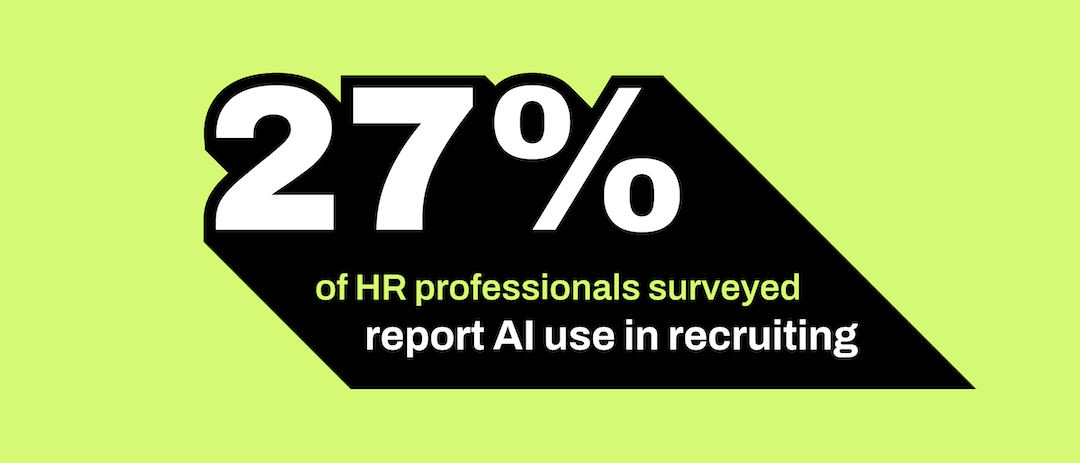
27% of HR professionals surveyed by SHRM report AI use in recruiting
Source: SHRM, State of AI in HR 2026, executive summary p. 3
2. 39% of HR professionals surveyed by SHRM say AI is adopted in their HR function (SHRM, State of AI in HR 2026). SHRM surveyed 1,908 HR professionals, managers, and leaders in December 2025.
In SHRM’s research, “extra-large organizations” means employers with 5,000 or more employees (SHRM, 2024 Talent Trends).
3. 60% of extra-large organizations have implemented AI in HR, versus 33% of small ones, SHRM’s December 2025 survey found (SHRM, State of AI in HR 2026). Midsize organizations came in at 35%, and recruiting was the most common AI area at every size.
Other Estimates of AI Use in Hiring
Other surveys of employers, recruiters and hiring managers give these figures.
4. 79% of US hiring managers say their companies use AI somewhere in hiring or recruiting (Resume Genius, 2026 Hiring Insights Report). Pollfish surveyed 1,000 US hiring managers for the report, published in January 2026.
5. 57% of US companies use AI to support hiring, according to managers surveyed by ResumeTemplates.com in 2025 (ResumeTemplates.com). Pollfish surveyed 1,399 US managers with hiring knowledge in August 2025.
6. 43% of HR professionals surveyed by SHRM reported AI adoption in HR tasks in 2025, up from 26% in 2024 (SHRM, 2025 Talent Trends). SHRM surveyed 2,040 US HR professionals from February 3 to 12, 2025.
7. 37% of organizations were “actively integrating” or “experimenting” with gen AI in recruiting, up from 27% (LinkedIn, Future of Recruiting 2025). LinkedIn surveyed 1,271 recruiting professionals in 23 countries in September 2024; the 27% was a year earlier.
An applicant tracking system (ATS) is software that collects and sorts job applications.
8. 53% of US recruiters have handed most screening to AI or applicant tracking systems, hiring-software maker Greenhouse found (Greenhouse, 2025 AI in Hiring Report).
AI in UK Recruitment
The CIPD’s latest survey of UK HR professionals is weighted to represent UK employers.
9. 56% of UK organisations don’t use AI or machine learning in recruitment, down from 62% in 2024 (CIPD, Resourcing and talent planning report 2026). The share was 84% in 2022; CIPD tightened its 2026 sample criteria, so year-on-year comparisons need caution.
10. 80% of UK SMEs don’t use AI or machine learning in any recruitment process, CIPD found in 2026 (CIPD, Resourcing and talent planning report 2026). Among larger organisations, the share is 38%.
11. 68% of UK public sector organisations don’t use AI or machine learning in recruitment, versus 52% in the private sector (CIPD, Resourcing and talent planning report 2026). Among non-profits, 71% don’t use AI or machine learning in recruitment.
How Do Employers Use AI in Hiring?
These figures show which hiring tasks employers use AI for.
12. 79% of US companies using AI in hiring use it for resume reviews, per ResumeTemplates.com’s 2025 survey (ResumeTemplates.com). Candidate assessments (66%) and researching applicants (63%) come next.
13. 64% of organizations using AI in HR applied it to recruiting, interviewing, or hiring, SHRM found in 2024 (SHRM, 2024 Talent Trends). SHRM surveyed 2,366 US HR professionals in January 2024.
In the UK, the CIPD breaks down AI use by stage of the recruitment process. Sourcing means finding people who might fit a role.
14. 16% of UK organisations use AI to write job descriptions, and 16% to screen candidates, CIPD found in 2026 (CIPD, Resourcing and talent planning report 2026). YouGov surveyed 1,014 UK HR professionals from April 2 to May 2, 2026, weighted to represent UK employers.
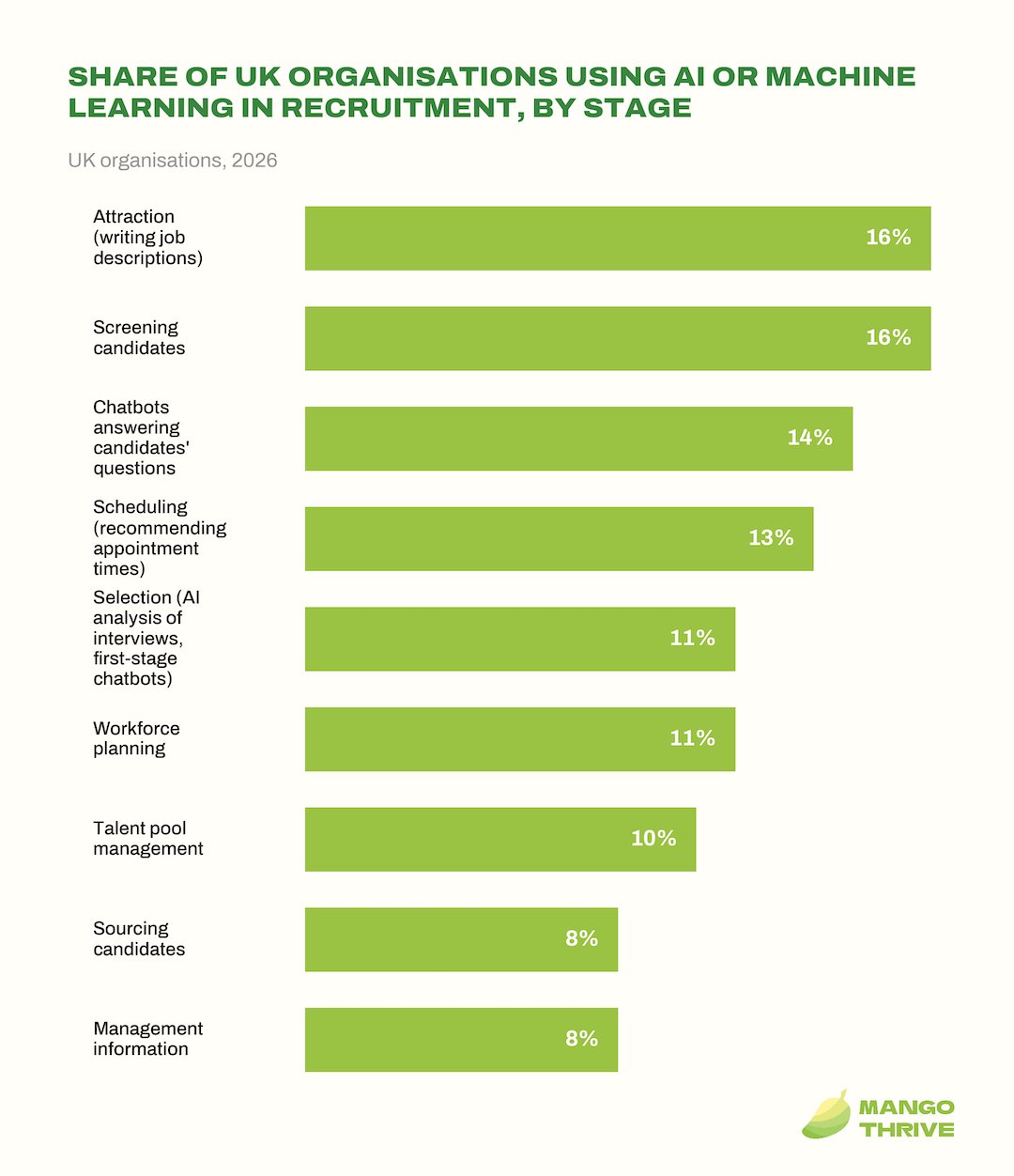
Share of UK organisations using AI or machine learning in recruitment, by stage, 2026
Source: CIPD, Resourcing and talent planning report 2026, Figure 30
15. 14% of UK organisations use chatbots to answer candidates’ questions, and 13% use AI to recommend appointment times, CIPD found in 2026 (CIPD, Resourcing and talent planning report 2026). Selection and workforce planning were at 11% each, talent pool management at 10%, and sourcing and management information at 8% each.
How Many Employers Plan to Use More AI in Hiring?
16. 74% of US companies plan to increase their use of AI in hiring over the next 12 months, per ResumeTemplates.com’s 2025 survey (ResumeTemplates.com).
17. 93% of recruiters surveyed say they plan to increase their use of AI in 2026, LinkedIn found (LinkedIn, January 2026 research). Censuswide surveyed 6,554 HR professionals in markets including the US, UK, India and Brazil in November 2025.
18. Two-thirds of recruiters surveyed (66%) plan to increase AI use for pre-screening interviews in 2026 (LinkedIn, January 2026 research). Censuswide surveyed HR professionals for LinkedIn in November 2025.
19. 46% of organizations in SHRM’s survey expect to use AI in HR in 2026 (SHRM, State of AI in HR 2026).
20. 84% of talent acquisition leaders plan to use AI next year, Korn Ferry’s 2026 trends survey found (Korn Ferry). Korn Ferry surveyed 1,674 talent leaders worldwide; 42% were from the US.
An AI agent is software that can carry out a series of tasks on its own.
21. 52% of leaders in Korn Ferry’s talent survey plan to add autonomous agents to their teams in 2026 (Korn Ferry).
How Much Time Does AI Save in Hiring?
Recruiters’ own estimates come first. Figures from hiring platforms and employers follow.
22. Talent pros using generative AI in hiring save about 20% of their work week on average (LinkedIn, Future of Recruiting 2025). LinkedIn surveyed 1,271 recruiting professionals in 23 countries in September 2024.
23. 35% of talent pros using generative AI say they spend the time it saves on candidate screening, LinkedIn’s 2024 survey found (LinkedIn, Future of Recruiting 2025). Another 26% put it toward skill assessments.
LinkedIn’s Hiring Assistant is an AI agent for recruiters. These figures are LinkedIn’s own data.
24. Early adopters of LinkedIn’s Hiring Assistant save 4+ hours per role, LinkedIn said in January 2026 (LinkedIn, January 2026 research).
25. Recruiters using LinkedIn’s Hiring Assistant review 81% fewer profiles to find a qualified match, per LinkedIn’s January 2026 data (LinkedIn, Hiring Assistant).
26. 33% faster: how quickly recruiters using LinkedIn’s Hiring Assistant find interview-quality applicants, per LinkedIn’s January 2026 data (LinkedIn, Hiring Assistant).
In LinkedIn’s data, a “quality hire” is scored on three equally weighted measures: high demand from recruiters, staying at least one year, and moving to a second internal role within a year (LinkedIn, Future of Recruiting 2025).
27. Companies whose recruiters use LinkedIn’s AI-Assisted Messaging most are 9% more likely to make a quality hire, LinkedIn’s Future of Recruiting 2025 found (LinkedIn, Future of Recruiting 2025). The comparison is against companies that use it the least.
Time to hire measures how long it takes to fill a job.
28. 20%: the average cut in time to hire for US employers testing Indeed’s Smart Screening, per Recruit Holdings (Recruit Holdings). The test compared 1,095 US job postings with the feature against similar postings without it, from May through December 2025.
29. Chipotle has cut its hiring time by 75% since launching its AI hiring platform, CEO Scott Boatwright told Fortune in 2025 (CNBC).
How Common Are AI Job Interviews?
30. 63% of US job seekers surveyed have been interviewed by an AI, Greenhouse reported in 2026 (Greenhouse, May 2026).
31. 38% of US candidates surveyed have walked away from a hiring process over an AI interview (Greenhouse, 2026) (Greenhouse, May 2026). Another 12% say they would.
32. 70% of US candidates who experienced AI evaluation say AI wasn’t clearly disclosed before their most recent AI interview, Greenhouse found in 2026 (Greenhouse, 2026 Candidate AI Interview Report).
33. Only 30% of job candidates are open to AI-led interviews, a 2025 Gartner survey found (Gartner, June 2026). Just 31% were told in advance they would take part in one; the survey covered 254 candidates.
What Happens When AI Runs Job Interviews?
Two studies tested AI interviews with real job applicants in field experiments. A field experiment randomly assigns real people to different conditions and compares the results.
34. Applicants interviewed by an AI voice agent were 12% more likely to get a job offer in a 2025 field experiment in the Philippines (Jabarian & Henkel, 2026). The offer rate was 9.73% with the AI interviewer versus 8.70% with human recruiters, for entry-level customer service jobs.
35. Applicants interviewed by AI were 18% more likely to start the job, Jabarian and Henkel’s 2025 field experiment found (Jabarian & Henkel, 2026).
36. AI-interviewed applicants were 18% more likely to stay employed at least one month in Jabarian and Henkel’s 2025 field experiment (Jabarian & Henkel, 2026). The gap held at four months, at 19%.
37. 78% of applicants in a 2025 field experiment in the Philippines chose an AI voice interviewer over a human recruiter when given the choice (Jabarian & Henkel, 2026).
38. 61% of recruiters in the 2025 AI interview study expected AI-led interviews to be of lower quality (Jabarian & Henkel, 2026).
A percentage point is the simple difference between two percentages.
39. 17.5 to 20 percentage points: the gain in final-interview pass rates for candidates shortlisted using AI interview reports (Aka et al., 2026). The comparison is with shortlisting from resumes alone, across two field experiments on one recruitment platform.
40. 75% of candidates invited to an AI interview did not complete it, in a Stanford-led field study (Aka et al., 2026).
How Many Job Seekers Use AI to Apply?
41. 74% of US job seekers personally use AI, according to Greenhouse’s 2025 survey (Greenhouse). 87% say it is important for employers to be transparent about their own AI use.
42. 39% of job candidates said they used AI during the application process, per a late-2024 Gartner survey (Gartner). Gartner surveyed 3,290 job candidates in the fourth quarter of 2024.
43. Among candidates who used AI to apply, 54% used it to generate résumé text, Gartner found in a late-2024 survey (Gartner). Another 50% used it for cover letter text, 36% for a writing sample and 29% for assessment answers.
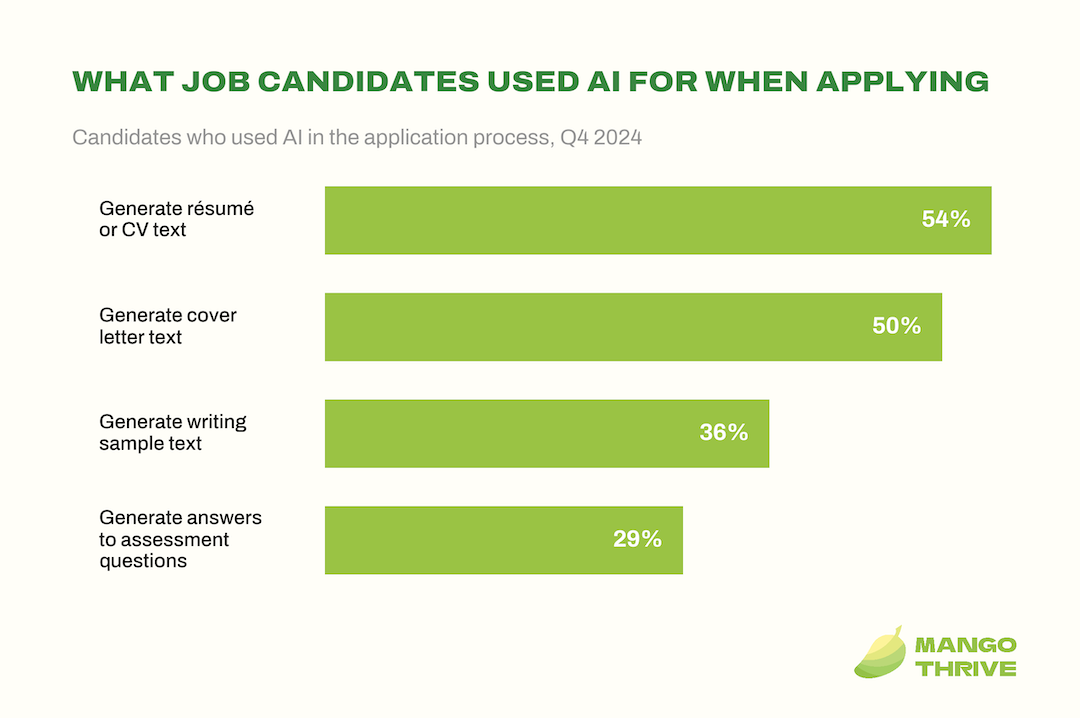
What job candidates used AI for when applying, Q4 2024
Source: Gartner. Base: candidates who used AI in the application process.
44. 59% of US job seekers surveyed use AI to write resumes, Resume Genius’s 2026 survey found (Resume Genius, 2026 Job Seeker Insights Report). 48% use it for cover letters and 22% to answer interview questions; the survey of 1,000 US job seekers launched on March 16, 2026.
45. 57% of job seekers surveyed used AI to create their resumes in 2024, Canva reported (Canva). Sago ran the survey for Canva across 10 countries and over 10,000 respondents.
How Many Applications Does a Job Get?
46. Greenhouse data show 244 applications per job in 2025, up from 116 in 2022 (Greenhouse, The Hire Standard). The figure was 189 in 2023 and 223 in 2024, based on over 640 million applications at over 6,000 companies.
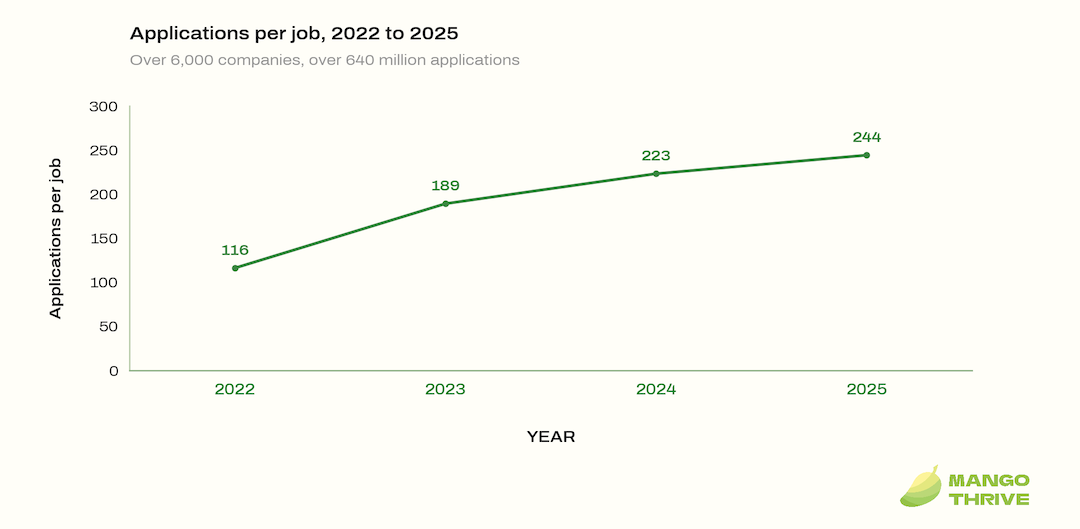
Applications per job, 2022 to 2025
Source: Greenhouse, The Hire Standard
47. US applicants per open role have doubled since spring 2022, LinkedIn data showed in January 2026 (LinkedIn, January 2026 research).
48. Nearly half (49%) of US job seekers surveyed submitted more applications than a year earlier, per Greenhouse (2025) (Greenhouse). 69% said they had encountered fake job postings.
How Do Hiring Managers View AI-Written Applications?
49. 80% of US hiring managers surveyed say they can often tell when AI wrote a resume (Resume Genius, 2026 Hiring Insights Report). Resume Genius surveyed 1,000 US hiring managers for its 2026 report.
50. About one in five (19.6%) US hiring managers surveyed would reject a candidate with an AI-generated resume or cover letter (TopResume). TopResume surveyed 600 US hiring managers on May 15–16, 2025.
51. 51%: the drop in the correlation between cover letters’ alignment with job posts and callbacks after an AI cover letter tool launched on a large online labor platform (Cui, Dias & Ye, 2025). Employers shifted toward other signals, including workers’ prior work histories.
How Do Job Seekers Feel About AI in Hiring?
52. Only 26% of job candidates trust AI will fairly evaluate them, according to a Gartner survey released in July 2025 (Gartner).
53. 25% of job candidates say they trust employers less if AI evaluates their information, Gartner found in 2025 (Gartner). The survey of 2,918 candidates also found 32% were concerned AI could fail their applications.
54. Only 8% of job seekers surveyed by Greenhouse believe AI makes hiring more fair (2025) (Greenhouse).
55. 79% of job seekers surveyed by HireVue want to know when AI is used in hiring decisions (2025) (HireVue). HireVue surveyed over 3,100 job seekers worldwide.
How Common Is Candidate Fraud?
These figures cover fake identities, deepfakes and AI use during interviews and tests. A deepfake is a fake video or voice made with AI.
A prompt injection is hidden text designed to bypass AI filters.
56. 6% of job candidates admitted to interview fraud in a 2025 Gartner survey (Gartner). Interview fraud meant posing as someone else or having someone else pose as them; the survey covered 3,000 job candidates in the second quarter of 2025.
57. 65% of US hiring managers surveyed have caught applicants using AI deceptively, Greenhouse found in 2025 (Greenhouse). Examples included reading from AI-generated scripts (32%), hiding prompt injections in resumes (22%) and showing up as deepfakes (18%).
58. 31% of US managers surveyed have interviewed a candidate later revealed to be using a fake identity, Checkr found in 2025 (Checkr). Checkr surveyed 3,000 American managers involved in hiring over the past 12 months.
59. 17% of US hiring managers surveyed have encountered candidates using deepfake technology in video interviews, per Resume Genius’s 2026 survey (Resume Genius, AI’s Impact on Hiring in 2026). The Pollfish survey, launched June 4, 2026, targeted 1,000 US hiring managers and hiring-team members.
60. 46% of US hiring managers surveyed have encountered interviewees using AI to answer interview questions, Resume Genius found in 2026 (Resume Genius, AI’s Impact on Hiring in 2026).
61. 36% of US job seekers surveyed have used AI to alter their appearance, voice or background in video interviews (Greenhouse). Greenhouse’s 2025 survey included 1,200 US job seekers.
62. 40% of US candidates report using prompt injection to bypass filters, Greenhouse’s 2025 AI in Hiring Report found (Greenhouse, 2025 AI in Hiring Report). Among those who don’t, 51% of US candidates say they would consider it.
A proctored assessment is an online test that is monitored while the candidate takes it.
63. 35%: CodeSignal’s cheating and fraud attempt rate on proctored assessments in 2025, up from 16% in 2024 (CodeSignal).
64. One in four candidate profiles worldwide will be fake by 2028, Gartner predicts (Gartner).
How Big Is the AI Recruitment Market?
Research firms publish their own estimates of the AI recruitment market. Each firm’s figure is listed separately.
65. Straits Research values the global AI recruitment market at $601.5 million in 2025, forecasting $1.16 billion by 2034 (Straits Research).
66. Market Research Future puts the AI recruitment market at $637.9 million in 2025, projecting $1.38 billion by 2035 (Market Research Future).
Large software companies have also bought hiring software firms.
67. Workday’s purchase price for conversational AI hiring company Paradox was $1.1 billion in September 2025, per its 10-K (Workday Form 10-K, fiscal 2026). That included $1.0 billion in cash.
68. Workday paid $530 million in cash for AI talent software provider HiredScore in March 2024 (Workday Form 10-K, fiscal 2026).
69. SAP’s purchase price for talent acquisition software provider SmartRecruiters was US$878 million (€753 million) in 2025 (SAP Form 20-F 2025). The deal closed on September 11, 2025, and most of it was paid in cash.
70. Paradox had powered more than 189 million AI-assisted candidate conversations by August 2025, per Workday (Workday).
Several AI hiring startups have announced new funding.
71. AI recruiting startup Juicebox announced an $80 million Series B at an $850 million valuation in March 2026 (Juicebox). DST Global led the round.
72. Hiring platform Paraform has raised $65 million in total, it said when announcing its Series B in March 2026 (Paraform). Scale Venture Partners led the round.
73. HR software startups worldwide raised $2 billion in venture funding in 2024, down from a $10.5 billion peak in 2021 (Crunchbase News).
Recruit Holdings owns the job sites Indeed and Glassdoor.
74. Recruit Holdings’ HR Technology segment, which runs Indeed and Glassdoor, generated $9.67 billion in revenue in fiscal 2025 (Recruit Holdings). That was up 7.6% on a US dollar basis for the year ended March 31, 2026.
Is Recruiting Being Replaced by AI?
Government job projections come first. Surveys and research on how AI is changing HR work follow.
75. US employment of human resources specialists is projected to grow 6% from 2025 to 2035, faster than average (BLS). BLS counts recruiters in this occupation.
76. The US had 939,700 human resources specialist jobs in 2025, a BLS category that includes recruiters (BLS).
77. About 73,700 openings for US human resources specialists are projected each year, on average, through 2035 (BLS).
78. Canada’s employment department (ESDC) projects 18,200 job openings for human resources and recruitment officers from 2024 to 2033, against 20,600 job seekers (ESDC COPS). It expects demand and supply to be broadly in line at the national level.
Seasonally adjusted figures remove regular yearly swings, such as holiday hiring.
79. US human resources job postings on Indeed, which include recruiter roles, were 3.2% below their February 2020 level on Sept. 25, 2026 (Indeed Hiring Lab). The index is seasonally adjusted and uses a seven-day average.
80. 7% of HR professionals at organizations using AI say it has led to slight job displacement, SHRM’s December 2025 survey found (SHRM, State of AI in HR 2026).
81. 39% of HR professionals at organizations using AI report shifts in workers’ job responsibilities, and 24% report new jobs or roles, SHRM found in December 2025 (SHRM, State of AI in HR 2026).
82. 73% of talent acquisition professionals agree AI will change the way organizations hire, per LinkedIn’s Future of Recruiting 2025 (LinkedIn, Future of Recruiting 2025). LinkedIn surveyed 1,271 recruiting professionals in management roles or higher across 23 countries in September 2024.
An LLM, or large language model, is the type of AI behind chatbots such as ChatGPT.
83. 60% of HR work tasks will be completed through an intelligent agent or LLM-centric interface by 2030, Gartner predicts (Gartner, December 2025).
84. Employers were 54 times more likely to list “relationship development” as a required recruiter skill on LinkedIn paid job posts, year over year (LinkedIn, Future of Recruiting 2025). LinkedIn compared job posts from Nov 2023–Oct 2024 with the previous 12 months.
In Microsoft’s research, the “AI applicability score” combines whether Copilot assists or performs an occupation’s work activities, how successfully, and how broadly (Microsoft Research).
85. Microsoft researchers gave human resources specialists an AI applicability score of 0.20, based on 2024 Bing Copilot conversations (Microsoft Research, Working with AI data). The study used about 200,000 anonymized US Copilot conversations from January to September 2024.
Conclusion
One thing is clear: AI is now part of hiring for employers and job seekers alike. Adoption still varies by employer size and sector. Trust is the weak point, especially among candidates. We’ll update this page as new data comes out.