
74 Social Media Addiction Statistics for 2026
It is easy to open an app for a minute and look up much later. Researchers measure that pull in different ways. Some studies use symptom scales. Others ask people if they feel hooked, or track how long they spend in each app. Here are the latest social media addiction statistics, from global estimates to the steps people take to cut back.
Top Social Media Addiction Statistics
-
24% is the combined social media addiction rate across 32 nations in a 2021 meta-analysis.
-
11% of adolescents in Europe, Central Asia and Canada showed problematic social media use in 2022, up from 7% in 2018.
WHO/Europe, HBSC report on adolescent social media use, 2024
-
21% of US adults agree "I am addicted to social media" (2025).
-
36% of US teens use at least one of five major social platforms "almost constantly" (2025).
Pew Research Center, Teens, Social Media and AI Chatbots 2025
-
More than 60% of all time spent in mobile apps worldwide in 2025 was in social media and social messaging apps.
-
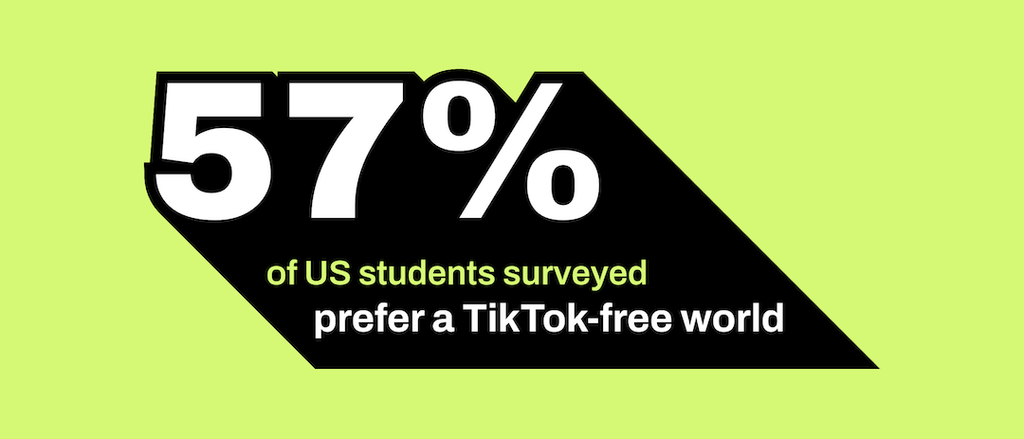
57% of US college students surveyed in 2023 said they'd prefer to live in a world without TikTok.
-
45% of US teens say they spend too much time on social media (2024).
-
44% of US teens say they have cut back on their time on social media (2024).
How Common Is Social Media Addiction?
How Many People Are Addicted to Social Media?
The headline estimate comes from a meta-analysis, a study that combines many earlier studies.
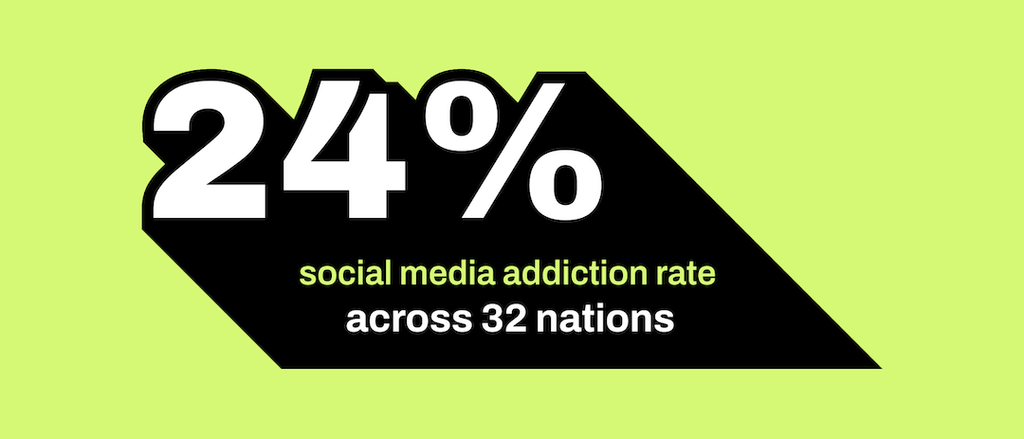
Source: Cheng et al., Addictive Behaviors, 2021. Combined estimate from 63 samples with 34,798 respondents.
1. 24% is the combined social media addiction rate across 32 nations in a 2021 meta-analysis (Cheng et al., Addictive Behaviors, 2021). The study pooled 63 samples with 34,798 respondents, and single-study estimates ranged from 0% to 82%.
In the Cheng et al. meta-analysis, the “strictest” classifications count someone as addicted only if they score at or above the cutoff on every item of a Bergen addiction scale.
2. 5% is the combined estimate of social media addiction across 32 nations in studies using the strictest classifications (Cheng et al., Addictive Behaviors, 2021). Two looser groups of classifications came to 13% and 25%.
Other Estimates of Social Media Addiction
Other meta-analyses have produced their own combined estimates. The meta-analysis in the section above also broke its estimate down by culture and region.
3. 17.42% is the global combined rate of social media addiction in a 2022 meta-analysis (Meng et al., Clinical Psychology Review, 2022). The study covered 2,123,762 people from 64 countries across five types of digital addiction.
4. 23% is the global combined estimate of problematic social media use in a 2026 review of reviews (Schwarze-Taufiq et al., medRxiv preprint, 2026). The preprint is not yet peer reviewed.
5. 18.4% is the global combined rate of social network addiction among university students in a meta-analysis (Salari et al., Journal of Public Health, 2023). It covered 51 studies and 35,520 students, with searches up to April 2022.
6. 25% is the combined rate of addictive or problematic social networking use across 20 studies of school-going adolescents (Ahmer et al., Archives of Psychiatric Nursing, 2026). The authors say the figure should be read as descriptive, not as a precise population estimate.
In the Cheng et al. meta-analysis, “individualist” nations score 50 or above on Hofstede’s individualism index and “collectivist” nations score below 50. People in collectivist countries tend to see themselves as part of their social networks.
7. 31% is the combined estimate of social media addiction in collectivist nations, versus 14% in individualist nations (Cheng et al., Addictive Behaviors, 2021). The authors describe the collectivist figure as twofold higher.
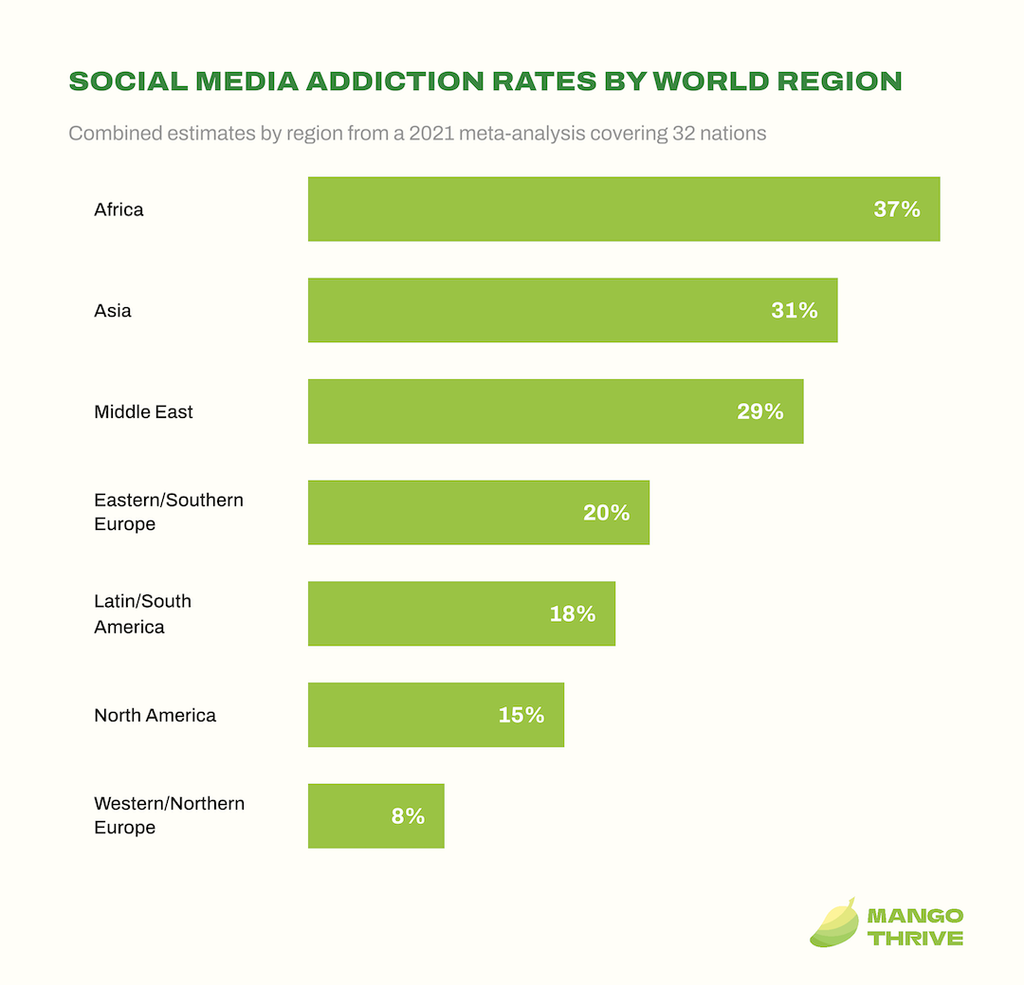
Source: Cheng et al., Addictive Behaviors, 2021. Combined estimates by world region. The Latin/South America figure is based on two samples.
How Many Americans Are Addicted to Social Media?
These figures cover US adults.
8. 21% of US adults agree “I am addicted to social media” (2025) (Civic Attention/YouGov, 2025). Among adults aged 18 to 29, it’s 30%. YouGov surveyed 1,653 US adults online in February and March 2025.
In Anderson and Wood’s study, “at risk of addiction” means scoring 24 or more out of 30 on a six-item Instagram symptom scale.
9. 2% of active adult US Instagram users scored as at risk of addiction in a 2025 study (Anderson & Wood, Scientific Reports, 2025). The study used a symptom scale based on the Bergen addiction scale, with a sample of 380 users.
10. 18% of active adult US Instagram users agreed at least somewhat that they’re addicted to Instagram in a 2024 survey (Anderson & Wood, Scientific Reports, 2025). Only 5% showed substantial agreement, a 6 or 7 on a 7-point scale.
Social Media Addiction Among Teens
How Many Teens Show Signs of Social Media Addiction?
Studies in Europe, Central Asia, Canada, the US and Germany use symptom scales to measure addiction-like social media use among young people.
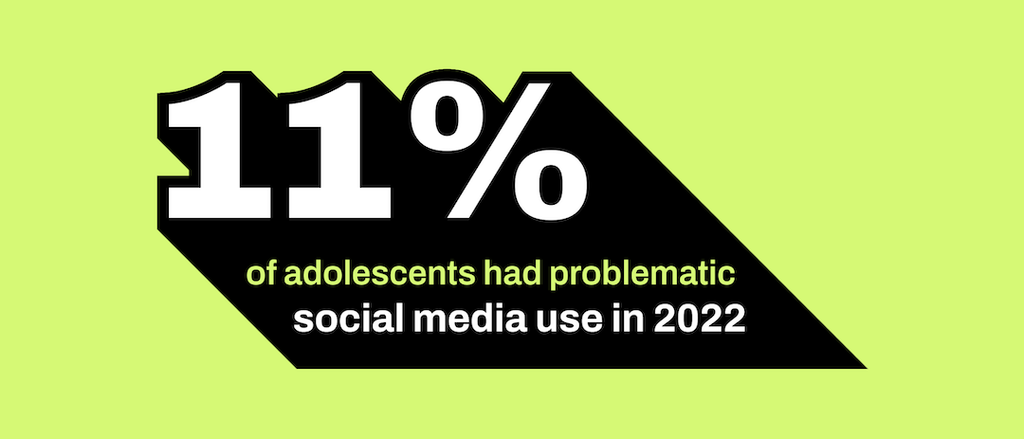
Source: WHO/Europe, HBSC report on adolescent social media use, 2024. Adolescents aged 11, 13 and 15 in 44 countries and regions in Europe, Central Asia and Canada.
In the HBSC study, “problematic social media use” means answering yes to six or more of nine addiction-like symptoms on the Social Media Disorder Scale.
11. 11% of adolescents in Europe, Central Asia and Canada showed problematic social media use in 2022, up from 7% in 2018 (WHO/Europe, HBSC report on adolescent social media use, 2024). The survey covered 11-, 13- and 15-year-olds in 44 countries and regions.
12. 13% of adolescent girls in 44 HBSC countries and regions showed problematic social media use in 2022, versus 9% of boys (WHO/Europe, HBSC report on adolescent social media use, 2024).
13. 31.3% of US youths in a long-running study followed an increasing addictive social media use pattern (Xiao et al., JAMA, 2025). Another 9.6% followed a high-peaking pattern. The analysis covered 4,285 participants in the ABCD study, who were 10 years old on average at the start. Data were collected from 2016 to January 2022.
In the DAK/UKE study, “pathological” use means meeting all core criteria (loss of control, rising priority, continuing despite harm) with real impairment, while “risky” use means meeting some criteria without impairment yet.
14. 21.5% of 10- to 17-year-olds in Germany showed risky social media use in fall 2025 (DAK-Gesundheit/UKE Media Addiction Study, 2026). The figure was 21.1% a year earlier, a change the study found was not statistically significant.
15. 6.6% of 10- to 17-year-olds in Germany met criteria for pathological social media use in fall 2025 (DAK-Gesundheit/UKE Media Addiction Study, 2026).
16. 10.2% of German 14- to 17-year-olds showed pathological social media use in 2025, versus 2.7% of 10- to 13-year-olds (DAK-Gesundheit/UKE Media Addiction Study, 2026). Boys (6.7%) and girls (6.5%) showed no significant difference.
Smartphone Overdependence in South Korea
South Korea’s government surveys smartphone overdependence every year. The survey measures phone use, not social media alone, and covers children and adults.
In the NIA survey, “smartphone overdependence” means heavy use that makes the phone more central, weakens self-control and leads to problems; the “risk group” combines high-risk and potential-risk users.
17. 43.0% of South Korean adolescent smartphone users aged 10 to 19 were in the overdependence risk group in 2025 (NIA, 2025 Smartphone Overdependence Survey). The rate was 30.6% in 2016.
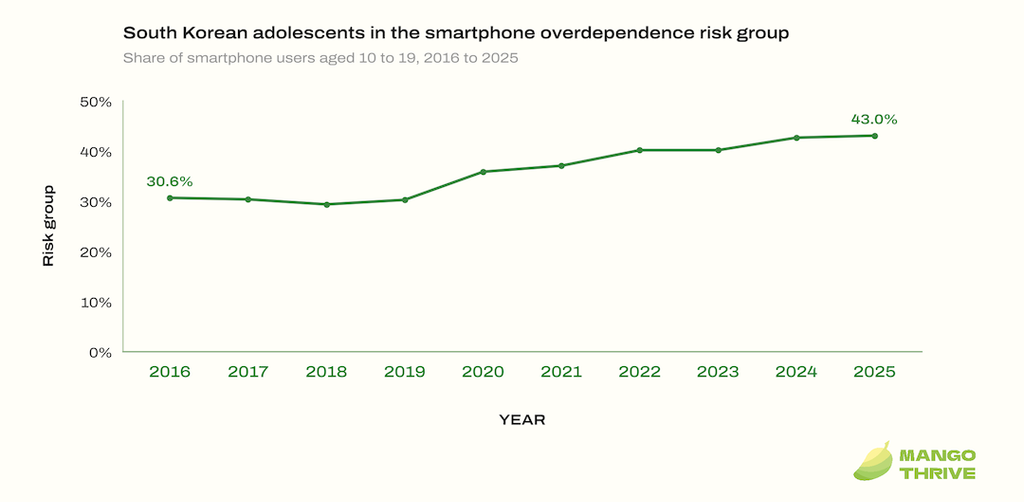
Source: NIA, 2025 Smartphone Overdependence Survey. Smartphone users aged 10 to 19.
18. 22.7% of South Korean smartphone users aged 3 to 69 were in the smartphone overdependence risk group in 2025 (NIA, 2025 Smartphone Overdependence Survey). That is an estimated 10,032,000 people in the risk group.
How Often Are Teens Online and on Social Media?
These surveys ask US teens how often they go online and use social media.
19. 36% of US teens use at least one of five major social platforms “almost constantly” (2025) (Pew Research Center, Teens, Social Media and AI Chatbots 2025). The five platforms are YouTube, TikTok, Instagram, Snapchat and Facebook.
20. 21% of US teens say they’re on TikTok “almost constantly” (2025), up from 16% in 2022 (Pew Research Center, Teens, Social Media and AI Chatbots 2025).
21. Four in ten US teens say they’re online “almost constantly” (2025) (Pew Research Center, Teens, Social Media and AI Chatbots 2025). Nearly all US teens (97%) say they use the internet daily.
22. 54% of US teens in households earning under $30,000 say they’re online almost constantly (2025) (Pew Research Center, 2025 teens report). In households earning $75,000 or more, the share is 35%.
23. 77.0% of US high school students reported using social media at least several times a day in 2023 (CDC MMWR, 2024). The rate was 81.8% among female students and 72.9% among male students.
In the CDC Youth Risk Behavior Survey, “every hour or more” means students said they used social media about once an hour or more than once an hour.
24. 36% of US high school students used social media every hour or more in 2025 (CDC, Youth Risk Behavior Survey 2025 data tables).
Time Spent on Social Media
How Much Time Do People Spend on Social Media?
These figures show how much time people spend on social and video apps.
25. Well over 2½ hours a day is the average online adult’s time on social and video platforms worldwide (2025) (DataReportal, Digital 2026 Global Overview Report). That figure includes video-centric platforms like YouTube and TikTok.
26. 18 hours and 36 minutes a week is the average online adult’s time on social and video platforms worldwide (2025) (DataReportal, Digital 2026 Global Overview Report). DataReportal says that equals roughly 16 percent of waking hours.
27. 25 hours and 45 minutes a week is what women aged 16 to 24 who use the internet spend on social and video platforms worldwide (2025) (DataReportal, Digital 2026 Global Overview Report). That equates to more than 3 hours and 40 minutes each day.
28. More than 1 hour a day is what online adults worldwide spend on social networks like Facebook and X, not counting video platforms (2025) (DataReportal, Digital 2026 Global Overview Report).
29. 3.4 trillion hours were spent in social media apps worldwide in 2025, up from 3.3 trillion in 2024 (Sensor Tower, State of Mobile 2026). Sensor Tower groups social media, social messaging and live streaming apps under social. The figures cover iOS and Google Play apps.
30. More than 60% of all time spent in mobile apps worldwide in 2025 was in social media and social messaging apps (Sensor Tower, State of Mobile 2026).
31. 630 billion hours were spent in social media apps worldwide in Q4 2025, up from 469 billion in Q1 2022 (Sensor Tower, State of Mobile 2026). These figures cover only Sensor Tower’s Social Media subgenre, led by apps such as TikTok, YouTube and Instagram.
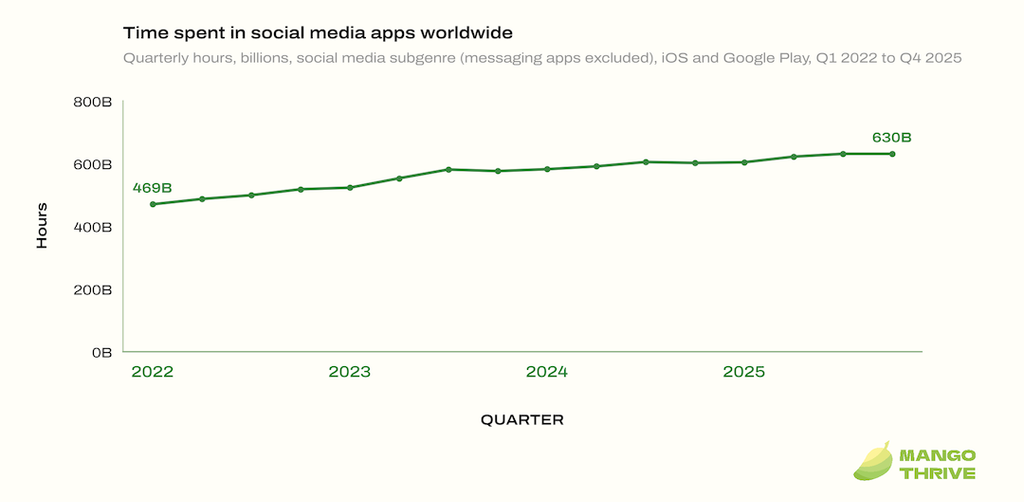
Source: Sensor Tower, State of Mobile 2026. Hours in Sensor Tower’s Social Media subgenre worldwide, which excludes messaging apps. iOS and Google Play (iOS only in China).
32. 4.8 hours a day is the average time US teens aged 13 to 19 spend on social media (2023) (Gallup, 2023). The figure covers seven platforms. Just over half (51%) report at least four hours a day.
Social Media Use by Platform
App tracking data and company reports show how much time people spend in each social app. Surveys show how teens and parents feel about specific apps.
33. 1 hour 34 minutes a day is the average active TikTok user’s time in its Android app worldwide (February 2026) (DataReportal, Digital 2026 Mid-Year Global Update (data: Similarweb)). TikTok topped Similarweb’s ranking of the top 15 social apps by daily time per user. The data excludes China.
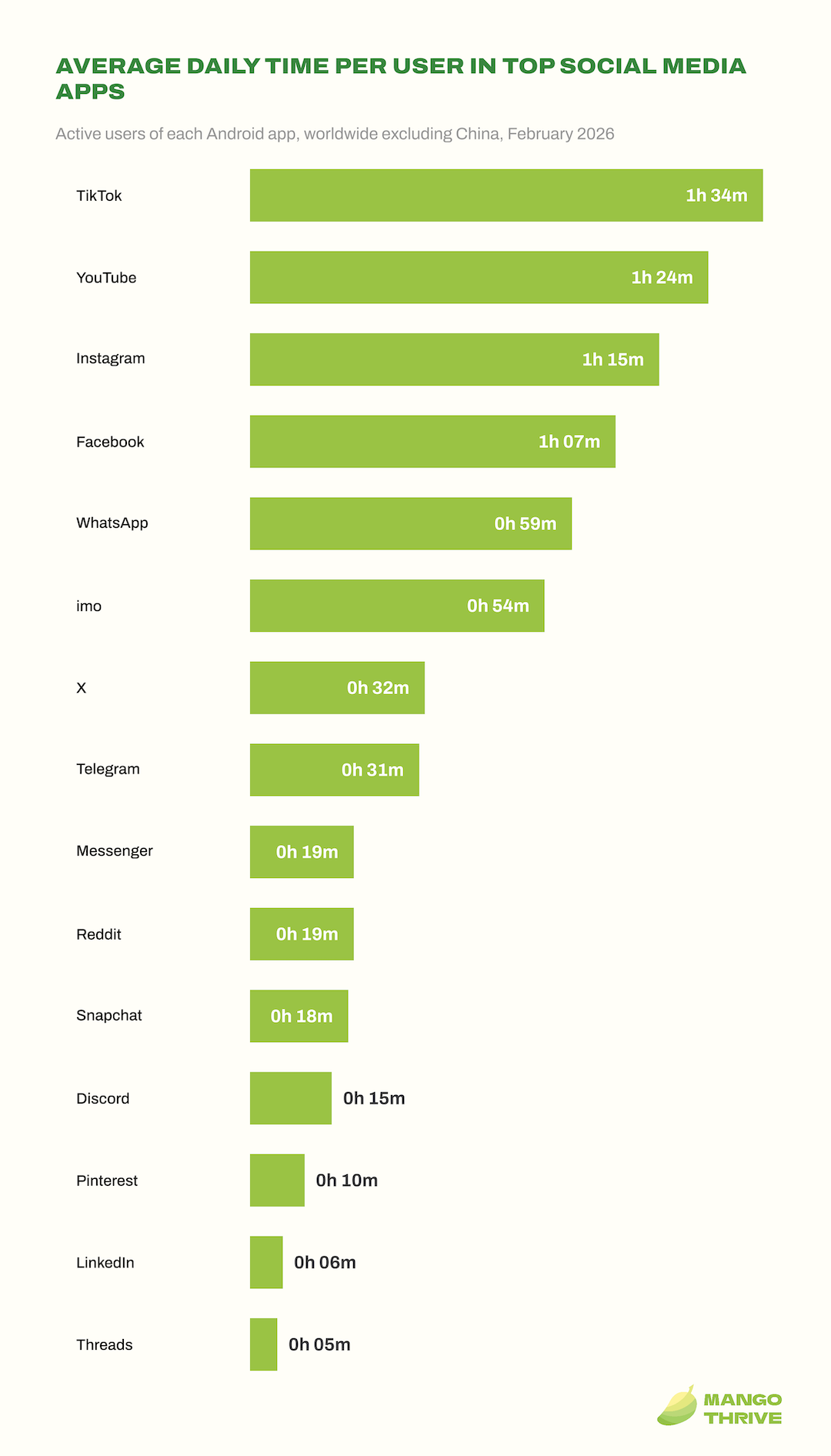
Source: DataReportal, Digital 2026 Mid-Year Global Update (data: Similarweb). Top 15 social media apps by monthly active users; Android phones, excluding China.
34. 1 hour 15 minutes a day is the average active Instagram user’s time in its Android app worldwide (February 2026) (DataReportal, Digital 2026 Mid-Year Global Update (data: Similarweb)). Facebook users averaged 1 hour 7 minutes. The data excludes China.
35. 20.7 times a day is how often active WhatsApp users worldwide opened its Android app (August 2025) (DataReportal, Digital 2026 Global Overview Report (data: Similarweb)). Instagram users averaged 12.3 opens. The data excludes China.
36. 46% of time spent on Instagram went to Reels in 2025, versus 29% on Facebook (Sensor Tower, State of Mobile 2026). The data covers Android phones in the US.
37. 25% of time spent across seven key social apps went to short-form video in 2025 (Sensor Tower, State of Mobile 2026). That was up 1.8 percentage points from 2024. The data covers Android phones in the US.
38. 31% of US teen TikTok users say they use TikTok almost constantly (2025) (Pew Research Center, 2025 teens topline). That’s up from 25% in 2024.
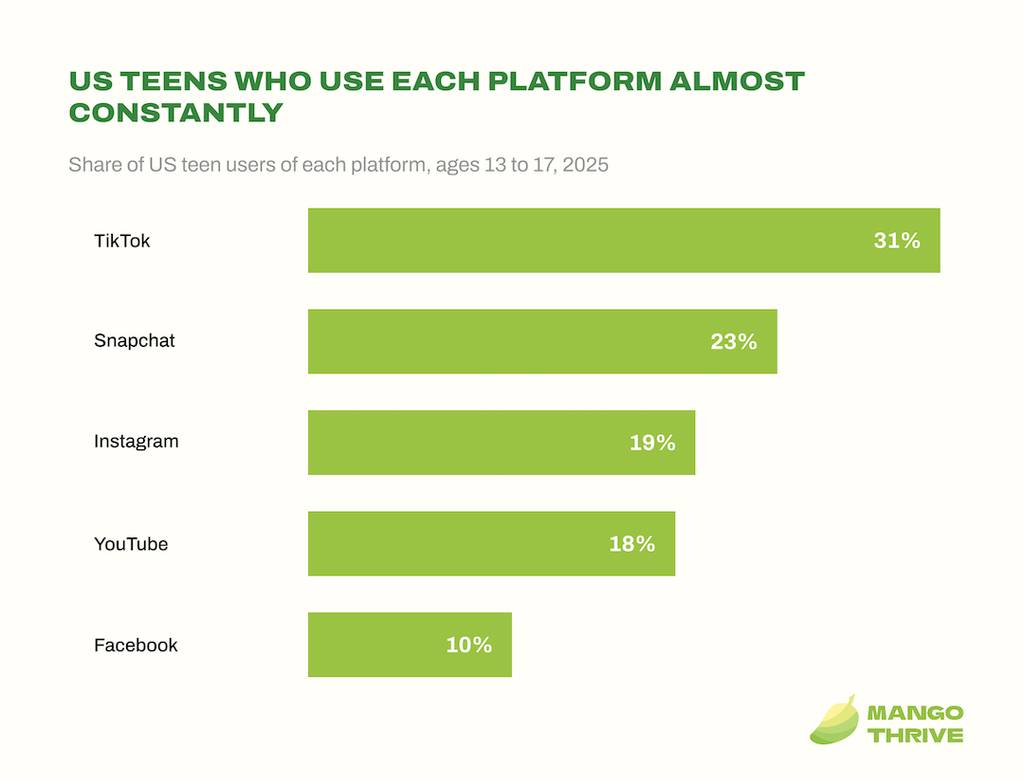
Source: Pew Research Center, 2025 teens topline. US teens ages 13 to 17 who use each platform.
39. 28% of US teen TikTok users say they spend too much time on TikTok (2025) (Pew Research Center, teens and parents topline, April 2026). Most (63%) say their time on it is about right.
40. 44% of US parents of teen TikTok users say their teen spends too much time on TikTok (2025) (Pew Research Center, teens and parents topline, April 2026).
41. Over 30% more video time was spent on Instagram in Q3 2025 than a year earlier, Meta CEO Mark Zuckerberg said (Meta Q3 2025 earnings call). He said AI recommendations led to 5% more time spent on Facebook in the quarter.
42. 9% more video time was spent on Facebook globally in Q2 2026 than a year earlier, Meta CFO Susan Li said (Meta Q2 2026 earnings call). She said Instagram’s global time spent grew double digits.
Overuse and Self-Control
How Much Social Media Use Is Hard to Control?
These surveys ask people whether they use social media more than they mean to.
43. 51% of people in the UK aged 16 to 75 say they often spend more time on social media than they intend to (2026) (Deloitte, Digital Consumer Trends 2026 UK). Among Gen Z, aged 16 to 30, it’s 66%.
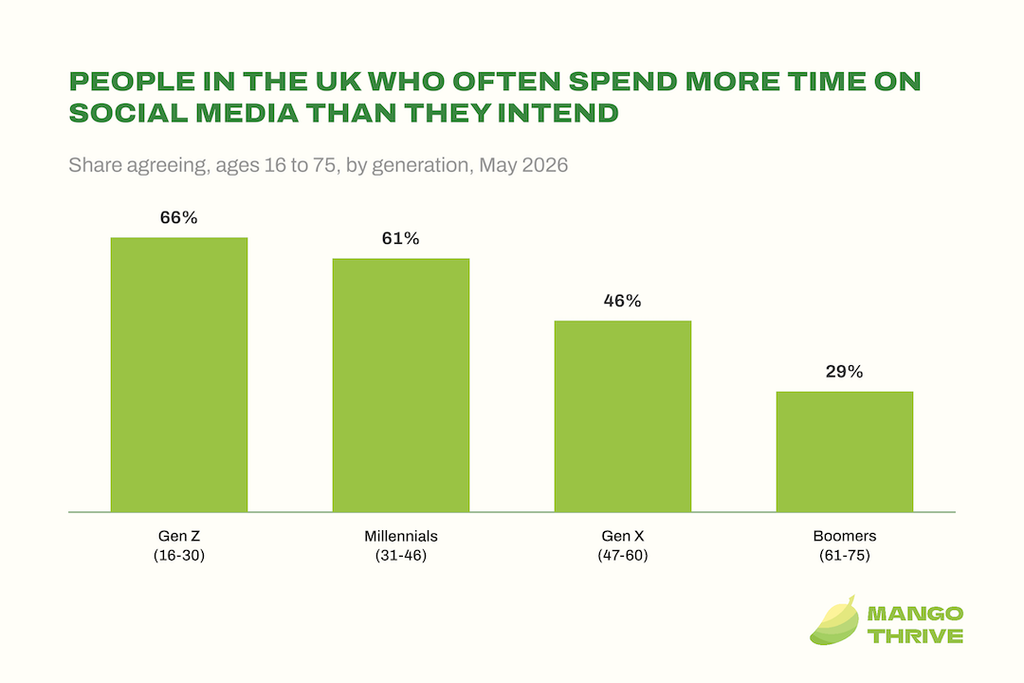
Source: Deloitte, Digital Consumer Trends 2026 UK. People in the UK aged 16 to 75, May 2026.
44. 40.0% of South Koreans who use social media on their smartphones say it’s hard to control their social media use (2025) (NIA, 2025 Smartphone Overdependence Survey). The survey covered ages 3 to 69. Parents or caregivers answered for children aged 3 to 9.
45. 63.2% of South Korean university students who use social media say it’s hard to control their use (2025) (NIA, 2025 Smartphone Overdependence Survey). Among high school students, the figure is 57.9%.
Would Users Rather Social Media Didn’t Exist?
In an economics experiment, researchers asked US college students how much they value TikTok and Instagram.
Source: Bursztyn et al., NBER Working Paper 31771. Survey of US college students, users and non-users.
46. 57% of US college students surveyed in 2023 said they’d prefer to live in a world without TikTok (Bursztyn et al., NBER Working Paper 31771). 58% said the same about Instagram. Both figures include users and non-users.
47. 57% of Instagram users in a 2023 US college survey said they’d prefer a world without Instagram (Bursztyn et al., NBER Working Paper 31771). Among TikTok users, 33% said the same about TikTok. Among Instagram users who declined to join the deactivation experiment, the share was 39%.
48. $55 on average is what US college students who used TikTok asked to deactivate it for four weeks while their peers kept using it (2023) (Bursztyn et al., NBER Working Paper 31771). For Instagram users, the average was $47.
Do People Think They Spend Too Much Time on Social Media and Screens?
These surveys ask people whether they spend too much time on social media, their phones or screens.
49. 45% of US teens say they spend too much time on social media (2024) (Pew Research Center, Teens, Social Media and Mental Health). The share was 36% in 2022 and 27% in 2023.
50. 47% of Americans say they worry they spend too much time on social media (YouGov, January 2025).
51. 66% of Americans aged 18 to 29 say they worry they spend too much time on social media (YouGov, January 2025).
52. 53% of US adults say they spend too much time on their smartphone (2026) (Pew Research Center, September 2026). Pew surveyed 9,750 US adults from May 26 to June 1, 2026.
53. Seven in ten US adults under 30 say they spend too much time on their smartphone (2026) (Pew Research Center, September 2026).
54. 40% of UK adults who go online say their screen time is too high every day or most days (2025) (Ofcom, Adults’ Media Use and Attitudes 2026).
55. 37% of UK children aged 8 to 17 say they spend too much time on screens, in Ofcom’s May 2026 report (Ofcom, Children and Parents: Media Use and Attitudes Report 2025-26). The figure rises to 44% among 16- and 17-year-olds.
Social Media, Sleep and Mental Health
Do People Say Social Media Hurts Their Sleep and Mental Health?
Pew Research Center asks US teens and parents how social media affects sleep, school and mental health.
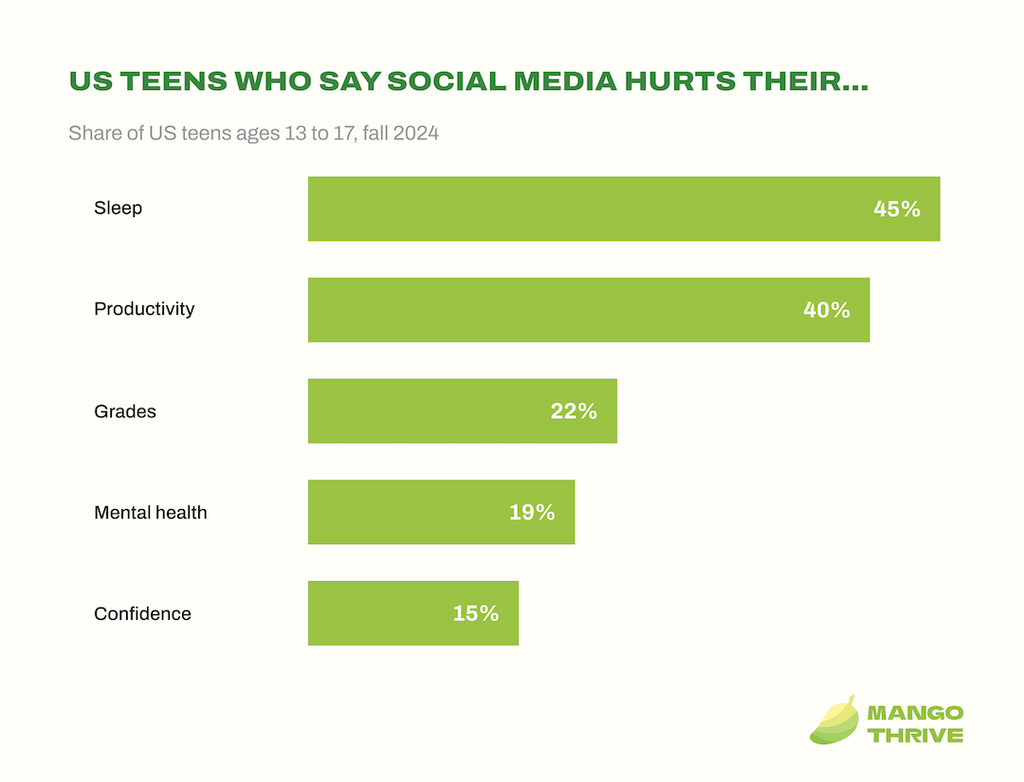
56. 45% of US teens say social media hurts the amount of sleep they get (2024) (Pew Research Center, Teens, Social Media and Mental Health). 40% say it hurts their productivity.
Source: Pew Research Center, Teens, Social Media and Mental Health. US teens ages 13 to 17, fall 2024.
57. Half of US teen girls say social media hurts the amount of sleep they get, versus 40% of boys (2024) (Pew Research Center, Teens, Social Media and Mental Health).
58. 19% of US teens say social media hurts their mental health, and 22% say it hurts their grades (2024) (Pew Research Center, Teens, Social Media and Mental Health). Half say it neither helps nor hurts their mental health.
59. 48% of US teens say social media has a mostly negative effect on people their age (2024), up from 32% in 2022 (Pew Research Center, Teens, Social Media and Mental Health). Just 14% say it has a mostly negative effect on them personally.
60. 44% of US parents of teens who are at least somewhat concerned about teen mental health name social media as the one thing that most hurts it (2024) (Pew Research Center, Teens, Social Media and Mental Health). Parents answered in their own words.
61. 15% of US parents of teen social media users say it has hurt their teen’s sleep a lot (2025) (Pew Research Center, teens and parents topline, April 2026). Another 40% say it has hurt their teen’s sleep a little.
What Happens When People Take a Break From Social Media?
The first three figures come from a one-week detox study with no randomized control group. The last comes from a review of randomized trials, where people are assigned to groups by chance.
62. 24.8% lower depression symptoms followed a one-week social media detox among US adults aged 18 to 24 in 2024–2025 (Calvert et al., JAMA Network Open, 2025). The 295 participants chose to take part in the detox. The authors say the detox was “associated with” reduced symptoms.
63. 16.1% lower anxiety symptoms followed the same one-week social media detox among US adults aged 18 to 24 (Calvert et al., JAMA Network Open, 2025).
64. 14.5% lower insomnia symptoms followed the same one-week social media detox among US adults aged 18 to 24 (Calvert et al., JAMA Network Open, 2025). Loneliness showed no significant change.
65. 10 randomized trials with 1,491 people, combined in a 2025 meta-analysis, showed that reducing social media use significantly decreased depressive symptoms (May, Malouff & Meynadier, EJIHPE, 2025).
Cutting Back on Social Media
How Many People Are Trying to Cut Back?
Surveys in the US and UK ask people whether they have cut back on social media or their phones.
66. 44% of US teens say they have cut back on their time on social media (2024) (Pew Research Center, Teens, Social Media and Mental Health). That share was 39% in 2023.
67. 48% of US teen girls say they have cut back on social media, versus 40% of boys (2024) (Pew Research Center, Teens, Social Media and Mental Health).
68. 45% of US adults say they tried to cut back on their smartphone use in the past 12 months (2026) (Pew Research Center, September 2026). A quarter of them say they were extremely or very successful.
69. 50% of US adults say they actively limited their social media use in 2025 (American Psychiatric Association, Healthy Minds Poll, August 2025). Two in five say they are cutting back on phone time overall.
70. 40% of people in the UK aged 16 to 75 say they’re actively trying to reduce their time on social media (2026) (Deloitte, Digital Consumer Trends 2026 UK). Among Gen Z, aged 16 to 30, it’s 53%.
71. 20% of people in the UK aged 16 to 75 deleted a social media app in the past 12 months (2025) (Deloitte UK, Digital Consumer Trends 2025). A quarter of them said the app took up too much of their time.
72. 24% of UK adults say they deleted an app because they were spending too much time on it (2025) (Ofcom, Adults’ Media Use and Attitudes 2026).
73. 65% of UK 13- to 17-year-olds who go online took at least one step to manage their time online in the past year (2025) (Ofcom, Children and Parents: Media Use and Attitudes 2025-26).
74. 21% of UK 13- to 17-year-olds who go online took a deliberate break from social media apps in the past year (2025) (Ofcom, Children and Parents: Media Use and Attitudes 2025-26).
Conclusion
Social media addiction is hard to pin to one number. Estimates range widely from study to study. Many people say they spend too much time on social media or their phones, and many are trying to cut back. We’ll update this page as new data comes out.