AI tools are now part of school life. Students ask chatbots to explain lessons and help with homework. Teachers use the same tools to plan lessons and get through paperwork. Schools are still working out training and rules. Here are the latest statistics on how students and teachers use AI, how it affects learning, and where the money is going.
Top AI in Education Statistics
- 92% of students and education leaders had used AI for school-related purposes, Microsoft’s 2026 six-country AI in Education Report found (Microsoft, AI in Education Report 2026).
- 60% of US public K-12 teachers used an AI tool for their work in the 2024-25 school year (Gallup and Walton Family Foundation, Teaching for Tomorrow 2025).
- On average across OECD countries, 36% of lower secondary teachers used AI in their work in 2024 (OECD, TALIS 2024 United States country note).
- 54% of US teens ages 13 to 17 say they have used AI chatbots to get help with schoolwork (Pew Research Center, How Teens Use and View AI).
- First-year senior secondary students in Benin City, Nigeria, scored 0.31 standard deviation higher than a control group after a six-week after-school GPT-4 tutoring program in 2024 (World Bank, From Chalkboards to Chatbots, 2025).
- 19.4% of US higher education submissions to Turnitin’s AI detector scored above 80% AI writing (Oct 2025–Apr 2026) (Turnitin, Learning Integrity Insights Report Q2 2026).
- 18% of US public K-12 teachers received formal guidance from administrators on using AI for work in 2026 (Gallup–Walton Family Foundation, Teaching for Tomorrow 2026).
How Many Students and Teachers Use AI?
K-12 covers schools from kindergarten through the end of high school. This first figure covers students, teachers and school leaders in six countries.
1. 92% of students and education leaders had used AI for school-related purposes, Microsoft’s 2026 six-country AI in Education Report found (Microsoft, AI in Education Report 2026). The share was 88% for educators. PSB Insights interviewed 3,345 people in K-12 and higher education in the US, UK, Australia, Brazil, Japan and Saudi Arabia.
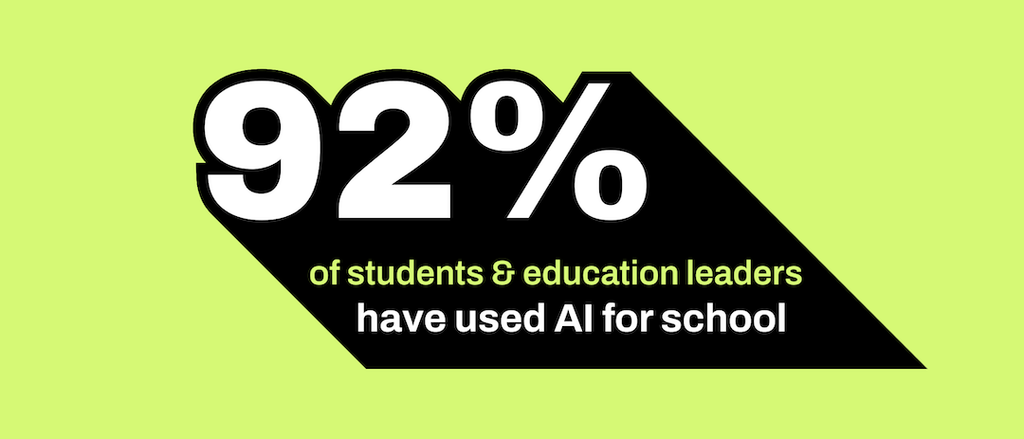
92% of students and education leaders have used AI for school
Source: Microsoft, AI in Education Report 2026
Student AI Use Around the World
Generative AI refers to tools such as ChatGPT that create text, images or other content from a prompt. Assessed work is coursework that counts toward a grade. These figures show student use in different countries.
2. 80% of undergraduates ages 18 to 21 in 15 countries have used generative AI to support their studies (Chegg, Global Student Survey 2025). Yonder Consulting surveyed 11,706 students online in October 2024.
3. 57% of undergraduates aged 18 to 21 in 15 countries who use generative AI for their studies ask it a question at least once a day (Chegg, Global Student Survey 2025). The share was 50% in Chegg’s 2023 survey.
4. 95% of undergraduates in Indonesia have used generative AI for their studies, versus 67% in the US and UK (Chegg, Global Student Survey 2025). Students were ages 18 to 21, surveyed in October 2024.
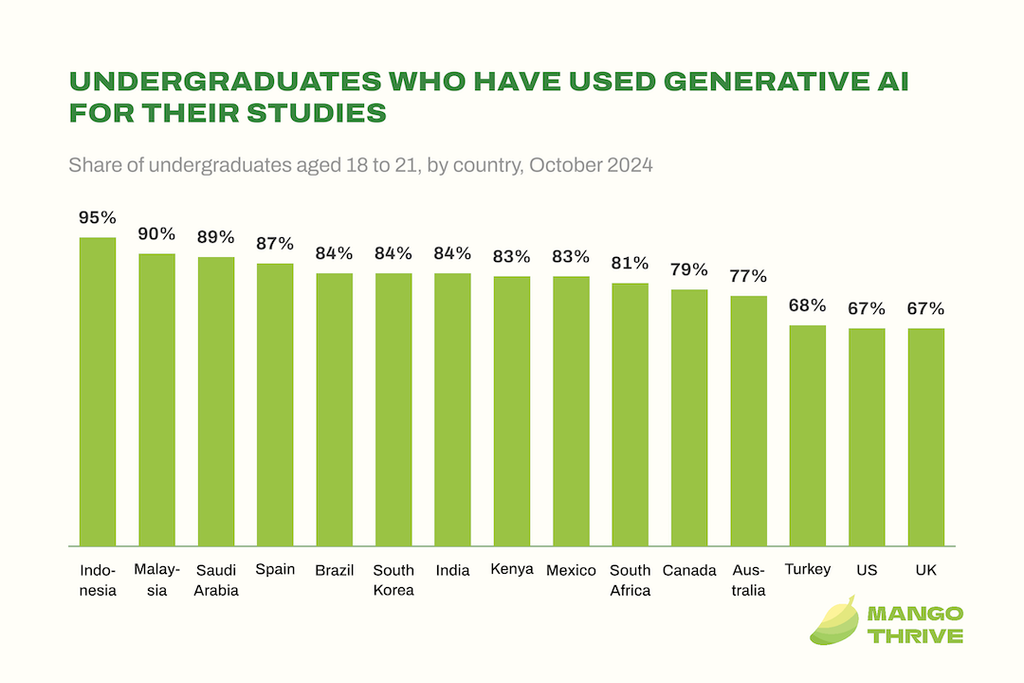
Bar chart of undergraduates who have used generative AI for their studies in 15 countries
Source: Chegg, Global Student Survey 2025, p. 12
In Eurostat’s household technology survey, “students” are one group within individuals ages 16 to 74.
5. 54.6% of students in the EU used generative AI tools for formal education in 2025 (Eurostat, isoc_ai_iaiu).
6. 87.8% of students in Malta used generative AI for formal education in 2025, versus 29.1% in Germany (Eurostat, isoc_ai_iaiu by country).
7. 95% of UK full-time undergraduates used AI in at least one way in the 2025-26 academic year, up from 66% in 2024 (HEPI/Kortext, Student Generative AI Survey 2026). The survey polled 1,054 full-time undergraduates through Savanta in December 2025.
8. 94% of UK full-time undergraduates have used generative AI to help with assessed work, up from 89% in 2025 (HEPI/Kortext, Student Generative AI Survey 2026).
How Many US Students Use AI?
These surveys cover high school students, teens and college students in the United States.
In College Board’s high school student survey, students “using GenAI tools” include those who said they use them often, sometimes or rarely.
9. 84% of US high school students reported using generative AI for schoolwork in May 2025, up from 79% in January (College Board, U.S. High School Students’ Use of GenAI).
10. 69% of US high school students reported using ChatGPT for school assignments and homework in May 2025 (College Board, U.S. High School Students’ Use of GenAI).
11. 64% of US teens ages 13 to 17 say they ever use AI chatbots (Pew Research Center, Teens, Social Media and AI Chatbots 2025). Pew surveyed 1,458 teens from Sept. 25 to Oct. 9, 2025.
12. About three in ten US teens ages 13 to 17 say they use AI chatbots every day (Pew Research Center, Teens, Social Media and AI Chatbots 2025). That includes 16% who use them several times a day or almost constantly.
13. 62% of US middle school, high school and college students reported using AI for homework help in December 2025, up from 48% in May (RAND, More Students Use AI for Homework). The December survey covered 1,214 enrolled youth ages 12 to 29; RAND notes that age eligibility differed slightly between the two surveys.
In Gallup’s Gen Z study, “generative AI” means technology that creates new content from your instructions, such as writing, brainstorming or creating images.
14. 56% of US Gen Z K-12 students say they use generative AI at least weekly (Gallup/Walton Family Foundation, Gen Z’s AI Adoption Steady, but Skepticism Climbs, 2026). Gallup surveyed 1,572 Americans ages 14 to 29 from Feb. 24 to March 4, 2026.
15. 42% of US college students reported daily or weekly personal use of generative AI tools in spring 2025, up from 14% in spring 2023 (Tyton Partners, Time for Class 2025). The student survey had 1,528 respondents.
What Do Students Use AI For?
Students use AI for more than writing. These figures show the tasks they bring to chatbots.
16. 54% of US teens ages 13 to 17 say they have used AI chatbots to get help with schoolwork (Pew Research Center, How Teens Use and View AI).
17. One in ten US teens ages 13 to 17 say they do all or most of their schoolwork with AI chatbots’ help (Pew Research Center, How Teens Use and View AI). Another 21% say some and 23% say a little.
18. 56% of UK full-time undergraduates used AI to generate text, for any purpose, in the 2025-26 academic year, down from 64% in 2025 (HEPI/Kortext, Student Generative AI Survey 2026). HEPI says generating text remains the most popular use of AI.
19. 61% of UK full-time undergraduates have used an AI assistant to explain concepts for assessed work (December 2025) (HEPI/Kortext, Student Generative AI Survey 2026). That was up from 36% in 2024.
20. 49% of UK full-time undergraduates have used generative AI to summarise a relevant article for assessed work (December 2025) (HEPI/Kortext, Student Generative AI Survey 2026).
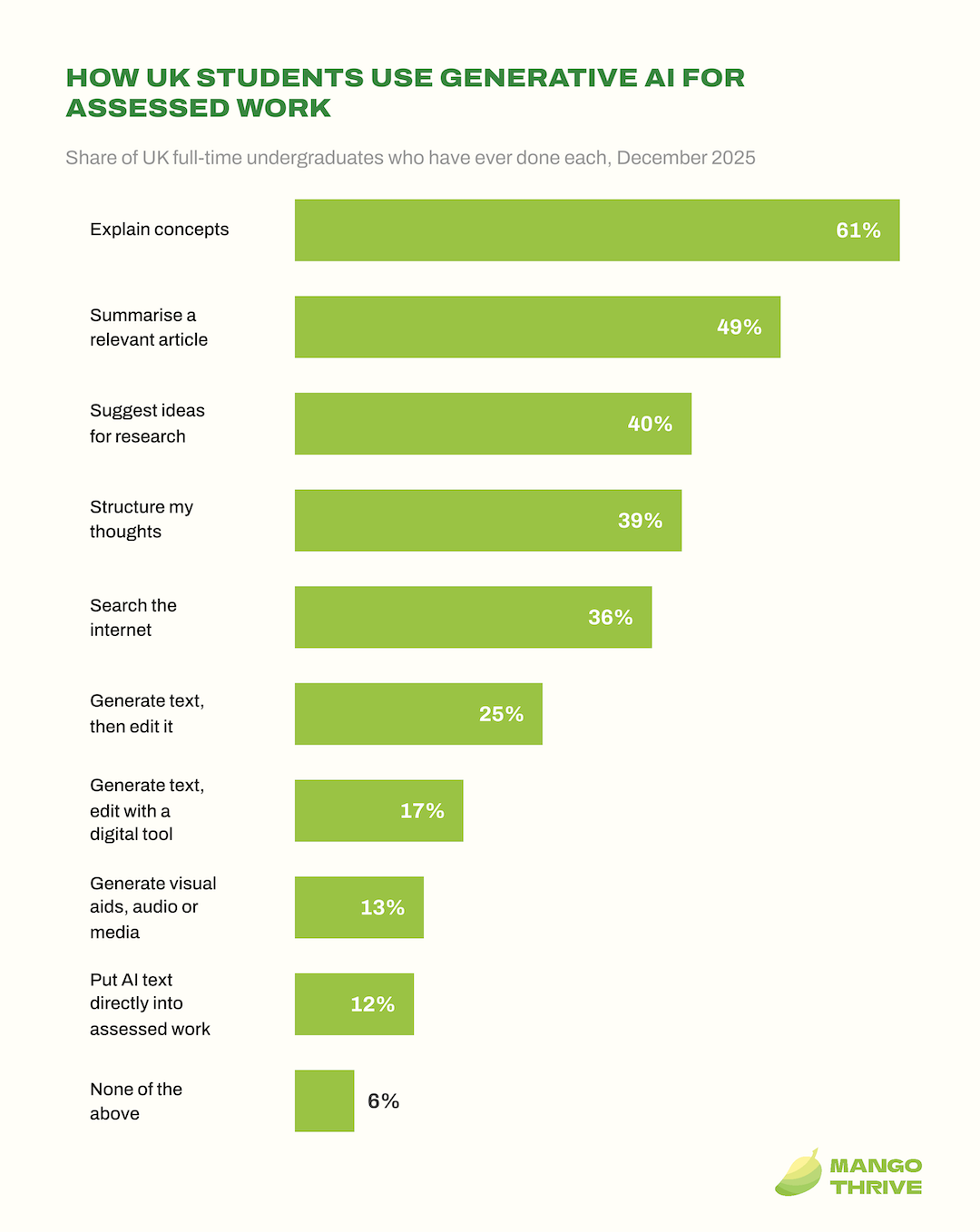
Bar chart of how UK full-time undergraduates use generative AI for assessed work
Source: HEPI/Kortext, Student Generative AI Survey 2026, p. 13
In Anthropic’s Education Report, “Direct” conversations are those where the user is looking to resolve their query as quickly as possible (Anthropic, Education Report).
21. 39.3% of student conversations on Claude.ai were about creating and improving educational content, Anthropic found in 2025 (Anthropic, Education Report: How university students use Claude). The analysis covered 574,740 academic conversations from accounts tied to higher education email addresses.
22. Nearly half (~47%) of students’ conversations with Claude were “Direct,” seeking answers or content with minimal engagement, in 2025 (Anthropic, Education Report: How university students use Claude).
How Many Teachers Use AI?
TALIS is the OECD’s Teaching and Learning International Survey. It covers lower secondary teachers, who teach students of roughly middle school age. These figures answer how many teachers use AI in their work.
In Gallup’s teacher survey, examples of “AI tools” included chatbots, adaptive learning systems and other interactive AI platforms.
23. 60% of US public K-12 teachers used an AI tool for their work in the 2024-25 school year (Gallup and Walton Family Foundation, Teaching for Tomorrow 2025). Use was higher among high school (66%) and early-career teachers (69%).
24. 32% of US public K-12 teachers used AI at least weekly in the 2024-25 school year (Gallup and Walton Family Foundation, Teaching for Tomorrow 2025). Another 28% used it infrequently, and 40% did not use it at all.
25. About half of US public K-12 teachers now use AI tools in their work, RAND’s Heather Schwartz said in August 2026 (RAND, Policy Minded podcast, Aug 2026). She said that is about double the rate from two years earlier.
26. 53% of US public school English, math and science teachers used AI for planning or teaching in spring 2025 (RAND, AI Use in Schools 2025). About 13% used it at least once a week.
27. 69% of US high school English, math and science teachers used AI for instructional planning or teaching in spring 2025 (RAND, AI Use in Schools 2025). The share was 64% for middle school and 42% for elementary teachers.
28. About 30% of US public school pre-kindergarten teachers used generative AI for their jobs in 2024-25 (RAND, Pre-K Teachers and Educational Technology 2025). Nine percent used it at least weekly.
29. On average across OECD countries, 36% of lower secondary teachers used AI in their work in 2024 (OECD, TALIS 2024 United States country note).
30. 75% of lower secondary teachers in Singapore used AI in their work in 2024 (OECD, TALIS 2024 Singapore country note).
31. 14% of lower secondary teachers in France used AI in their work in 2024 (OECD, TALIS 2024 France country note).
32. 43% of US lower secondary teachers used AI in their work in 2024 (OECD, TALIS 2024 United States country note).
33. Just 11% of teachers on the survey app Teacher Tapp had never used AI for work, it reported in October 2025 (Teacher Tapp, Oct 2025). A year earlier, 31% had never used it.
What Do Teachers Use AI For?
Teachers use AI for planning, materials and paperwork. These figures show the main tasks.
34. 37% of US public K-12 teachers use AI at least monthly when preparing to teach, its most common use (Gallup and Walton Family Foundation, Teaching for Tomorrow 2025). Fewer use it at least monthly to make worksheets (33%), make assessments (25%) or grade (16%).
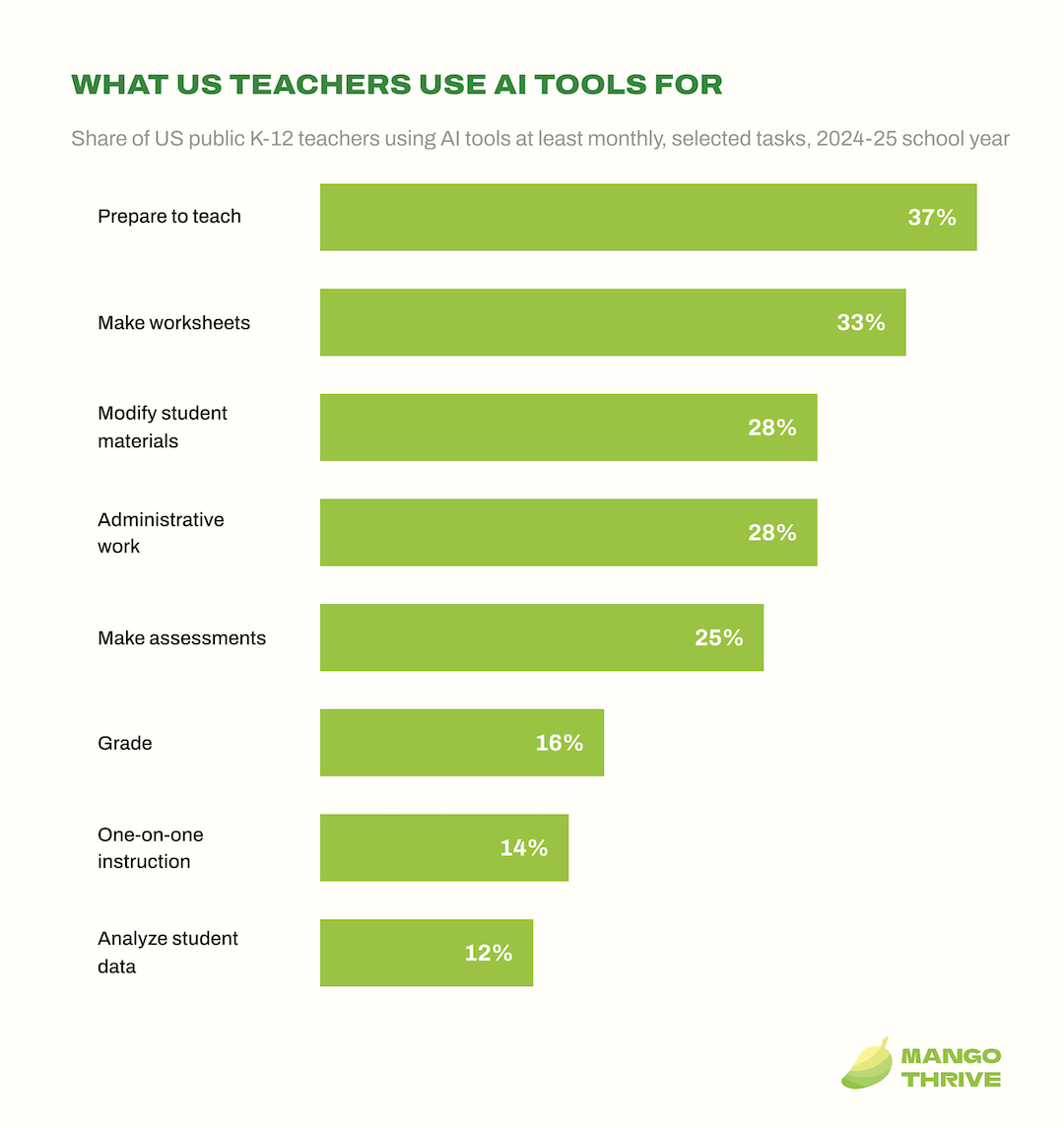
Bar chart of tasks US public K-12 teachers use AI tools for at least monthly
Source: Gallup and Walton Family Foundation, Teaching for Tomorrow 2025, p. 5
35. 5.9 hours a week is the average time US teachers who use AI at least weekly estimate it saves them (Gallup and Walton Family Foundation, Teaching for Tomorrow 2025). Over a school year, Gallup says this adds up to about six weeks.
36. 64% of US teachers who use AI to modify student materials say the quality improves (Gallup and Walton Family Foundation, Teaching for Tomorrow 2025). 57% of those using it for feedback and grading say quality improves.
37. On average, 73% of lower secondary teachers who use AI rely on it to learn about and summarize topics, per TALIS 2024 (OECD, TALIS 2024 press release). And 69% use it to generate lesson plans.
AI in College Teaching
These figures cover college instructors and other higher education staff.
38. 30% of US college instructors used generative AI daily or weekly in spring 2025, up from 4% in spring 2023 (Tyton Partners, Time for Class 2025).
39. 57% of the educator conversations Anthropic analyzed on Claude.ai were about developing curricula, in 2025 (Anthropic, Education Report: How educators use Claude). The analysis covered about 74,000 conversations from higher education professionals in May and June.
40. 48.9% of faculty grading conversations on Claude.ai in 2025 were automation-heavy, with AI directly performing the task (Anthropic, Education Report: How educators use Claude). Grading was a less frequent use than others.
AI Training and Guidance in Schools
Schools and districts are still building training and guidance on AI. These figures show where they stand, with a final figure covering students and educators in six countries.
41. 45% of US principals said their school or district had given any AI policy or guidance in 2024–25 (RAND, AI Use in Schools 2025). The survey covered 3,668 principals in March–April 2025.
42. 34% of US public school teachers said their school or district had generative AI policies on academic integrity in fall 2024 (RAND, AI Use in Schools 2025). Only 6% of all teachers described their school’s or district’s policies as clear and comprehensive.
43. 55% of US teachers said their school or district had offered training or resources on generative AI by fall 2024 (RAND, AI Use in Schools 2025). The share was 65% for high school teachers and 47% for elementary teachers.
44. 35% of US district leaders said their district trained students on AI as of spring 2025 (RAND, AI Use in Schools 2025). Only 19% of US middle and high school students said their teachers gave them guidance on using AI for schoolwork.
45. 48% of US school districts had trained teachers on AI by fall 2024, up from 23% in fall 2023 (RAND, More Districts Are Training Teachers on AI). The survey covered about 300 districts, weighted to be nationally representative.
In Gallup’s teacher survey, “formal guidance” means written policies or official guidance; “informal guidance” means verbal conversations or shared norms.
46. 18% of US public K-12 teachers received formal guidance from administrators on using AI for work in 2026 (Gallup–Walton Family Foundation, Teaching for Tomorrow 2026). About one-third (34%) received no guidance at all across 10 work tasks.
47. 38% of lower secondary teachers across the OECD took part in AI training, per TALIS 2024 (OECD, TALIS 2024 press release). Participation was highest in Singapore (76%) and lowest in France (9%).
48. 29% of teachers in TALIS 2024 said they need more training on using AI, more than for any other training topic surveyed (OECD, TALIS 2024 press release).
49. 77% of students and 53% of educators say they have not received formal AI training, according to Microsoft’s 2026 six-country AI in Education Report (Microsoft, AI in Education Report 2026).
AI at Colleges and Universities
These figures cover AI tools, training and policies at colleges and universities. UNESCO Chairs and UNITWIN Networks are UNESCO’s university partner programs.
50. 61% of US college chief technology officers said their institution gives students generative AI through an institutionwide license in 2026 (Inside Higher Ed, 2026 Survey of Campus CTOs/CIOs). That was more than double the 27% reported a year earlier.
51. 76% of university students in a 35-country survey had never joined AI literacy training offered by their institution in 2026 (Digital Education Council, AI in Higher Education Global Survey 2026). 47% were not aware such training existed.
52. 57% of university faculty in a 35-country survey had voluntarily taken AI literacy training offered by their institution in 2026 (Digital Education Council, AI in Higher Education Global Survey 2026). In the US and Canada, 29% of faculty were unaware of any such training, versus 15% globally.
53. 19% of respondents from UNESCO Chairs and UNITWIN Networks in 90 countries said their institution had a formal AI policy in 2025 (UNESCO, survey of UNESCO Chairs and UNITWIN Networks 2025). Another 42% said AI guiding frameworks were under development.
54. 23% of students at 30 UK higher education institutions said their institution provided AI systems, chatbots or assistants in 2024/25 (Jisc, Student Digital Experience Insights 2024/25). The survey drew 15,398 students.
55. More than 460,000 students across the 23-campus California State University system were set to get ChatGPT Edu in 2025 (CSU press release, Feb 4, 2025). The rollout also covered 63,000 faculty and staff.
What Are the Biggest Concerns About AI in Education?
Parents, students and teachers share some worries about AI. These figures show some common ones.
56. 61% of US parents of 12- to 17-year-olds agreed in early 2025 that more student AI use will harm critical-thinking skills (RAND, AI Use in Schools 2025). So did 55% of high school students and 48% of middle school students. Only 22% of district leaders, surveyed in late 2024, agreed.
57. 51% of US middle and high school students worry they might be accused of cheating with AI even if they did not (2025) (RAND, AI Use in Schools 2025). 16% were worried because they or someone they knew had been falsely accused.
58. 54% of US K-12 teachers say “AI makes it harder for students to learn critical thinking skills” describes their views extremely or very well (NPR/Ipsos, Teachers and AI poll 2026). Ipsos polled 545 teachers from April 27 to May 5, 2026.
59. Seven in 10 lower secondary teachers in OECD’s TALIS 2024 worry AI makes student plagiarism and cheating easier (OECD, TALIS 2024 press release).
60. 42% of UK full-time undergraduates say the risk of being accused of cheating by their institution makes them less likely to use AI for their studies (December 2025) (HEPI/Kortext, Student Generative AI Survey 2026). That was down from 53% in the 2025 survey.
61. 64% of UK parents of children aged 3-17 agree that children will rely on AI to do their schoolwork (Internet Matters, Me, Myself & AI 2025). The survey asked 2,000 parents; 62% also worry children might spend too much time using AI chatbots.
AI and Academic Integrity
These figures cover AI-written work and cheating cases.
62. 12% of UK full-time undergraduates say they have put AI-generated text directly into assessed work, up from 8% in 2025 and 3% in 2024 (HEPI/Kortext, Student Generative AI Survey 2026).
In Turnitin’s reports, an “AI writing score” below 20% is not shown, because Turnitin found more false positives in that range.
63. An average of 14.8% of English-language submissions to Turnitin’s AI detector had 80% or more AI-generated writing (Oct 2025–Feb 2026) (Turnitin, press release Feb 2026). The average was 3.3% in April–August 2023, with the original detector.
64. 19.4% of US higher education submissions to Turnitin’s AI detector scored above 80% AI writing (Oct 2025–Apr 2026) (Turnitin, Learning Integrity Insights Report Q2 2026). The rate was 9.8% in the UK and 10.2% in Australia.
65. UK universities recorded 5.1 proven cases of AI cheating per 1,000 students in 2023-24, up from 1.6 in 2022-23 (The Guardian, freedom of information investigation, 2025). The Guardian sent freedom of information requests to 155 universities; 131 provided some data.
Does AI Improve Learning?
Several studies below report effects in standard deviations, a common way to compare test results across studies. A randomized trial assigns people to groups by chance. A meta-analysis combines results from many studies, and publication bias means studies with positive results are more likely to be published. In active-learning classes, students work on problems during the lesson.
66. First-year senior secondary students in Benin City, Nigeria, scored 0.31 standard deviation higher than a control group after a six-week after-school GPT-4 tutoring program in 2024 (World Bank, From Chalkboards to Chatbots, 2025). The test covered English, AI knowledge and digital skills; the effect on English, the main outcome, was 0.23 standard deviations.
67. A six-week AI tutoring pilot in Nigeria produced learning gains that take 1.5 to 2 years of business-as-usual schooling, World Bank researchers say (World Bank, From Chalkboards to Chatbots, 2025).
68. Harvard physics students learned more with a custom AI tutor than in active-learning classes, an effect of 0.73 to 1.3 standard deviations (2023) (Kestin et al., Scientific Reports, 2025). The randomized crossover trial covered 194 undergraduates.
69. GPT-4 access raised high school practice-problem grades by 48% (standard chat) and 127% (tutor with safeguards) at a high school in Turkey in 2023 (Bastani et al., PNAS, 2025). The field experiment covered nearly 1,000 math students.
70. High school students who used a standard GPT-4 chat scored 17% lower once access was removed than peers who never had it (one high school in Turkey, 2023) (Bastani et al., PNAS, 2025). These negative effects were largely mitigated in the version with safeguards.
71. Students whose tutors were given access to the AI tool Tutor CoPilot were 4 percentage points more likely to master math topics in 2024 (Wang et al., Tutor CoPilot, Stanford, 2025). The randomized trial, in one Southern US school district, involved 900 tutors and 1,800 students from historically under-served communities.
72. A 2026 meta-analysis of 36 studies found a medium positive effect of generative AI on learning outcomes in higher education (Fan et al., Frontiers in Psychology, 2026). The studies covered 7,229 participants.
73. In a 2026 meta-analysis of 49 studies on generative AI in STEM learning, the overall positive effect “can be largely attributed to publication bias” (Boolzen et al., Artificial Intelligence Review, 2026).
Children, Parents and AI
Children use AI chatbots for school too. These figures cover children and the parents of teens.
In Ofcom’s survey, “AI” was explained to children as tools “that can answer your question or respond to instructions in a ‘human’ way, such as having a conversation with you.”
74. 56% of UK children aged 8-17 say they have used AI such as ChatGPT, Copilot or Gemini (Ofcom, Children and Parents: Media Use and Attitudes Report 2025-6). Ofcom reported 50% last year, but says trends are indicative due to changes in methodology.
75. Half (51%) of UK 8-17-year-olds who have used AI say they use it for schoolwork or homework (Ofcom, Children and Parents: Media Use and Attitudes Report 2025-6). Ofcom says this appears to have risen from 34% in 2023 and 45% in 2024, a trend it calls indicative.
76. Two-thirds (64%) of UK children aged 9-17 say they have used an AI chatbot (Internet Matters, Me, Myself & AI 2025). The survey covered a representative sample of 1,000 UK children, carried out in April and May 2025.
77. 42% of UK children aged 9-17 who use AI chatbots say they use them for help with schoolwork or homework (Internet Matters, Me, Myself & AI 2025). It was the most common reason, based on 638 children who had used at least one chatbot.
78. 51% of US parents of teens ages 13-17 said in fall 2025 that their teen uses AI chatbots (Pew Research Center, What Parents Say About Their Teen’s AI Use, 2026). About three in ten were not sure.
79. 58% of US parents of teens ages 13-17 would be OK with their teen using AI chatbots for schoolwork help in fall 2025 (Pew Research Center, Teens and AI topline, 2026). Another 23% would not be OK and 15% are not sure.
Teaching Jobs and AI Exposure
These figures cover how exposed teaching work is to AI and how teaching jobs are projected to change. The BLS describes postsecondary teachers as those who “instruct students in a variety of academic subjects beyond the high school level.”
In the ILO’s index, “Not Exposed” means occupations “where most tasks remain relatively unaffected by GenAI,” and “Minimal Exposure” means occupations “with low GenAI exposure, where some tasks show moderate automation potential, but overall occupational exposure remains limited.”
80. Primary school teachers score 0.26 on the ILO’s 2025 generative AI exposure index, in its “Not Exposed” group (ILO, Generative AI and Jobs: A Refined Global Index, 2025). Secondary teachers score 0.30, also Not Exposed; university teachers score 0.37, in “Minimal Exposure”.
In Microsoft Research’s study, the “AI applicability score” captures “if there is a non-trivial amount of AI usage that successfully completes activities relevant to an occupation.”
81. 0.31 is Microsoft Research’s AI applicability score for US postsecondary teachers, versus 0.18 for primary, secondary and special education teachers (Microsoft Research, Working with AI, 2025). Scores draw on 200,000 anonymized Bing Copilot conversations from 2024; Microsoft says relative comparisons matter more than absolute values.
82. University and secondary education teachers are among the 15 jobs with the largest projected net growth worldwide, 2025–2030 (WEF, Future of Jobs Report 2025). The ranking combines employer survey expectations with ILO employment data.
83. About 871,900 openings a year are projected in US educational instruction and library occupations, 2025–2035 (BLS, Occupational Outlook Handbook: educational instruction and library occupations). BLS projects employment to grow slower than average, with openings largely replacing workers who leave permanently.
84. Little or no change (0%) is projected in US kindergarten and elementary school teacher employment, 2025–2035 (BLS, Occupational Outlook Handbook: kindergarten and elementary school teachers). BLS still projects about 99,400 openings a year, on average, over the decade.
85. 7% growth is projected for US postsecondary teacher employment from 2025 to 2035 (BLS, Occupational Outlook Handbook: postsecondary teachers). BLS calls this much faster than the average for all occupations.
How Much Do People Use Chatbots for Learning?
AI companies publish data on how people use their chatbots. These figures show how much of that use relates to learning.
In OpenAI’s study, “tutoring or teaching” means “explaining concepts, teaching subjects, or helping the user understand educational material.”
86. 10.2% of consumer ChatGPT messages sampled from May 2024 to June 2025 were requests for tutoring or teaching (OpenAI, How People Use ChatGPT, 2025).
87. 12% of sampled Claude.ai conversations in August 2025 were matched to Educational Instruction and Library tasks, up from 9% (Anthropic Economic Index, September 2025 report). The 9% figure is from December 2024–January 2025.
88. More than 460 million US ChatGPT messages a week relate to classwork and homework at the school-year peak, OpenAI said in August 2026 (OpenAI, Learning never stops). They stay above 180 million a week in summer.
AI in Education Companies
ChatGPT Edu, Gemini for Education and Khanmigo are AI tools built for schools and universities. These figures come from the companies themselves.
89. Over 300,000 US K-12 educators and staff get ChatGPT for Teachers access and training through OpenAI’s school partnerships, as of August 2026 (OpenAI, Bringing ChatGPT for Teachers to more U.S. school districts). These partnerships cover more than 100 K-12 organizations across 30 states; the tool is free for verified US K-12 educators through June 2028.
90. Over 20,000 students and 4,600 teachers in Estonia are reached by a national ChatGPT Edu deployment, OpenAI said in May 2026 (OpenAI, The next phase of OpenAI’s Education for Countries).
91. More than 10 million US college students had access to Gemini for Education across over 1,000 institutions, as of September 2025 (Google, How Gemini for Education accelerates learning).
92. Khan Academy’s product tests covered more than 15 million Khanmigo tutoring threads from October 2025 to April 2026 (Khan Academy, How Khan Academy Is Building a Better AI Tutor).
93. 15 enrollments per minute went into Coursera’s generative AI courses in 2025, up from eight per minute in 2024 (Coursera, Q4 2025 Shareholder Letter). The catalog has more than 1,100 generative AI courses.
94. Chegg announced plans in 2025 to cut about 56% of its then-current workforce, citing challenges including student adoption of generative AI (Chegg, Form 10-K for fiscal 2025). That was approximately 640 employees.
AI in Education Market and Investment
These figures cover market size estimates from research firms and edtech venture funding. Deal volume means the number of deals.
95. $8.3 billion was Grand View Research’s valuation of the global AI in education market in 2025 (Grand View Research, AI in Education Market Report). It projects $57.2 billion by 2033.
96. $7.05 billion is Precedence Research’s figure for the global AI in education market in 2025 (Precedence Research, AI in Education Market). It predicts approximately $136.79 billion by 2035.
97. $2.21 billion was MarketsandMarkets’ projection for the global AI in education market in 2024 (MarketsandMarkets, AI in Education Market). It projects $5.82 billion by 2030.
98. $2.6 billion in venture capital went into edtech globally in 2025, up roughly 11% from 2024 (HolonIQ, EdTech hits $2.6B in investment).
99. $1 billion in global edtech venture funding was raised in the first half of 2026, down 26% from $1.35 billion a year earlier (HolonIQ, $1B in EdTech Venture Capital for 1H). Deal volume stayed stable.
Conclusion
AI is already part of studying and teaching for most students and many teachers. Training and clear guidance still trail that use. Research on learning effects points in different directions. We’ll update this page as new data comes out.