
AI on farms is more than chatbots. It includes sprayers that use cameras to spot weeds. It builds on older precision tools, such as tractors that steer themselves by satellite signal. Generative AI is the newest addition. Here are the latest statistics on who uses AI in agriculture, where the money goes and what field trials show.
Top AI in Agriculture Statistics
- 17% of farmers in McKinsey’s 10-country 2026 survey used gen AI for farm-related tasks (McKinsey, Global Farmer Insights 2026).
- 50% of farmers in the seven countries McKinsey surveyed in both 2024 and 2026 used at least one form of agtech in 2026, up four percentage points from 2024 (McKinsey, Global Farmer Insights 2026 full report).
- 22% of US farms used precision agriculture practices to manage crops or livestock in 2025, down from 27% in 2023 (USDA NASS, Technology Use 2025).
- 52% of US farmers said they saw no meaningful benefit from AI or data-driven farm tools in June 2026 (Purdue-CME Group, Ag Economy Barometer June 2026).
- $898 million was invested in farm robotics, mechanization and equipment startups in 2025, across 114 deals (AgFunder, Global AgriFoodTech Investment Report 2026).
- More than 5 million acres of farmland were covered by John Deere’s See & Spray technology in the 2025 growing season (John Deere, via Precision Farming Dealer).
- Over 600,000 DJI agricultural drones were deployed worldwide as of December 31, 2025 (DJI Agriculture, Agricultural Drone Industry Insight Report 2025/2026).
- 162 AI use cases were publicly reported by the US Department of Agriculture in the 2025 federal inventory (OMB, 2025 Federal Agency AI Use Case Inventory).
How Many Farmers Use AI?
1. 17% of farmers in McKinsey’s 10-country 2026 survey used gen AI for farm-related tasks (McKinsey, Global Farmer Insights 2026). Only 4% paid for these tools, which may include general AI subscriptions that are not farm specific.
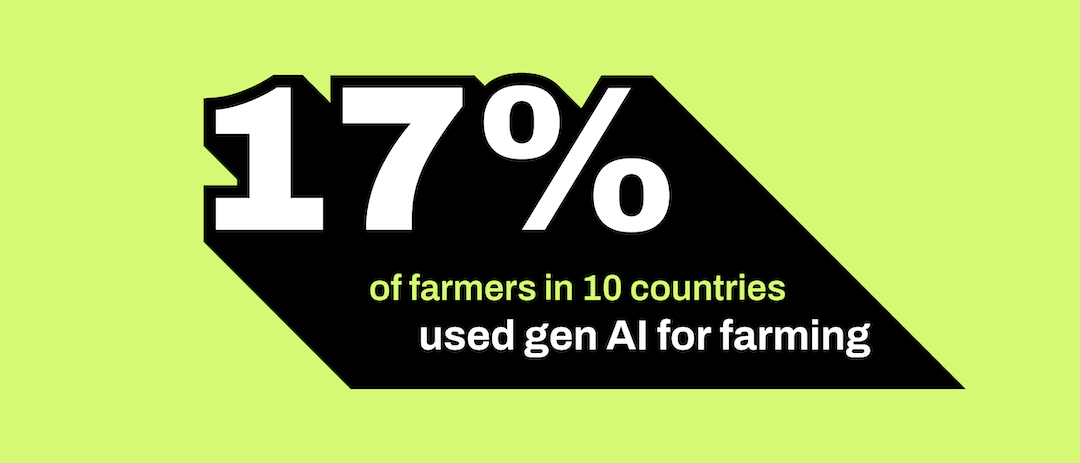
17% of farmers in 10 countries used gen AI for farm-related tasks in 2026
Source: McKinsey, Global Farmer Insights 2026, full report p. 24
McKinsey’s agtech figures below include precision tools that are not AI.
2. 50% of farmers in the seven countries McKinsey surveyed in both 2024 and 2026 used at least one form of agtech in 2026, up four percentage points from 2024 (McKinsey, Global Farmer Insights 2026 full report). McKinsey counts AI-enabled tools such as precision spraying as agtech, but not gen AI.
3. 31% of farmers used digital agronomy tools in 2026, the most widely used agtech category in McKinsey’s survey (McKinsey, Global Farmer Insights 2026 full report). Precision agriculture hardware was at 27%, remote sensing at 26%, farm management software at 24%, sustainability software at 7% and automation or robotics at 5%. These global figures cover the seven countries surveyed in both 2024 and 2026.
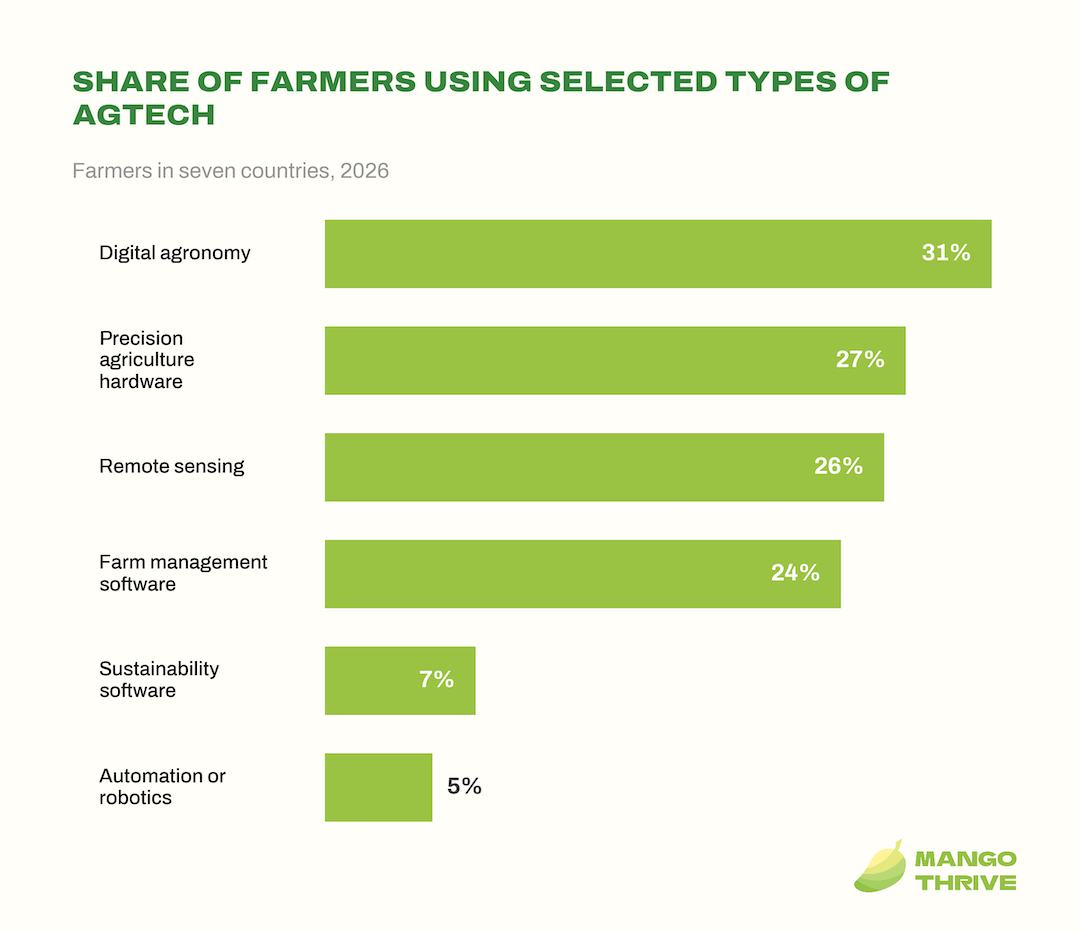
Share of farmers using selected types of agtech, 2026
Source: McKinsey, Global Farmer Insights 2026, full report p. 22. Global figures cover the seven countries surveyed in both 2024 and 2026.
How Are Farmers Using Generative AI?
Generative AI tools are chatbots and assistants that write answers to questions. These figures come from McKinsey’s latest global survey of farmers.
4. 26% of farmers in Latin America used gen AI for farm tasks in 2026, versus 23% in North America (McKinsey, Global Farmer Insights 2026 full report). Europe was at 13% and Asia at 7%.
5. 11% of US farmers reported using paid gen AI tools in 2026 (McKinsey, Global Farmer Insights 2026 full report). McKinsey says that matches the adoption level of variable-rate technology (equipment that changes seeding, pesticide or fertilizer rates across a field) within five years of its launch.
6. 43% of farmers who use gen AI use it for planning, the top use case in McKinsey’s 2026 survey (McKinsey, Global Farmer Insights 2026 full report). Crop management came second at 33%.
7. 72% of farmers expect gen AI to have at least some impact on their farm operations in the next three to five years (McKinsey, Global Farmer Insights 2026 full report). That includes 15% who expect a significant impact.
8. 6% of farmers in McKinsey’s 2026 survey named gen AI tools or AI search as a trusted source for decision-making (McKinsey, Global Farmer Insights 2026). The figure covers the seven countries surveyed in both 2024 and 2026.
What Do US Farmers Think About AI?
The Purdue-CME Group Ag Economy Barometer surveys US farmers every month. Several recent surveys asked about AI.
9. 52% of US farmers said they saw no meaningful benefit from AI or data-driven farm tools in June 2026 (Purdue-CME Group, Ag Economy Barometer June 2026). About 23% named higher production as the main benefit.
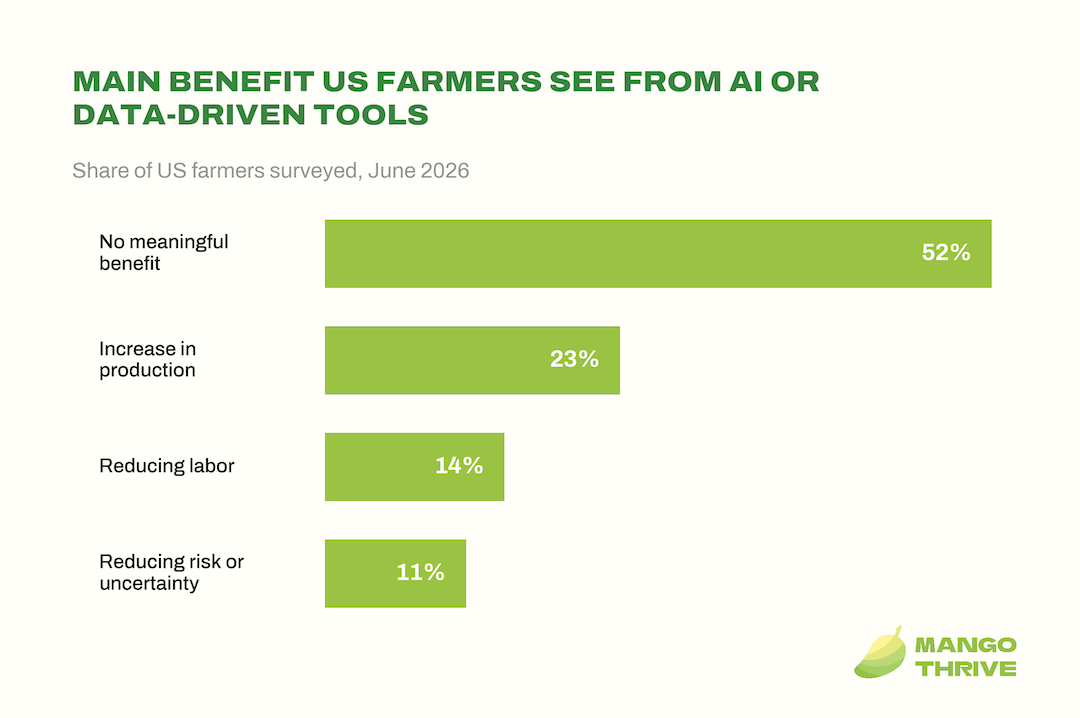
Main benefit US farmers see from AI or data-driven tools, June 2026
Source: Purdue-CME Group, Ag Economy Barometer June 2026, Figure 5
10. 22% of US farmers said recommendations from data-driven tools would often be difficult to follow in June 2026 (Purdue-CME Group, Ag Economy Barometer June 2026). About 63% said they would sometimes be difficult to follow.
11. About 59% of US farmers said AI tools would not improve their labor and equipment situation in May 2026 (Purdue-CME Group, Ag Economy Barometer May 2026). Another 37% expected some help, and 4% expected a lot.
12. 32% of US farmers named strategic planning as the farm skill AI could improve most in August 2026 (Purdue-CME Group, Ag Economy Barometer August 2026). Financial management and analysis came second at 28%.
How Many US Farms Use Precision Agriculture?
Precision agriculture uses data, sensors and guided machines to manage fields and animals.
In USDA NASS’s farm technology survey, “precision agriculture practices” include GPS guidance, yield monitoring, soil mapping, variable rate inputs, drones, electronic tagging, precision feeding and robotic milking.
13. 22% of US farms used precision agriculture practices to manage crops or livestock in 2025, down from 27% in 2023 (USDA NASS, Technology Use 2025).
The US Department of Agriculture also tracks adoption by farm size. Many figures below compare family farms by size.
In USDA ERS reports, small family farms have gross cash farm income under $350,000 a year, midsize family farms $350,000 to $999,999, and large-scale family farms $1,000,000 or more.
In USDA ERS reports, “guidance autosteering” means systems that use satellite signals to steer tractors and harvesters automatically.
14. 70% of large-scale US family crop farms used guidance autosteering in 2023, compared with 9% of small family farms (USDA ERS, America’s Farms and Ranches at a Glance 2024). Midsize family farms were at 52%.
In USDA ERS reports, “yield monitors” are in-cab screens that map crop yields in real time during harvest.
15. 68% of large-scale US family crop farms used yield monitors, yield maps or soil maps in 2023, compared with 13% of small family farms (USDA ERS, America’s Farms and Ranches at a Glance 2024).
In USDA ERS reports, “variable rate technologies” let farmers change seeding, pesticide or fertilizer rates across a field in real time.
16. 45% of large-scale US family crop farms used variable rate technology in 2023, against 5% of small family farms (USDA ERS, America’s Farms and Ranches at a Glance 2024). Midsize family farms were at 32%.
17. 12% of large-scale US crop-producing family farms used drones in 2023 (USDA ERS, America’s Farms and Ranches at a Glance 2024). Among nonfamily farms the share was 13%.
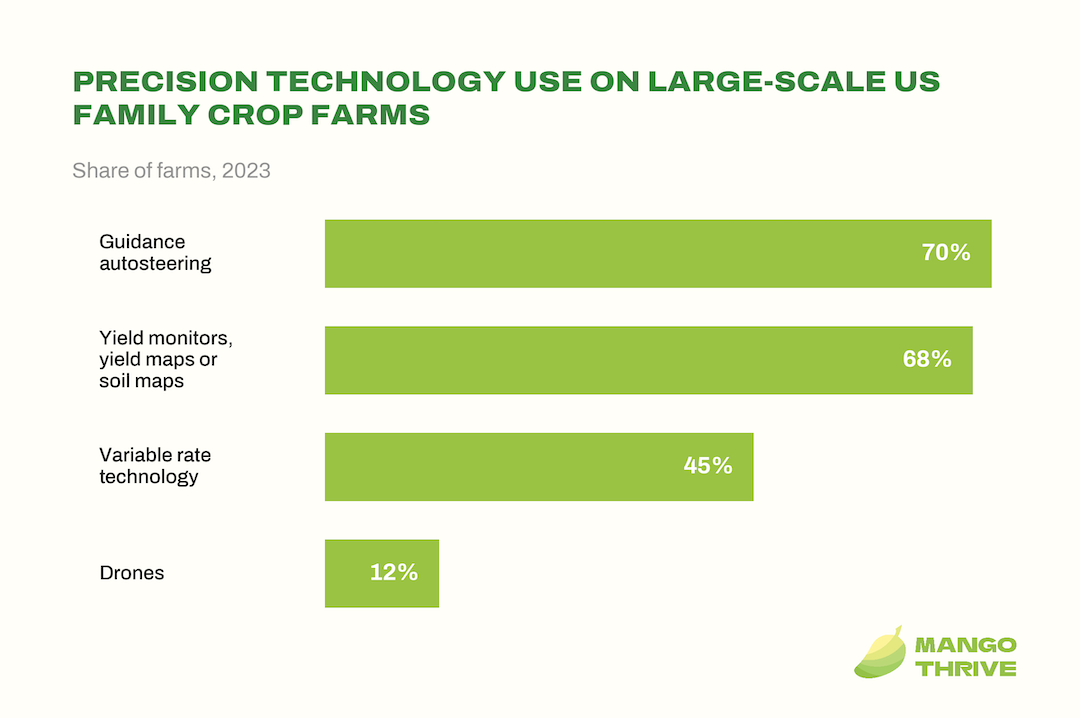
Precision technology use on large-scale US family crop farms, 2023
Source: USDA ERS, America’s Farms and Ranches at a Glance 2024, Figure 10
18. 64% of US farms using autosteering named reduced operator fatigue as a reason for adopting it in 2023 (USDA ERS, America’s Farms and Ranches at a Glance 2024). Half of farms using autosteering named saving labor time.
19. 62% of US farms using variable rate technology named cutting purchased input costs as a reason for adopting it in 2023 (USDA ERS, America’s Farms and Ranches at a Glance 2024).
20. 19% of large-scale US family farms producing milk used robotic milking in 2023 (USDA ERS, America’s Farms and Ranches at a Glance 2024). Wearable livestock technology use ranged from 1% of small family farms to 12% of large-scale family farms.
In USDA ERS dairy research, “box” robots are automated milking systems with a box-like appearance (USDA ERS, Precision Dairy Farming, Robotic Milking, and Profitability, 2026).
21. Only 6% of US milk came from cows milked by robotic “box” systems in 2021 (USDA ERS, Precision Dairy Farming, Robotic Milking, and Profitability, 2026).
22. 13% higher dairy net returns came from using robotic “box” milking on US dairies, compared with nonadopters, USDA ERS estimates from 2000–2021 survey data (USDA ERS, Precision Dairy Farming, Robotic Milking, and Profitability, 2026).
23. At least 90% of US milk in 2021 came from farms using records for each cow, diets designed by a nutritionist, or reproduction technologies such as sexed semen (USDA ERS, Precision Dairy Farming, Robotic Milking, and Profitability, 2026).
How Many US Farms Are Online?
These figures come from the US Department of Agriculture’s farm technology survey.
24. 85% of US farms had internet access in 2025 (USDA NASS, Technology Use 2025).
25. 82% of US farms had a smartphone in 2025, and 68% had a desktop or laptop computer (USDA NASS, Technology Use 2025).
26. 74% of US farms reached the internet through a cellular data plan in 2025, and 55% through broadband (USDA NASS, Technology Use 2025). Farms could report more than one type of access.
27. 50% of US farms bought agricultural inputs online in 2025 (USDA NASS, Technology Use 2025). Also, 29% used the internet for agricultural marketing activities, such as direct sales, online auctions or commodity price tracking.
Precision Farming in Europe and Canada
In Eurostat farm statistics, “farm management information systems” are digital platforms for farm operations, and “robotics” means machines that operate without direct human intervention.
28. About 43% of EU farms had internet access in 2023 (Eurostat, 43% of EU farms with internet access). In Denmark, Germany, Slovakia, Latvia, Czechia and Austria, the rate was above 90%.
29. Around 18% of EU farms used some precision farming technology or practice in 2023 (Eurostat, 43% of EU farms with internet access). These farms managed about 44% of the EU’s farmland (utilised agricultural area).
30. About 11% of EU farms used farm management information systems in 2023, and about 7% used robotics (Eurostat, 43% of EU farms with internet access). France had the highest adoption of farm management information systems, at about 60%.
31. 50,917 Canadian farms reported using auto-steer in the 2021 Census of Agriculture (Statistics Canada, Technologies used on the operation). In the same census, 6,781 farms reported using drones.
How Much Money Goes Into Agrifood Tech Startups?
Agrifood tech startups build technology for farming and food. AgFunder tracks the money they raise each year. Its totals include grocery and restaurant tech, not only farm tech.
32. $16.2 billion went into agrifood tech startups worldwide in 2025, down 3% from 2024 (AgFunder, Global AgriFoodTech Investment Report 2026).
33. 2,031 funding deals closed in agrifood tech in 2025, down 12.2% from 2,312 in 2024 (AgFunder, Global AgriFoodTech Investment Report 2026).
34. $5.9 billion went to US agrifood tech startups in 2025, down 8% from 2024, across 507 deals (AgFunder, Global AgriFoodTech Investment Report 2026).
In AgFunder’s reports, “Farm Robotics, Mechanization & Equipment” means on-farm machinery, automation, drone makers and grow equipment (AgFunder, Global AgriFoodTech Investment Report 2026).
35. $898 million was invested in farm robotics, mechanization and equipment startups in 2025, across 114 deals (AgFunder, Global AgriFoodTech Investment Report 2026). Funding in this category was $859 million in 2021, $791 million in 2022, $805 million in 2023 and $837 million in 2024.
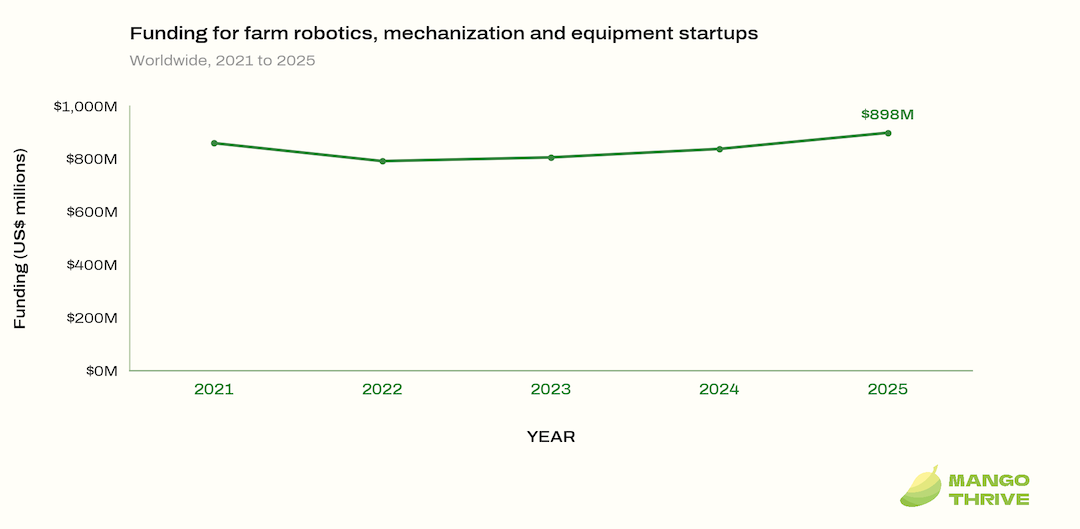
Funding for farm robotics, mechanization and equipment startups, 2021 to 2025
Source: AgFunder, Global AgriFoodTech Investment Report 2026, p. 36
In AgFunder’s 2026 report, “deeptech” means companies whose core competitive advantage comes from scientific or engineering innovation (AgFunder, Global AgriFoodTech Investment Report 2026).
36. $0.6 billion of 2025 farm robotics funding went to deeptech startups, across 71 deals (AgFunder, Global AgriFoodTech Investment Report 2026).
37. $105 million for Switzerland’s Ecorobotix (Series D) topped AgFunder’s list of the top five farm robotics deals of 2025 (AgFunder, Global AgriFoodTech Investment Report 2026). Ecorobotix focuses on AI-guided precision crop treatment.
38. Startups in the Americas took 43% of farm robotics funding across the Americas, Asia and Europe in 2025 (AgFunder, Global AgriFoodTech Investment Report 2026). Asia and Europe each took 28%.
In AgFunder’s reports, “Farm Management Software, Sensing & IoT” means farm data-capture devices, decision-support software and big data analytics (AgFunder, Global AgriFoodTech Investment Report 2026).
39. $1.4 billion went to farm management software, sensing and IoT startups in 2025, across 221 deals (AgFunder, Global AgriFoodTech Investment Report 2026).
Farm AI by the Numbers: John Deere, Carbon Robotics, Syngenta and AGCO
Most figures below come from the companies themselves. John Deere’s See & Spray uses cameras to spot weeds and spray only where they grow. Non-residual herbicides do not keep working in the soil after they are sprayed.
40. More than 5 million acres of farmland were covered by John Deere’s See & Spray technology in the 2025 growing season (John Deere, via Precision Farming Dealer).
41. Nearly 50% less non-residual herbicide was used on average by John Deere customers with See & Spray in 2025, Deere says (John Deere, via Precision Farming Dealer). The company says this saved nearly 31 million gallons of herbicide mix.
Broadcast spraying covers the whole field, whether or not weeds are there.
42. 59% average herbicide savings were reported by John Deere for See & Spray on US corn, soybean and cotton fields in 2024 (John Deere, See & Spray 59 Percent Herbicide Savings). Deere calls See & Spray AI-powered weed-sensing technology and measures the savings against broadcast spraying.
43. Over 510,000 hectares were covered by US producers’ See & Spray machines in 2023–2024, and 212,000 hectares of that were sprayed (Agrosystems, Geosciences & Environment, 2026). The figures come from a 2026 peer-reviewed study.
In-crop acres have a growing crop on them. Fallow acres are left unplanted.
44. $5 per in-crop acre was John Deere’s See & Spray fee in 2025 under its Application Savings Guarantee, or $1 per fallow acre (John Deere, via Precision Farming Dealer). Farmers pay it when the technology delivers measurable savings.
In John Deere’s reporting, “engaged acres” means unique acres with at least one field operation logged in its Operations Center software in the past 12 months (Deere & Company, Leap Ambitions 2025).
45. 600 million engaged acres on its Operations Center software is John Deere’s target for 2030 (Deere & Company, Leap Ambitions 2025).
46. More than $100 million in annual revenue was reported by laser-weeding robot maker Carbon Robotics for its fiscal year ended January 2026 (Carbon Robotics, CFO Appointment and Growth Milestone).
47. 150 million labeled plants were used to train Carbon Robotics’ plant-recognition AI model launched in February 2026 (Carbon Robotics, Large Plant Model launch).
48. Nearly 76 million hectares in more than 30 countries are covered by Syngenta’s Cropwise platform, as of 2026 (Syngenta Group, Making agricultural intelligence happen). Syngenta says the coverage figure is independently audited by KPMG.
49. About $1.95 billion in cash, before adjustments, was AGCO’s agreed payment to Trimble in the April 2024 deal that gave AGCO an 85% stake in precision-farming venture PTx Trimble (AGCO, 2025 Form 10-K).
Drones and Farm Robots
DJI makes farm drones. Its annual report counts the drones its customers use.
50. Over 600,000 DJI agricultural drones were deployed worldwide as of December 31, 2025 (DJI Agriculture, Agricultural Drone Industry Insight Report 2025/2026).
51. An estimated 400,000 DJI agricultural drones were in use worldwide at the end of 2024, up 90% from 2020 (DJI, fourth annual Agricultural Drone Industry Insight Report).
52. About 410 million tons of water had been saved by DJI agricultural drones by the end of 2025, DJI estimates (DJI Agriculture, Insight Report 2025/2026).
53. About 51 million tons of CO2 emissions were avoided by DJI agricultural drones by the end of 2025, per DJI (DJI Agriculture, Insight Report 2025/2026).
54. DJI agricultural drones were used on more than 300 crop types in 2025 (DJI Agriculture, Insight Report 2025/2026). DJI says its agriculture operations have reached more than 100 countries and regions.
55. Close to 19,500 agricultural service robots were sold worldwide in 2024, down 6% from 2023 (IFR, World Robotics 2025 – Service Robots).
What Do Field Trials Show?
University and journal studies test AI and precision tools on real fields. Each result below applies only to the crop and place tested.
Postemergence herbicides are sprayed after weeds come up.
56. 28.4% to 62.4% less postemergence herbicide was used with See & Spray in Arkansas and Mississippi soybean trials (Weed Technology, 2024). Weed control was 93% or higher, with no more than a 1% decrease compared with broadcast spraying.
In the Nebraska precision-sprayer study, “precision sprayers” are sprayers with cameras and sensors that detect weeds in real time and spray only where needed (Agrosystems, Geosciences & Environment, 2025).
57. Herbicide savings ranged from 1% to 94% for precision sprayers in Nebraska corn (2022) and soybean (2023) trials (Agrosystems, Geosciences & Environment, 2025). Savings depended on how many weeds were present; yields matched broadcast spraying.
58. 43% to 59% less herbicide could be used with a See & Spray prototype than with broadcast spraying, a three-year Arkansas soybean trial indicates (University of Arkansas System Division of Agriculture, 2025). At a low sensitivity setting, which sprays only larger weeds, populations of Palmer amaranth (a weed) in the trial rose 280% each year.
Subsurface drip irrigation uses water lines buried below the soil. The AI-radar system in the next study combines artificial intelligence with ground-penetrating radar to guide irrigation.
59. 23.5% to 25.1% less irrigation water was used by an AI-radar system than subsurface drip on a central Kansas corn farm (Agricultural & Environmental Letters, 2025). Crop water stress was also lower under the AI system.
AI and Digital Farm Tools in India
India’s government runs several AI and digital tools for farmers. Most figures below come from Indian government releases. The FarmerChat figure comes from Digital Green, which runs the app. Extension workers are farm advisers who work directly with farmers. Kharif is India’s monsoon crop season.
60. More than 9.3 million farmer queries were answered by India’s Kisan e-Mitra AI chatbot as of December 2025 (PIB, AI Transforming Indian Agriculture).
61. Over 10,000 extension workers used India’s AI-based National Pest Surveillance System as of December 2025 (PIB, AI Transforming Indian Agriculture). It covers 66 crops and more than 432 pest species.
62. Over 38.8 million farmers in 13 Indian states received AI-based monsoon onset forecasts by SMS in a Kharif 2025 pilot (PIB, AI Transforming Indian Agriculture).
63. FarmerChat passed 1 million users in India by August 2026, Digital Green India says (Digital Green, via Rural Voice). The AI-powered farm advice app counts farmers and frontline extension workers, and has been available since October 2024.
In Indian government releases, “AgriStack” is a digital public infrastructure of three state-run registries: village maps, crops sown and farmers.
64. ₹2,817 crore (₹28.17 billion) is the outlay of India’s Digital Agriculture Mission, which the Union Cabinet approved in September 2024 (PIB, Cabinet approves Digital Agriculture Mission). The central government’s share is ₹1,940 crore (₹19.40 billion).
65. Over 92 million Farmer IDs (9.20 crore) had been created under India’s AgriStack as of March 19, 2026 (PIB, AgriStack Farmers Registry).
Government Funding and Use of AI in Agriculture
US federal agencies publish a yearly list of the ways they use AI.
66. 162 AI use cases were publicly reported by the US Department of Agriculture in the 2025 federal inventory (OMB, 2025 Federal Agency AI Use Case Inventory).
67. 86 USDA AI use cases were deployed or in pilot in the 2025 federal inventory (OMB, 2025 Federal Agency AI Use Case Inventory).
68. About $20 million over five years was awarded to each of 11 new National Science Foundation (NSF) AI research institutes in 2021, including two agriculture institutes funded by USDA’s National Institute of Food and Agriculture (NIFA) (USDA NIFA, $220M AI Research Institutes release).
In European Commission materials, the AI “Testing and Experimentation Facilities” are open to technology providers across Europe to test and experiment with AI and robotics.
69. €220 million worth of investment in four EU AI testing facilities, including one for agri-food, was launched in June 2023 (European Commission, EU invests €220 million to test AI). The Commission co-funds them with €110 million over five years.
70. €30 million in EU co-funding supports AgrifoodTEF, a five-year agri-food AI testing project started in 2023 (European Commission, AgrifoodTEF success story). It has 34 partners in 9 countries.
71. More than 200 AI services are listed in the EU AgrifoodTEF catalogue to help companies develop, test and roll out AI and robotic products, according to a Commission fact page updated in January 2025 (European Commission, AgrifoodTEF success story).
72. £20 million was offered in England’s 2026 Farming Futures Automation and Robotics competition, part of the Farming Innovation Programme (Defra Farming blog, Apply now for automation and robotics funding). It funds joint projects that help farmers, growers and foresters improve productivity and manage labour pressures.
73. $30 million (CAD) will go to agrifood AI projects through Protein Industries Canada’s AI program by March 2028 (Protein Industries Canada, Artificial Intelligence program).
74. $33.1 million (CAD) had been committed to seven Canadian agrifood AI projects, counting industry money, by March 2025 (Protein Industries Canada, Annual Report 2024-25). About $15 million of that came from the program itself.
75. 36 AI-related intellectual property assets are listed in Protein Industries Canada’s 2024-25 annual report, alongside seven AI projects (Protein Industries Canada, Annual Report 2024-25).
AI in Agriculture Market Size Estimates
Research firms publish their own estimates of the AI in agriculture market. Each firm’s figure is listed separately below.
76. USD 3.11 billion is Mordor Intelligence’s estimate for the global AI in agriculture market in 2026 (Mordor Intelligence, AI in Agriculture Market). The firm forecasts USD 8.39 billion by 2031.
77. USD 2.57 billion was Precedence Research’s estimate for the global AI in agriculture market in 2025 (Precedence Research, Artificial Intelligence in Agriculture Market). The firm projects about USD 20.12 billion by 2035.
78. USD 2.6 billion was IMARC Group’s valuation of the global AI in agriculture market in 2025 (IMARC Group, AI in Agriculture Market). IMARC expects USD 13.0 billion by 2034.
79. USD 2.58 billion was Straits Research’s valuation of the global AI in agriculture market in 2025 (Straits Research, AI in Agriculture Market). Straits projects USD 16.18 billion by 2034.
80. USD 4.21 billion was Global Market Insights’ valuation of the global AI in agriculture market in 2025 (Global Market Insights, AI in Agriculture Market). GMI projects USD 23.93 billion by 2035.
81. USD 9.55 billion is Grand View Research’s forecast for the global AI in agriculture market by 2030, in a December 2024 release (Grand View Research, AI in Agriculture press release).
82. USD 701.61 million was Precedence Research’s estimate for the US AI in agriculture market in 2025 (Precedence Research, Artificial Intelligence in Agriculture Market). The firm projects about USD 5.68 billion by 2035.
The next estimate covers all digital farm tools in low- and middle-income countries, not only AI.
83. About US$500 billion a year could be added to agriculture in low- and middle-income countries by 2033 through digital agriculture, Beanstalk AgTech estimated in a 2023 report (Beanstalk AgTech, State of the Digital Agriculture Sector). That would be a 28% increase in the value of agricultural output across the report’s focus regions under its “thriving” scenario.
Conclusion
Precision tools such as self-steering tractors are already common on large US farms. AI-guided sprayers now cover millions of acres. Generative AI is the newest layer, and few farmers pay for it yet. We’ll update this page as new data comes out.