
70 Local SEO Statistics for 2026
Finding a plumber or a dentist often starts with a search. That search can now happen on Google, in a map app, on social media or in an AI chatbot. Reviews, business profiles and listings feed many of these tools. This page covers how people search for local businesses, how they use reviews, what shapes local rankings and how AI tools choose which businesses to show.
Top Local SEO Statistics
- 52% of US consumers started their latest local business search on Google Search in 2026 (BrightLocal, Consumer Search Behavior 2026).
- 45% of US consumers used ChatGPT or other AI tools for local business recommendations in 2026, up from 6% in 2025 (BrightLocal, Local Consumer Review Survey 2026).
- 71% of US consumers used Google for business reviews and recommendations in 2026, down from 83% in 2025 (BrightLocal, Local Consumer Review Survey 2026).
- 41% of US consumers “always” read reviews when browsing for businesses in 2026, up from 29% in 2025 (BrightLocal, Local Consumer Review Survey 2026).
- Local search experts estimate 32% of local pack and Maps ranking weight comes from Google Business Profile signals (2026) (Whitespark, Local Search Ranking Factors 2026).
- 68% of local business-related queries tested in three US cities showed a Google AI Overview (2025) (Whitespark, AI Overviews in local search).
- AI tools recommended US brand locations 17.6% of the time on average (2025) (SOCi, The Factors Driving AI Visibility).
- Over 292 million policy-violating reviews were blocked or removed from Google Maps in 2025 (Google, Protecting businesses on Maps 2026).
Where Do People Search for Local Businesses?
1. 52% of US consumers started their latest local business search on Google Search in 2026 (BrightLocal, Consumer Search Behavior 2026). A further 9% started on Google Maps. The survey covered 1,227 US consumers who had searched online for a local business in the last three months.
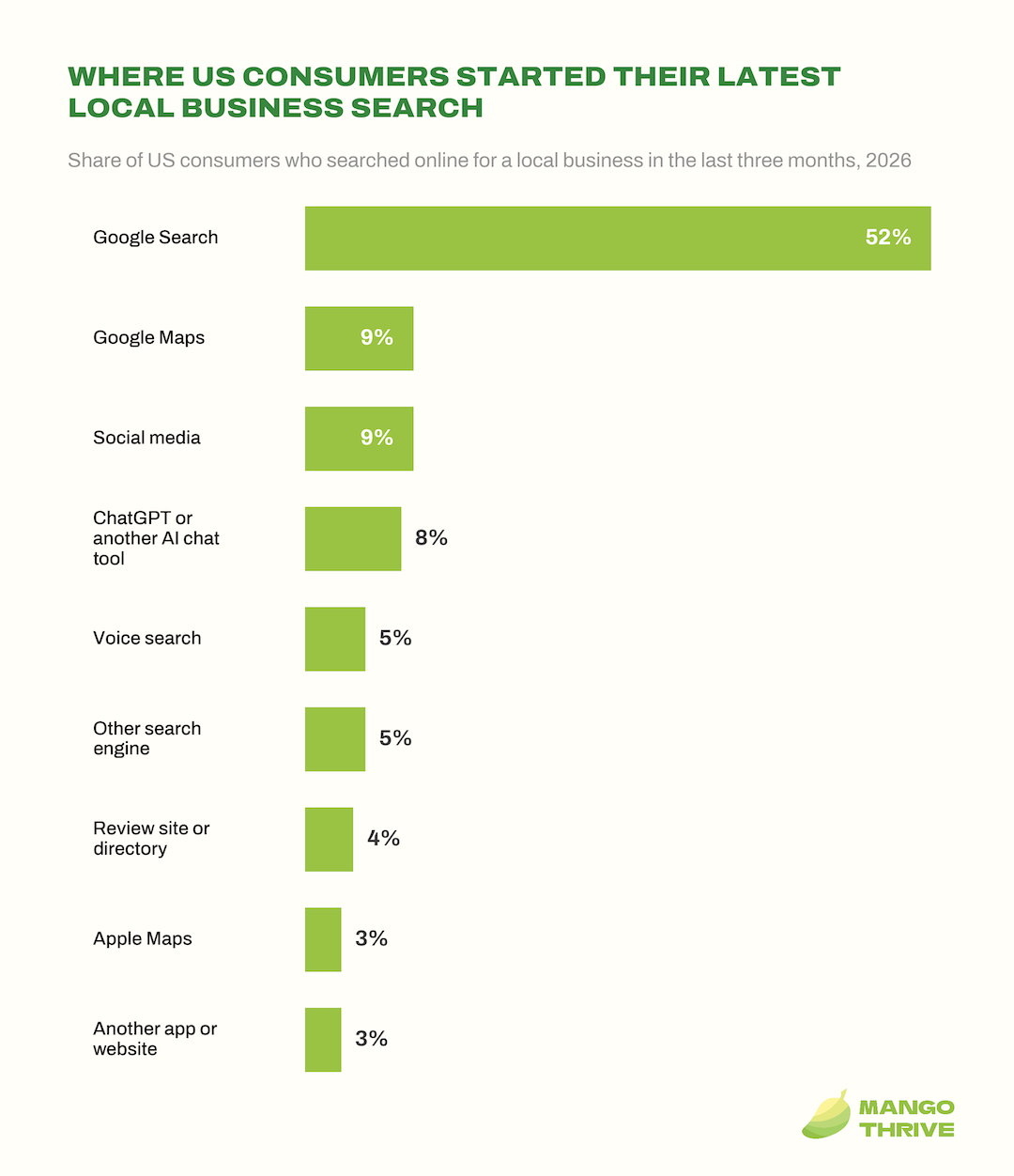
Where US consumers started their latest local business search, 2026
Source: BrightLocal, Consumer Search Behavior 2026
Local Search Behavior Statistics
These figures show how often people look for local businesses and which platforms they use.
2. 39% of US consumers estimate that at least 41% of their searches are about local businesses (2025) (BrightLocal, Consumer Search Behavior 2025). This is a self-estimate from a survey of 1,000 US consumers.
3. 83% of consumers still use traditional search engines to search, and 73% use social media (2025) (SOCi, Consumer Behavior Index 2025). Navigation apps are used by 58%.
4. 40% of US adults start their search for local business recommendations on social media (2026) (Yext, US findings 2026). Only Google, at 59%, is a more common starting point.
5. 26% of US Gen Z consumers use social media as their main way to search locally (2025) (BrightLocal, Consumer Search Behavior 2025). TikTok is the default for 10% of Gen Z, the only generation where it makes the top three.
6. 67% of US consumers often or always check business reviews after a local search (2025) (BrightLocal, Consumer Search Behavior 2025).
Google Maps and Google Business Profile Statistics
Google Business Profile is the free listing a business gets on Google Search and Maps. Some of the figures below come from Google itself. Others come from the UK regulator Ofcom and from Birdeye’s data on large brands.
7. More than 2 billion users turn to Google Maps each month, Google said in February 2025 (Google, Maps 20th anniversary).
8. Google Maps draws on information from over 300 million places (2026) (Google, Ask Maps announcement). That includes reviews from more than 500 million contributors.
9. Over 1 billion reviews were shared on Google Maps in 2025, plus 80 million suggested updates to business details (Google, Protecting businesses on Maps 2026). The updates covered things like business hours and contact information.
10. 78% of UK online adults used Google Maps in May 2025, up from 69% in May 2023 (Ofcom, Online Nation 2025). The data comes from Ipsos audience measurement of adults aged 18+.
11. 72% of UK iPhone users used Google Maps in May 2025, while 28% used Apple Maps (Ofcom, Online Nation 2025). The base is UK internet users aged 18+ on iPhones.
12. 47% of Google Business Profile actions were website visits for large brands on Birdeye (2026 report) (Birdeye, State of Google Business Profile 2026). Direction requests made up 38% and phone calls 15%.
Impressions are the number of times a profile was shown in search results.
13. 86% of Google Business Profile impressions came from category searches, not branded searches (2026 report) (Birdeye, State of Google Business Profile 2026). The data covers large brands using Birdeye.
14. Google hosts 77% to 90% of reviews across industries, for large brands using Birdeye (2026 report) (Birdeye, State of Google Business Profile 2026).
Online Review Statistics
This section covers how US consumers read and use reviews of local businesses. The figures come from BrightLocal’s Local Consumer Review Survey.
15. 41% of US consumers “always” read reviews when browsing for businesses in 2026, up from 29% in 2025 (BrightLocal, Local Consumer Review Survey 2026). The survey used a representative panel of 1,002 US adults.
16. 71% of US consumers used Google for business reviews and recommendations in 2026, down from 83% in 2025 (BrightLocal, Local Consumer Review Survey 2026). Google is still far ahead of other platforms.
| Platform | % of US consumers who used it for local business reviews and recommendations, 2026 | Same measure, 2025 |
|---|---|---|
| 71% | 83% | |
| 49% | 40% | |
| Yelp | 44% | 44% |
| YouTube | 43% | 34% |
| 37% | 31% | |
| ChatGPT | 31% | – |
| Tripadvisor | 30% | 22% |
| Better Business Bureau | 29% | 20% |
| TikTok | 29% | 20% |
| Local news | 29% | 48% |
| Apple Maps | 27% | 14% |
| 26% | 20% | |
| X (Twitter) | 23% | 13% |
| Google’s AI Mode | 23% | – |
| Trustpilot | 21% | 11% |
Source: BrightLocal, Local Consumer Review Survey 2026. Top 15 of 25 platforms, ranked by 2026 share. 2025 figures are those shown in the source chart.
17. 31% of US consumers will only use a business rated 4.5 stars or higher (2026) (BrightLocal, Local Consumer Review Survey 2026). That was up from 17% in 2025.
18. 47% of US consumers won’t use a business with fewer than 20 reviews (2026) (BrightLocal, Local Consumer Review Survey 2026). Only 9% would use a business with five reviews or fewer.
19. 74% of US consumers look for reviews written in the last three months (2026) (BrightLocal, Local Consumer Review Survey 2026). 18% are only swayed by reviews from the last week.
20. 19% of US consumers expect a reply to their review on the same day, up from 6% in 2025 (BrightLocal, Local Consumer Review Survey 2026). 81% expect a reply within a week.
21. Half of US consumers are put off by generic or templated replies to reviews (2026) (BrightLocal, Local Consumer Review Survey 2026). 80% say they are likely to use a business that responds to all its reviews.
22. 11% of US consumers were offered an incentive to write a positive review (2026) (BrightLocal, Local Consumer Review Survey 2026). Businesses caught doing this can be fined under the FTC’s Final Rule on Online Reviews.
How Common Are Fake Reviews?
Review platforms and regulators publish their own numbers on fake and policy-breaking reviews.
23. Over 292 million policy-violating reviews were blocked or removed from Google Maps in 2025 (Google, Protecting businesses on Maps 2026).
24. Over 13 million fake Business Profiles were removed by Google in 2025 (Google, Protecting businesses on Maps 2026).
25. 79 million inaccurate or unverified edits to Business Profiles were blocked by Google in 2025 (Google, Protecting businesses on Maps 2026).
26. 17% of the roughly 22 million reviews posted to Yelp in 2025 were not recommended by its software (Yelp, 2025 Trust & Safety Report). The software may have flagged these reviews as unreliable, solicited or unfairly biased.
27. 2.7 million fraudulent reviews were stopped by Tripadvisor in 2024 (Tripadvisor, 2025 Transparency Report). Most of them (54%) were “review boosting” by owners, staff or others tied to the business.
28. 7.4% of reviews submitted to Trustpilot in 2024 were removed as fake, up from 6.1% in 2023 (Trustpilot, Trust Report 2025). That came to 4.5 million reviews.
29. Two thirds of EU online shoppers came across fake consumer reviews at least sometimes in 2024 (European Commission, Consumer Conditions Scoreboard 2025). The survey covered adults who had bought online in the past 12 months.
30. 90% of the 54 firms sent advisory letters by the UK Competition and Markets Authority changed their review practices (CMA, March 2026). The letters followed a sweep of over 100 review publishers.
Local Ranking Factor Statistics
On a Google results page, local businesses can appear in a map with a short list of businesses, called the local pack. They also appear in the regular results below it, called local organic results.
In Google’s Business Profile Help, “distance” means how far each business is from the person searching (Google, Business Profile Help). Google says local results are “mainly based on relevance, distance, and popularity.”
The next figures come from Whitespark’s survey of local search experts.
31. Local search experts estimate 32% of local pack and Maps ranking weight comes from Google Business Profile signals (2026) (Whitespark, Local Search Ranking Factors 2026). The figure comes from a survey of 47 local search experts, not from Google.
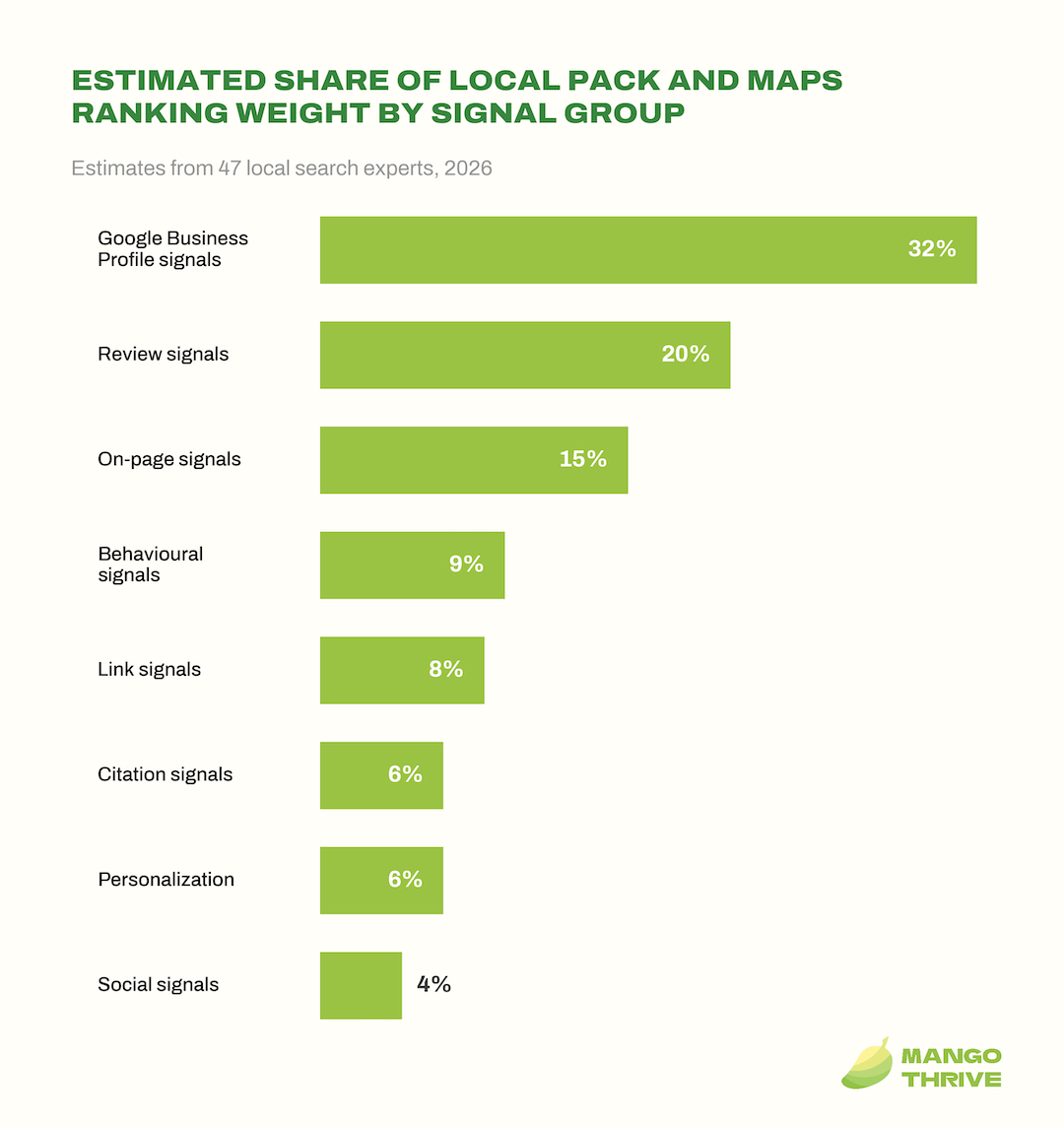
Estimated share of local pack and Maps ranking weight by signal group, 2026
Source: Whitespark, Local Search Ranking Factors 2026
32. Review signals make up an estimated 20% of local pack and Maps ranking weight in 2026 (Whitespark, Local Search Ranking Factors 2026). The report says review signals gained importance in this edition.
33. On-page signals carry an estimated 33% of local organic ranking weight in 2026 (Whitespark, Local Search Ranking Factors 2026). Link signals carry 24%.
Citations are mentions of a business on other websites, often including its name, address and phone number (NAP).
In Whitespark’s ranking factors survey, “citation signals” cover “location data, NAP consistency, citation volume, etc.” (Whitespark, Local Search Ranking Factors 2026).
34. Citation signals get an estimated 13% of AI search visibility weight in 2026, versus 6% of local pack weight (Whitespark, Local Search Ranking Factors 2026). AI search weighting is new in this edition.
35. The No. 1 local pack factor in 2026 is a business’s primary Google Business Profile category, experts say (Whitespark, Local Search Ranking Factors 2026). Distance between the searcher and the business ranks second.
36. 3 of the top 5 AI search visibility factors in 2026 are citation factors, experts say (Whitespark, Local Search Ranking Factors 2026).
Local Falcon studied which businesses actually appear in Google’s local 3-pack.
In the Local Falcon study, the “local 3-pack” means the map with three businesses shown for searches like “dentist near me” (Local Falcon, 3-Pack study).
37. The typical US business in Google’s local 3-pack has 50 to 300 reviews in most categories (Q4 2025) (Local Falcon, 3-Pack study). Local Falcon looked at 50.4 million US search results across 1,993 business categories.
| Business category | Median Google reviews of US businesses in the local 3-pack, Q4 2025 |
|---|---|
| Home Health Care | 20 |
| General Contractor | 28 |
| Tree Service | 47 |
| Electrician | 56 |
| Painter | 58 |
| Roofing Contractor | 79 |
| Chiropractor | 150 |
| Personal Injury Lawyer | 153 |
| Locksmith | 166 |
| Auto Repair Shop | 188 |
| Self Storage | 194 |
| Plumber | 215 |
| Dentist | 346 |
| Tire Shop | 413 |
| Phone Repair Shop | 452 |
| Oil Change Service | 512 |
| Cannabis Store | 581 |
| Breakfast Restaurant | 976 |
Source: Local Falcon, 3-Pack study
38. The typical US business in Google’s local 3-pack has 4.8 to 4.9 stars (Q4 2025) (Local Falcon, 3-Pack study).
39. On average, US businesses in metro areas need roughly 1.5 to 2 times as many reviews as rural ones to compete in the local 3-pack (Q4 2025) (Local Falcon, 3-Pack study). This varies significantly by category.
How Many People Use AI to Find Local Businesses?
AI chatbots are now part of how people look for local businesses. Several recent surveys measured how many people use them this way.
40. 45% of US consumers used ChatGPT or other AI tools for local business recommendations in 2026, up from 6% in 2025 (BrightLocal, Local Consumer Review Survey 2026). AI tools are now the third most popular source of business recommendations.
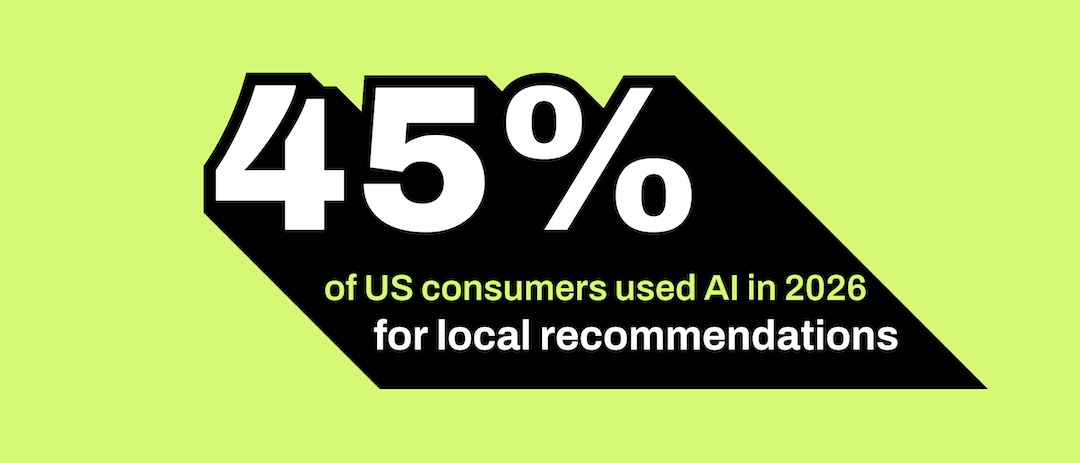
45% of US consumers used AI tools for local recommendations in 2026
Source: BrightLocal, Local Consumer Review Survey 2026
41. 47% of US adults used an AI tool to find a local business in the past month (March 2026) (Yext, US findings 2026).
42. 42.7% of local searchers worldwide used an AI tool for local search in the past month (2026) (Yext, Consumer Search Behaviors 2026). The survey covered 3,848 adults who search for local businesses.
43. 36.7% of UK consumers used AI for local search in the past month (2026) (Yext, UK local search 2026). That is below the average of 40.8% for Europe, the Middle East and Africa.
44. 64% of US adults aged 30 to 44 asked AI tools for a business recommendation in the past year (2026) (BrightLocal, AI and local recommendations 2026). Among those over 60, the share was 24%.
45. 63% of US AI users trust AI tools’ recommendations (2026) (BrightLocal, AI and local recommendations 2026). AI users here are 455 people who used AI for local business recommendations in the past 12 months.
46. 97% of US AI users sometimes double-check AI recommendations against real reviews (2026) (BrightLocal, AI and local recommendations 2026). AI users here are 455 people who used AI for local business recommendations in the past 12 months.
How Often Do AI Overviews Show Up in Local Search?
AI Overviews are the AI-written summaries at the top of some Google results. Two studies tested how often they appear for local searches.
In the Whitespark AI Overviews study, an example of a “local-intent” query is “personal injury lawyers in Phoenix,” and an example of a “hybrid” query is “should I get a lawyer after a car accident in Phoenix?” (Whitespark, AI Overviews in local search)
47. 68% of local business-related queries tested in three US cities showed a Google AI Overview (2025) (Whitespark, AI Overviews in local search). The 540 queries mixed local-intent, informational and hybrid searches in Houston, Phoenix and Denver.
48. Google AI Overviews appeared in 40.2% of local business searches across 20 countries (April 2025) (Local Falcon, AI Overviews study). The test ran 60,000 AI-generated queries for 4,423 businesses.
49. 15% of local-intent searches tested in three US cities triggered an AI Overview in 2025 (Whitespark, AI Overviews in local search). A local pack showed for 93% of them.
50. 97% of hybrid-intent local searches tested in three US cities showed an AI Overview (2025) (Whitespark, AI Overviews in local search). A local pack showed for 17% of them.
51. When a test query’s AI Overview already included a US business, it still appeared 72.0% of the time for searches within 1 mile (2025) (Local Falcon, AI Overviews study). At 1 to 2 miles away, the rate was 68.5%. The test covered 430 US businesses.
Which Sources Do AI Tools Use for Local Businesses?
When an AI tool recommends a business, it often links to the sources it used. These links are called AI citations. Yext and SOCi each measured where they point.
52. 44% of AI citations for location-based queries came from brands’ own websites in 2025 (Yext, AI citations study). Business listings made up 42%. Yext analyzed 6.8 million citations from ChatGPT, Gemini and Perplexity.
53. 2% of AI citations for location-based queries came from Reddit and similar platforms in 2025 (Yext, AI citations study).
54. 48.7% of ChatGPT’s citations for location-based queries came from business listings in 2025 (Yext, AI citations study). Gemini took 52.1% of its citations from websites.
55. 32.5% of local citations in AI tools’ recommendations came from Google Maps (2025) (SOCi, The Factors Driving AI Visibility). Brand websites made up 23.1%, Yelp 10.5% and Facebook 7.6%. SOCi examined 2 million source URLs.
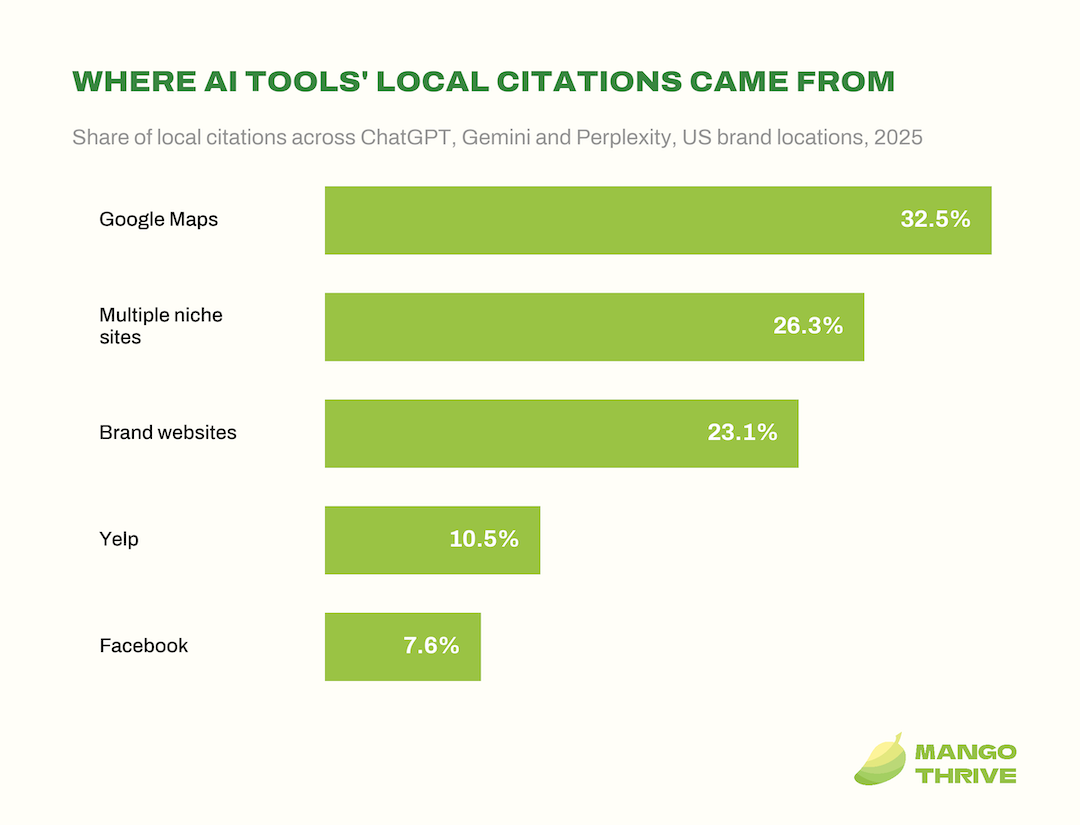
Where AI tools’ local citations came from, 2025
Source: SOCi, The Factors Driving AI Visibility, p. 10
How Often Do AI Tools Recommend Local Businesses?
SOCi also asked AI tools to recommend businesses near US brand locations and checked the answers.
56. AI tools recommended US brand locations 17.6% of the time on average (2025) (SOCi, The Factors Driving AI Visibility). In SOCi’s separate Local Visibility Index, brands appeared in Google’s 3-Pack for their top keyword 23.6% of the time. ChatGPT recommended 12.3% of locations and Perplexity 25.8%.
57. ChatGPT’s business profile details for US brand locations were 65.5% accurate, versus 99.2% for Gemini (2025) (SOCi, The Factors Driving AI Visibility). Perplexity scored 69.8%. SOCi checked details like address, phone number and opening hours.
58. Businesses recommended by ChatGPT averaged 4.4 stars, versus 4.2 stars for the average business on Google (2025) (SOCi, The Factors Driving AI Visibility). The average business on Yelp had 3.1 stars.
How Many Small Businesses Have a Website?
Government surveys in the EU, Canada and Australia track how many small businesses have a website. A UK survey tracks how many sell online.
59. 76.7% of small EU businesses (10 to 49 persons employed) had a website in 2025 (Eurostat, isoc_ciweb). The figure excludes agriculture, forestry, fishing, mining and finance.
| Country | % of businesses with 10 to 49 persons employed that had a website, 2025 |
|---|---|
| EU27 | 76.7% |
| Belgium | 87.7% |
| Bulgaria | 45.1% |
| Czechia | 80.9% |
| Denmark | 93.4% |
| Germany | 90.5% |
| Estonia | 68.3% |
| Ireland | 75.9% |
| Greece | 56.9% |
| Spain | 81.2% |
| France | 70.7% |
| Croatia | 63.4% |
| Italy | 74.6% |
| Cyprus | 67.2% |
| Latvia | 64.6% |
| Lithuania | 70.7% |
| Luxembourg | 83.2% |
| Hungary | 63.5% |
| Malta | 79.2% |
| Netherlands | 90.9% |
| Austria | 90.9% |
| Poland | 63.1% |
| Portugal | 59.2% |
| Romania | 51.0% |
| Slovenia | 81.5% |
| Slovakia | 72.4% |
| Finland | 98.2% |
| Sweden | 89.0% |
| Norway | 85.4% |
| Serbia | 81.5% |
| Montenegro | 85.7% |
| Bosnia and Herzegovina | 63.1% |
| Albania | 59.3% |
| Türkiye | 52.2% |
Source: Eurostat, isoc_ciweb. Covers businesses outside agriculture, forestry, fishing, mining and finance.
60. 45% of Canadian micro businesses (0 to 4 employees) had a company website in 2023 (Statistics Canada, Table 22-10-0120-01). 39.8% had no web presence at all.
61. 44.6% of Australian employing businesses with 0 to 4 staff had their own website or app in 2024-25 (ABS, Characteristics of Australian Business 2024-25). The rate was 68.7% for businesses with 5 to 19 staff.
62. 39.8% of Australian construction businesses had their own website or app in 2024-25 (ABS, Characteristics of Australian Business 2024-25). Across all employing businesses, 55.1% did.
63. 19.6% of small Canadian businesses (at least 5 employees, up to 19 full-time) used paid online advertising in 2023 (Statistics Canada, Table 22-10-0120-01). 74.7% had a company website.
64. 67.9% of small Canadian businesses without a web presence said they didn’t need one (2023) (Statistics Canada, Table 22-10-0121-01). 11.6% said set-up costs were too high.
Small Business Marketing and Agency Statistics
65. 30.6% of small EU businesses (10 to 49 persons employed) paid for internet advertising in 2024 (Eurostat, isoc_cismt). The figure excludes agriculture, forestry, fishing, mining and finance.
66. 13.5% of small EU businesses (10 to 49 persons employed) paid for internet ads targeted by users’ location in 2024 (Eurostat, isoc_cismt).
67. 23% of UK SME employers used technology or web-based software to sell online in 2024 (UK Department for Business and Trade, Small Business Survey 2024). 65% used it to manage the business. SMEs here are businesses with 1 to 249 employees.
68. 42% of small businesses in the US, UK, Canada and Australia have under one hour a day for marketing (2025) (Constant Contact, State of Small Business Marketing 2025). The share was 51% in the US, 47% in Australia and New Zealand, 39% in Canada and 32% in the UK.
69. 68% of local agency marketers surveyed offered Google Business Profile optimization or management (2024) (BrightLocal, Local Marketing Industry Survey: Agencies). The survey had 385 respondents.
70. 37% of local agency marketers said customers not being able to find the business online was a common client challenge (2024) (BrightLocal, Local Marketing Industry Survey: Agencies). The survey covered 385 agency marketers, freelancers and consultants.
Conclusion
Google is still where most US consumers start a local search in these surveys. AI tools, map apps and social media also play a part. Reviews show up across the data, from consumer surveys to the sources AI tools cite. We’ll update this page as new data comes out.