
Online safety covers scams, harassment, account security and the tools families use to protect children. Governments, researchers and tech companies publish regular data on these risks. This page brings together figures from several countries. Here are the latest statistics on the risks people face online and what they do to stay safe.
Top Internet Safety Statistics
- 64% of people surveyed in 15 countries faced at least one online risk in the past year, per a 2025 survey (Microsoft, Global Online Safety Survey).
- 57% of adults surveyed in 42 markets experienced a scam in the past 12 months, per a 2025 survey (GASA, Global State of Scams 2025).
- $20.877 billion in losses was reported to the FBI’s IC3 in 2025, from 1,008,597 complaints (FBI IC3, 2025 Internet Crime Report).
- As much as $195.9 billion was the total cost of fraud to U.S. consumers in 2024, the FTC estimates (FTC, testimony to the Joint Economic Committee).
- Only 41% of adults surveyed in seven countries regularly use multi-factor authentication, in 2025 (NCA and CybSafe, Oh, Behave! 2025–2026).
- Over 99% of identity-based attacks can be blocked by phishing-resistant MFA, Microsoft said in 2025 (Microsoft, Digital Defense Report 2025).
- 51% of U.S. tablet owners surveyed said the tablet had parental controls in 2025, versus 35% of game console owners (FOSI, 2025 Online Safety Survey).
How Many People Experience Online Risks?
The figures below come from a multi-country survey about harms people faced online.
In Microsoft’s survey, an “online risk” is any of 11 listed harms, from hate speech and scams to cyberbullying and threats of violence.
1. 64% of people surveyed in 15 countries faced at least one online risk in the past year, per a 2025 survey (Microsoft, Global Online Safety Survey). The survey covered teens aged 13 to 17, adults aged 18 to 64, and parents answering for their children aged 6 to 17.
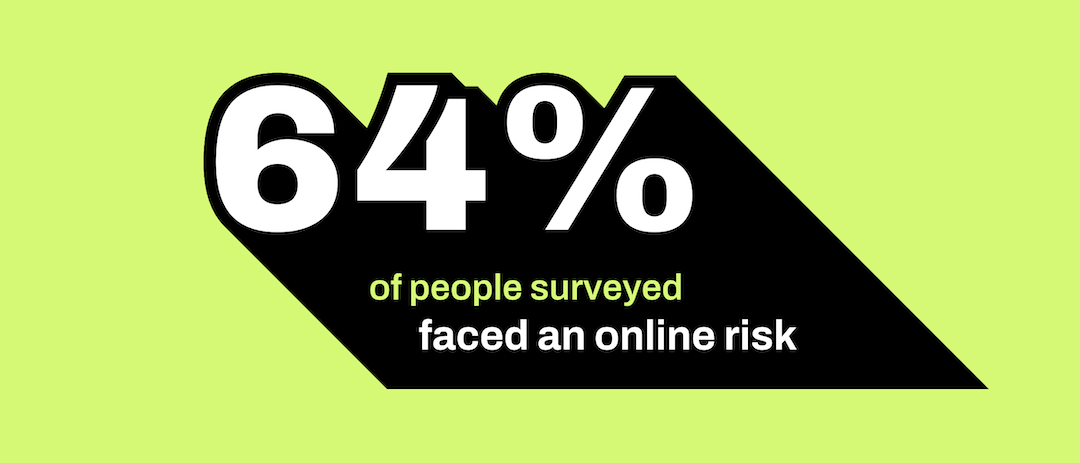
Share of people surveyed in 15 countries who faced at least one online risk in the past year, 2025
Source: Microsoft, Global Online Safety Survey, p. 46.
| Country | People surveyed who faced at least one online risk in the past year, 2025 |
|---|---|
| Australia | 62% |
| Brazil | 63% |
| Canada | 60% |
| Colombia | 71% |
| Denmark | 56% |
| France | 56% |
| Germany | 57% |
| India | 79% |
| Italy | 57% |
| Mexico | 68% |
| Singapore | 68% |
| South Africa | 79% |
| South Korea | 53% |
| United Kingdom | 58% |
| United States | 67% |
Source: Microsoft, Global Online Safety Survey, p. 46. Includes parents answering for their children.
How Common Are Cybercrime and Scams?
These surveys measure how many people run into scams, fraud, cybercrime and harmful content. Some fraud figures include fraud that happens offline.
2. 57% of adults surveyed in 42 markets experienced a scam in the past 12 months, per a 2025 survey (GASA, Global State of Scams 2025). 23% lost money. The survey covered 46,000 adults.
3. 29% of people surveyed in 15 countries faced online frauds or scams in the past year, per a 2025 survey (Microsoft, Global Online Safety Survey).
4. 45.5% of Australian adult internet users surveyed were cybercrime victims in the past 12 months, in 2025 (AIC, Cybercrime in Australia 2025). The survey covered 10,593 online Australians aged 18 and over.
In the AIC survey, “online abuse and harassment” means online communication to or about a person that may cause them emotional distress.
5. 24.9% of Australian adult internet users surveyed faced online abuse and harassment in the past 12 months, in 2025 (AIC, Cybercrime in Australia 2025).
6. 73% of U.S. adults say they have experienced at least one of six types of online scam or attack, as of 2025 (Pew Research Center, Online Scams and Attacks). 32% say it happened in the past year.
7. 21% of U.S. adults say they have lost money to an online scam or attack, as of 2025 (Pew Research Center, Online Scams and Attacks).
8. 66% of UK internet users aged 18+ encountered potentially harmful content online in the past four weeks, in June 2025 (Ofcom, Online Nation 2025). They chose from a set list of potential harms.
9. 7.8% of people aged 16 and over were fraud victims in the past 12 months, according to the Crime Survey for England and Wales for the year ending March 2026 (ONS, Crime in England and Wales). That was up 0.7 percentage points on the year before.
10. An estimated 15% of Australians aged 15 and over experienced personal fraud in 2024–25 (ABS, Personal Fraud). This includes card fraud, scams, identity theft and online impersonation.
How Much Money Is Lost to Scams and Fraud?
The FBI’s Internet Crime Complaint Center (IC3) collects online crime reports from people and businesses. The FTC’s Consumer Sentinel Network is a database of reports consumers file about problems in the marketplace, including fraud. Agencies and industry bodies in other countries publish their own counts of reported losses.
11. $20.877 billion in losses was reported to the FBI’s IC3 in 2025, from 1,008,597 complaints (FBI IC3, 2025 Internet Crime Report). Losses were up 26% from 2024.
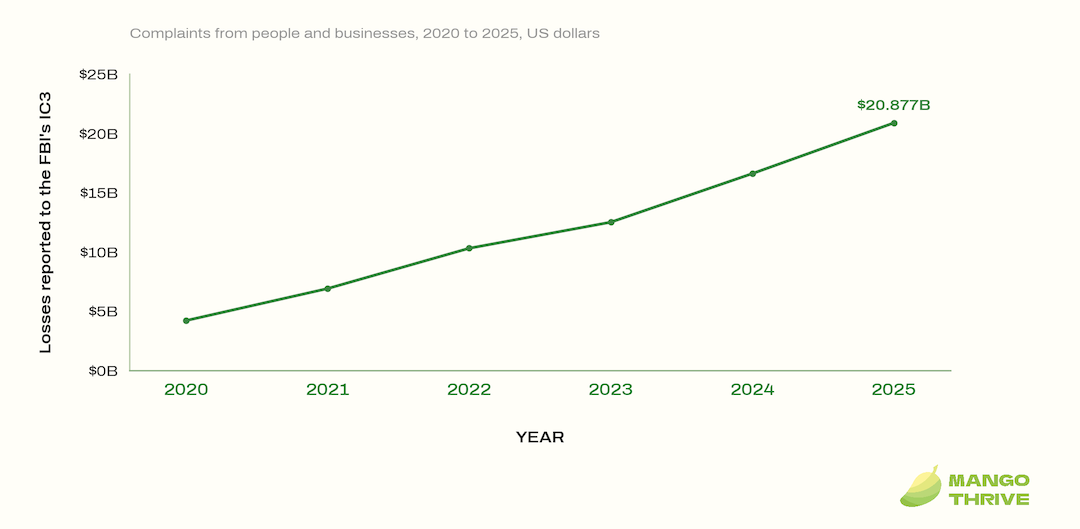
Losses reported to the FBI’s IC3 by year, 2020 to 2025
Source: FBI IC3, 2025 Internet Crime Report, p. 4.
12. $8.65 billion was reported lost to investment fraud in 2025, the largest share of IC3 losses (FBI IC3, 2025 Internet Crime Report).
In the IC3 report, “investment fraud” means tricking investors into making purchases based on false information, usually with promises of big returns and little risk.
| Crime type | Losses reported to the FBI’s IC3, 2025 |
|---|---|
| Investment | $8.65 billion |
| Business email compromise | $3.05 billion |
| Tech/customer support | $2.13 billion |
| Personal data breach | $1.31 billion |
| Confidence/romance | $929.3 million |
| Government impersonation | $797.9 million |
| Other | $512.1 million |
| Non-payment/non-delivery | $503.4 million |
| Data breach | $435.2 million |
| Employment | $362.9 million |
Source: FBI IC3, 2025 Internet Crime Report, p. 26. Top 10 crime types by reported losses.
13. As much as $195.9 billion was the total cost of fraud to U.S. consumers in 2024, the FTC estimates (FTC, testimony to the Joint Economic Committee). The estimate takes underreporting into account.
14. $15.9 billion in fraud losses was reported by consumers to the FTC’s Consumer Sentinel Network in 2025 (FTC, testimony to the Joint Economic Committee). That came from 3 million fraud reports, and the FTC says it is a fraction of actual losses.
15. Over $7.9 billion was reported lost to investment scams by consumers in 2025, about half of FTC-reported fraud losses (FTC, testimony to the Joint Economic Committee).
16. Over $2 billion was reported lost by consumers to fraud where social media was the contact method, in FTC fiscal year 2025 (FTC, testimony to the Joint Economic Committee). Among 2025 reports that named a contact method, text messages were the most common.
17. More than C$704 million in fraud losses was reported to the Canadian Anti-Fraud Centre in 2025 (CAFC, Top 10 frauds in 2025). That came from over 112,000 reports.
18. A$2.18 billion in scam losses was reported by Australians in 2025 (ACCC, National Anti-Scam Centre). That came from 274,577 reports with a financial loss, made to several reporting bodies.
19. £1.28 billion was stolen through payment fraud in the UK in 2025, UK Finance members reported (UK Finance, Annual Fraud Report 2026). That was up 4%.
20. About S$913.1 million was lost to scams in Singapore in 2025, down 17.9% from 2024 (Singapore Police Force, Annual Scam and Cybercrime Brief 2025). Scam cases fell to 37,308.
How Much Do Older People Lose to Scams and Fraud?
These figures cover scam and fraud losses among older people. Scamwatch is the scam reporting service run by Australia’s consumer regulator.
21. $7.748 billion in losses was reported to IC3 by people aged 60 and over in 2025 (FBI IC3, 2025 Internet Crime Report). That came from 201,266 complaints, with losses up 59% from 2024.
22. 26.5% of 2025 Scamwatch losses came from Australians aged 65 and over (ACCC, National Anti-Scam Centre). That age group makes up about 17.1% of the population.
23. S$37,053 was the average scam loss per victim aged 65 and above in Singapore in 2025 (Singapore Police Force, Annual Scam and Cybercrime Brief 2025). That was the highest of any age group.
How Common Are Hostile Messages and Cyberbullying Online?
These numbers show how many people see hostile content or are bullied online.
24. 42.3% of EU internet users aged 16 to 74 saw online messages they considered hostile and degrading in the three months before the 2025 survey (Eurostat, Hostile messages online).
| Country | Internet users aged 16 to 74 who saw hostile and degrading messages online in the three months before the survey, 2025 |
|---|---|
| Ireland | 66.2% |
| Hungary | 60.9% |
| Finland | 56.7% |
| Slovakia | 56.2% |
| Malta | 53.2% |
| Netherlands | 52.8% |
| Sweden | 51.1% |
| Portugal | 50.5% |
| Luxembourg | 47.4% |
| Slovenia | 47.3% |
| France | 45.9% |
| EU aggregate | 42.3% |
| Romania | 41.8% |
| Belgium | 39.5% |
| Poland | 39.4% |
| Austria | 39.0% |
| Cyprus | 39.0% |
| Bulgaria | 34.1% |
| Lithuania | 33.8% |
| Germany | 33.7% |
| Greece | 29.4% |
| Latvia | 29.3% |
Source: Eurostat, dataset isoc_ci_hm. EU countries with 2025 data. The EU aggregate is calculated by Eurostat.
25. 53.7% of EU internet users aged 16 to 24 saw hostile or degrading messages online in the three months before the 2025 survey (Eurostat, news 18 June 2026).
In the HBSC study, being “cyberbullied” means receiving mean messages or posts, or having photos or videos shared without permission.
26. 15% of adolescents aged 11, 13 and 15 in 44 countries and regions reported being cyberbullied in the 2021/2022 HBSC survey (WHO/Europe, HBSC 2022). That means at least once or twice in the past couple of months.
27. 16% of U.S. high school students were electronically bullied in the past year, in 2023 (CDC, YRBS Data Summary & Trends). That includes bullying by text or on social media.
28. 52% of Australian children aged 10 to 15 had been cyberbullied, per a 2024–25 survey (eSafety Commissioner, Digital use and risk).
How Common Are Deepfakes, AI-Related Scams and Fake Content?
These figures cover deepfakes, crime reports that mention AI, and worry about fake content.
In Ofcom’s research, a “deepfake” is a video, picture or audio clip made with artificial intelligence to look real.
29. 43% of UK people aged 16+ say they saw at least one deepfake online in the past six months, in 2024 (Ofcom, deepfakes research). The figure rises to 50% among children aged 8 to 15 in Great Britain.
30. 9% of UK people aged 16+ say they are confident they could spot a deepfake, in 2024 (Ofcom, deepfakes research).
In the IC3 report, “AI related” means the complaint contains a reference to artificial intelligence.
31. 22,364 complaints to the FBI’s IC3 in 2025 included AI-related information (FBI IC3, 2025 Internet Crime Report). Adjusted losses in those complaints exceeded $893 million.
32. 62% of people are concerned about what is real or fake online, on average across 48 markets in 2026 (Reuters Institute, Digital News Report 2026). The question asked about online news.
How Many People Use Basic Security Habits?
These surveys cover passwords, multi-factor authentication, updates and passkeys. A passkey is a login that uses your device’s fingerprint, face scan or PIN instead of a password. Identity attacks are attempts to break into an account.
33. 62% of adults surveyed in seven countries frequently use unique passwords, in 2025 (NCA and CybSafe, Oh, Behave! 2025–2026). The survey covered adults in the US, UK, Germany, Australia, India, Brazil and Mexico.
34. 41% of adults surveyed in seven countries have never used a password manager, in 2025 (NCA and CybSafe, Oh, Behave! 2025–2026).
In the Oh, Behave! report, “multi-factor authentication (MFA)” means logging in with two or more pieces of information, such as a password plus a code sent to a phone.
35. Only 41% of adults surveyed in seven countries regularly use multi-factor authentication, in 2025 (NCA and CybSafe, Oh, Behave! 2025–2026). 23% have never heard of it.
36. 54% of UK adults surveyed regularly use MFA, the highest of seven countries, in 2025 (NCA and CybSafe, Oh, Behave! 2025–2026). Australia followed at 53%.
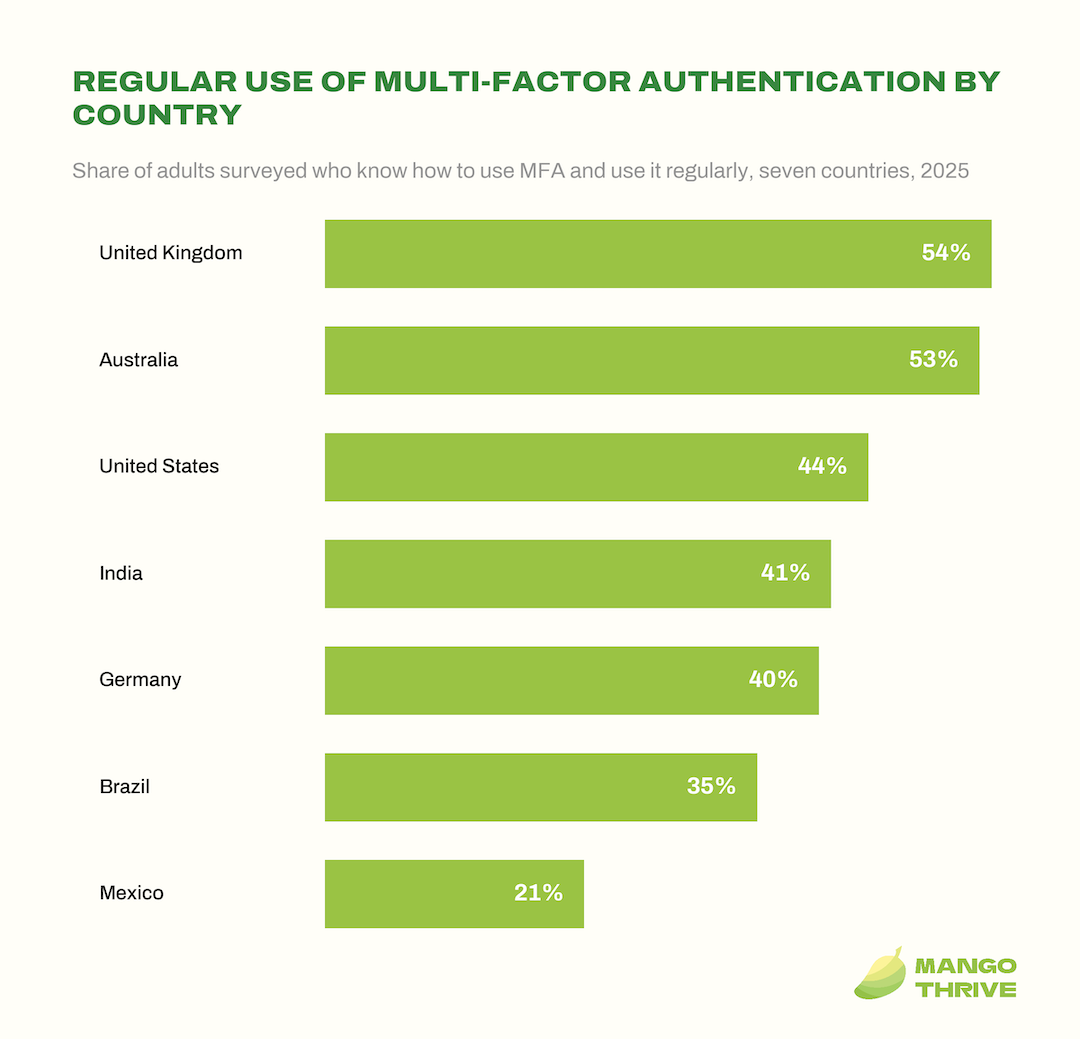
Share of adults surveyed who regularly use multi-factor authentication, by country, 2025
Source: NCA and CybSafe, Oh, Behave! 2025–2026 full report, p. 135.
37. 60% of adults surveyed in seven countries install software updates, in 2025 (NCA and CybSafe, Oh, Behave! 2025–2026). 23% say they know how to update but choose not to.
38. More than 97% of identity attacks are password attacks, Microsoft reported in 2025 (Microsoft, Digital Defense Report 2025).
39. Over 99% of identity-based attacks can be blocked by phishing-resistant MFA, Microsoft said in 2025 (Microsoft, Digital Defense Report 2025).
40. 80% of consumers surveyed received a data breach notice in the past 12 months, in 2025 (ITRC, 2025 Annual Data Breach Report). The survey asked 1,040 consumers in November 2025.
41. 75% of adults surveyed in 10 countries have enabled passkeys on at least some accounts, in 2026 (FIDO Alliance, State of Passkeys 2026). The survey covered 11,000 adults who regularly log in online.
How Common Are Parental Controls and Family Online Safety Rules?
These numbers cover parental controls, family rules and how often parents talk about online safety.
42. 51% of U.S. tablet owners surveyed said the tablet had parental controls in 2025, versus 35% of game console owners (FOSI, 2025 Online Safety Survey). Both parents and children were asked whether the devices children use had parental controls.
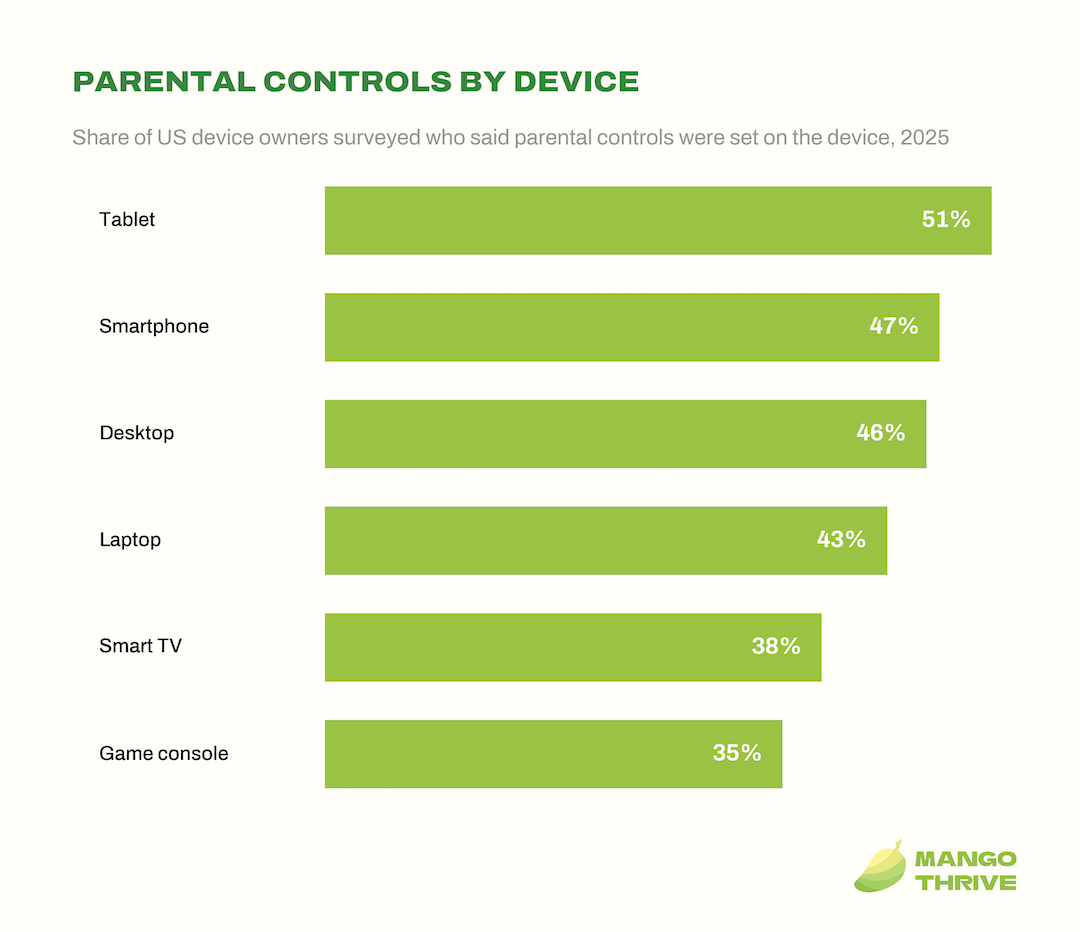
Share of US device owners surveyed who said parental controls were set, by device, 2025
Source: FOSI, 2025 Online Safety Survey, p. 4.
43. 89% of U.S. kids aged 10 to 17 say they feel comfortable turning to parents if something online feels unsafe, in 2025 (FOSI, 2025 Online Safety Survey).
44. 86% of U.S. parents of kids aged 12 and under say they have screen rules, in 2025 (Pew Research Center, How Parents Manage Screen Time for Kids). 19% say they stick to them all the time.
45. 66% of UK parents surveyed say they talk to their child about online safety at least every few months, per Ofcom’s 2026 report (Ofcom, Children and Parents: Media Use and Attitudes 2026). 43% do so at least every few weeks.
What Action Do Platforms and Regulators Take Against Online Harms?
Tech companies and regulators publish their own counts of the action they take.
46. Over 159 million scam ads were removed by Meta in 2025 (Meta, anti-scam update). Meta says 92% were taken down before anyone reported them.
47. 10.9 million Facebook and Instagram accounts linked to criminal scam centers were taken down by Meta in 2025 (Meta, anti-scam update).
48. 40 formal investigations covering over 100 services were opened by Ofcom over 18 months, it said in September 2026 (UK Parliament, Lords Communications and Digital Committee). The investigations fall under the UK’s Online Safety Act.
49. £7 million in penalties has been imposed by Ofcom under the UK’s online safety rules, as of September 2026 (UK Parliament, Lords Communications and Digital Committee). Ofcom said most of it has not been paid.
Conclusion
Across these surveys, large shares of people report facing scams, harassment or other online risks. Most adults surveyed in seven countries do not regularly use multi-factor authentication. We’ll update this page as new data comes out.