
Are the jobs most exposed to AI actually asking workers to use it?
To find out, we analyzed 4,192 U.S. job postings across 21 occupations, roughly 200 each, collected between June 3 and September 1, 2026. Using the ILO’s generative-AI exposure index, we selected 14 highly exposed occupations and 7 low-exposure controls.
The answer: not very often.
Key Findings
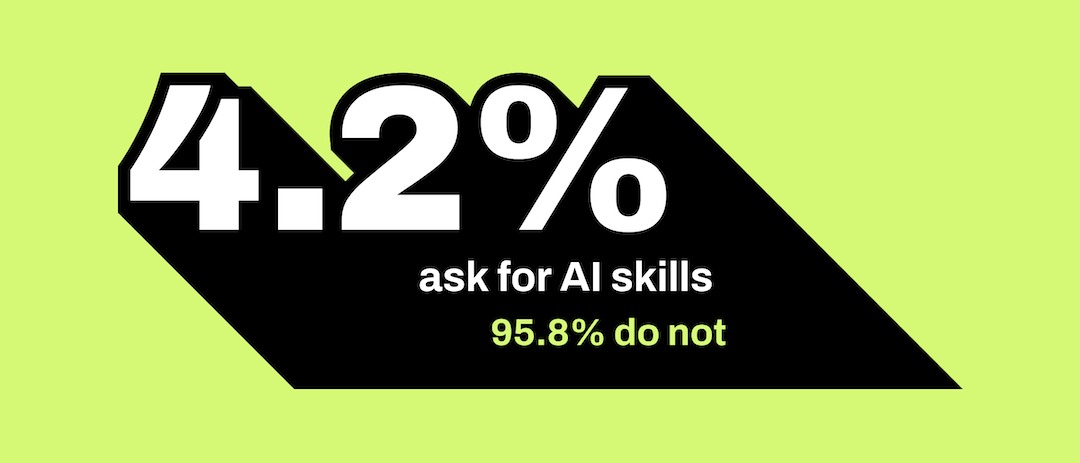
- 4.2% of postings in the 14 highly exposed occupations ask for AI skills. Across all 21 occupations, it’s 2.9%.
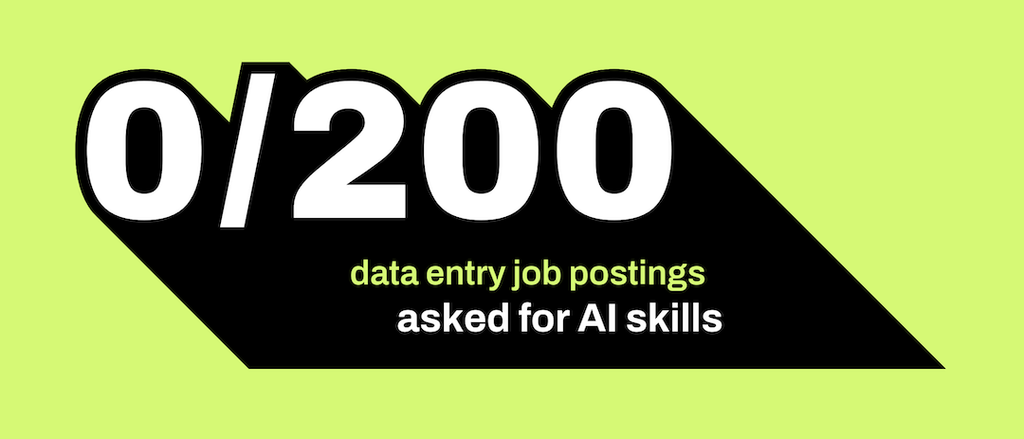
- Data entry is the #1 most-exposed occupation on the ILO index. Out of 200 postings, none asked for AI skills.
- 9.7% of postings mention AI, but most of those mentions are contextual. Two-thirds are hiring disclosures, company descriptions, or job-board features, not skill requirements.
- Copywriters come in at 22.5%, highest of all 21 occupations, even though they rank only 12th on exposure.
- Among postings that ask for AI skills, 80% make them a requirement rather than a nice-to-have.
- Highly exposed occupations are 6.7× more likely to ask for AI skills than low-exposure office jobs (4.2% vs 0.6%).
- Jobs ranked as more exposed to AI were not necessarily more likely to ask for AI skills. Across all 21 occupations, the relationship was weak (Spearman ρ = 0.26). Among the 14 highly exposed occupations, it was slightly negative (ρ = −0.31).
- Postings that ask for AI skills advertise 6.6% higher median salaries than other postings in the same occupation (n = 98).
- 13 postings (0.3%) told candidates not to use AI during hiring, including postings for truck drivers and electricians.
AI Exposure vs. AI Skill Demand
4.2% of postings in the most AI-exposed occupations ask for AI skills
Out of 2,795 postings in 14 occupations from the ILO’s two highest exposure tiers, 117 required or preferred AI skills. For all 21 occupations combined, it’s 122 of 4,192 (2.9%).
Go more specific and the number shrinks. Only 2.0% of the exposed group mentioned a generative AI tool or skill by name, things like ChatGPT, Copilot, Claude, LLMs, or prompt engineering. 96 out of every 100 postings don’t ask for AI skills at all.
Not one of 200 data entry postings asked for AI skills
Data entry clerks top all 427 occupations on the ILO index at 0.70. Loan officers, office clerks, and receptionists also had zero.
Five of the eight top-tier occupations we studied asked for AI skills in 1% of postings or fewer:
| Occupation | ILO exposure score | Postings asking for AI |
|---|---|---|
| Data entry clerk | 0.70 (highest of 427) | 0 of 200 |
| Bookkeeper / accounting clerk | 0.64 | 1 of 200 |
| Payroll clerk | 0.61 | 2 of 200 |
| Loan officer | 0.60 | 0 of 200 |
| Office clerk | 0.60 | 0 of 200 |
Highly exposed jobs are 6.7× more likely to ask for AI skills than low-exposure office jobs
The numbers by tier tell an odd story. Second-tier occupations asked for AI skills in 6.2% of postings, while the top tier came in at 2.7%. Low-exposure office jobs (HR managers, attorneys, civil engineers, elementary teachers) sat at 0.6%. Physical jobs (nurses, truck drivers, electricians) had none.
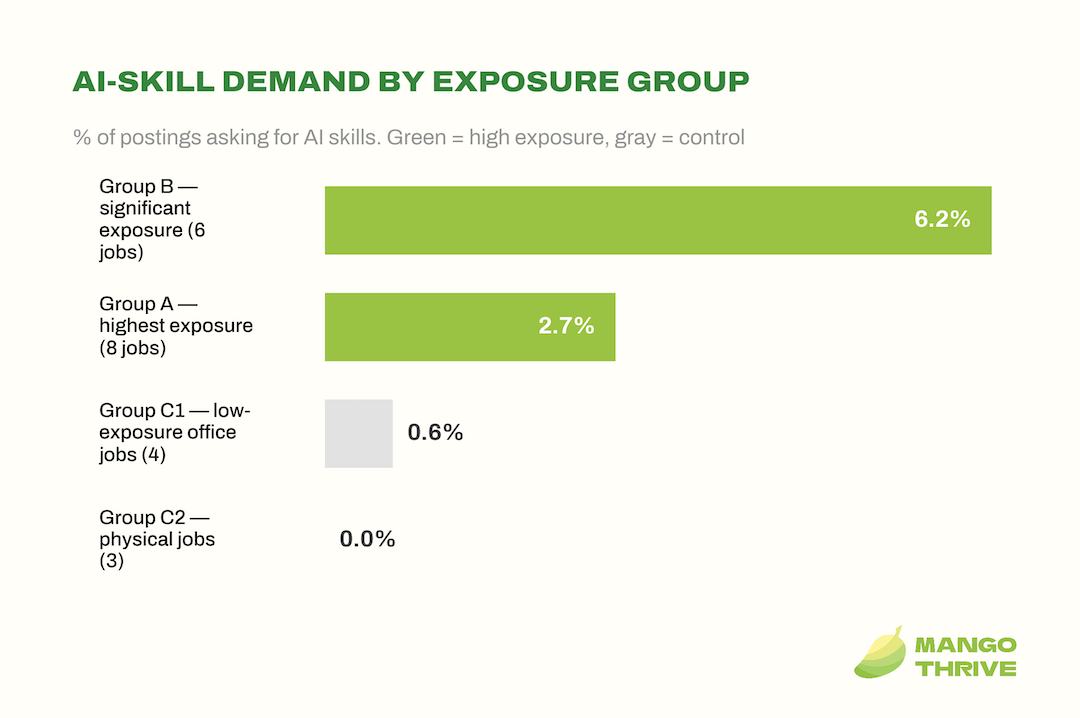
Exposed occupations do ask for AI more than unexposed ones. But within the exposed group, the ranking is close to backwards.
ILO exposure barely predicts which jobs ask for AI
The correlation is weak. Across all 21 occupations, the Spearman coefficient between ILO exposure score and the share of postings asking for AI is 0.26. Narrow it to the 14 exposed occupations and it turns negative: −0.31. The more clerical the job, the less likely the posting asks for AI. These numbers describe these 21 occupations only, not the labor market as a whole.
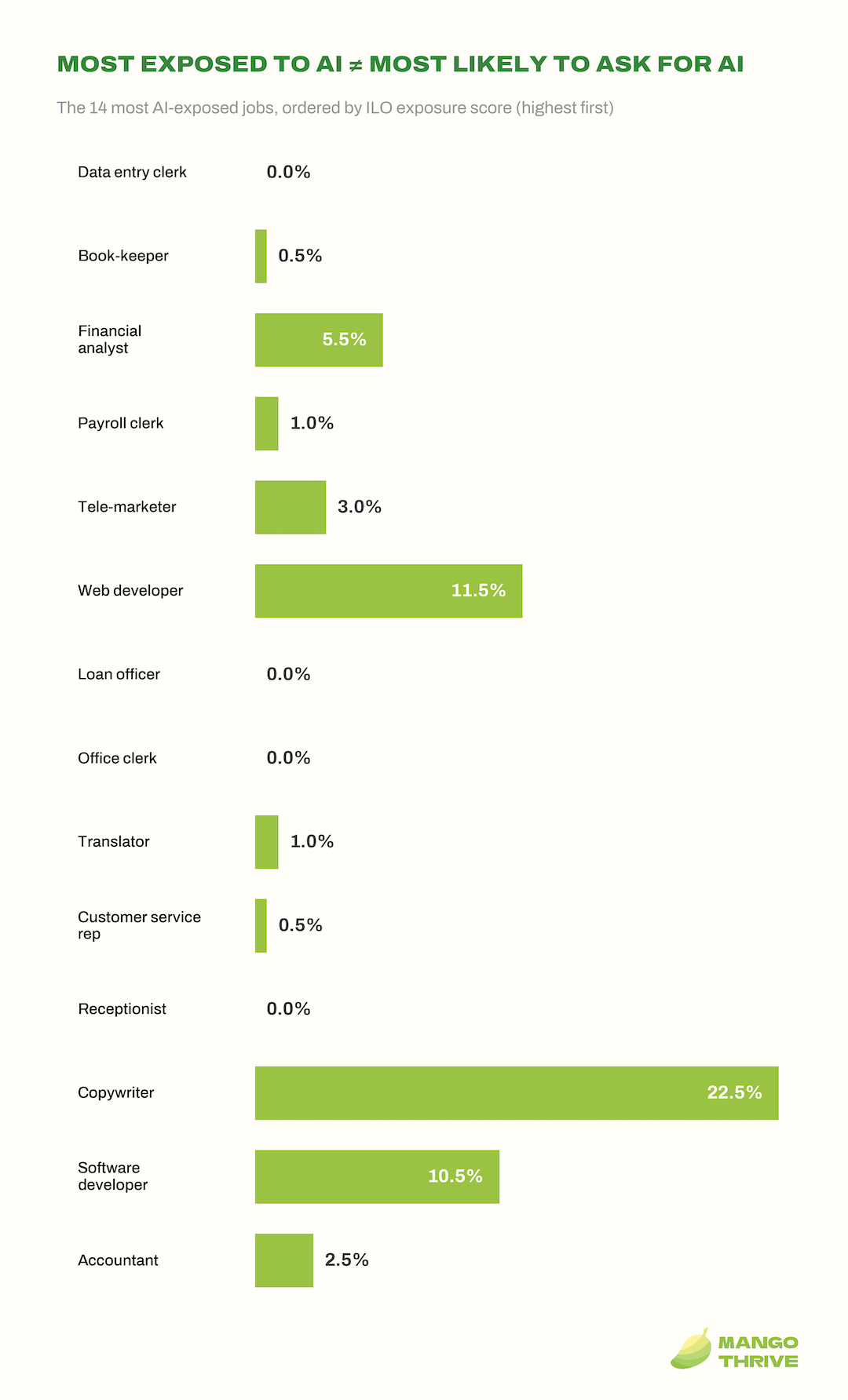
Copywriters rank 12th on exposure but first on demand. Software developers rank 13th on exposure and third on demand.
One possible explanation: the ILO index measures whether AI can do a job’s tasks, not whether employers hire for AI skills. Clerical employers may be automating that work quietly, or they haven’t updated their postings yet. Creative and technical employers are doing the opposite: asking the person to use the tool. Our data shows the pattern but can’t tell us why it exists.
What “AI” in a Job Posting Usually Means
9.7% of postings mention AI, but only 2.9% ask the candidate to use it
The gap comes from mentions that ask nothing of the applicant, like hiring-process disclosures, company descriptions, and job-board features.
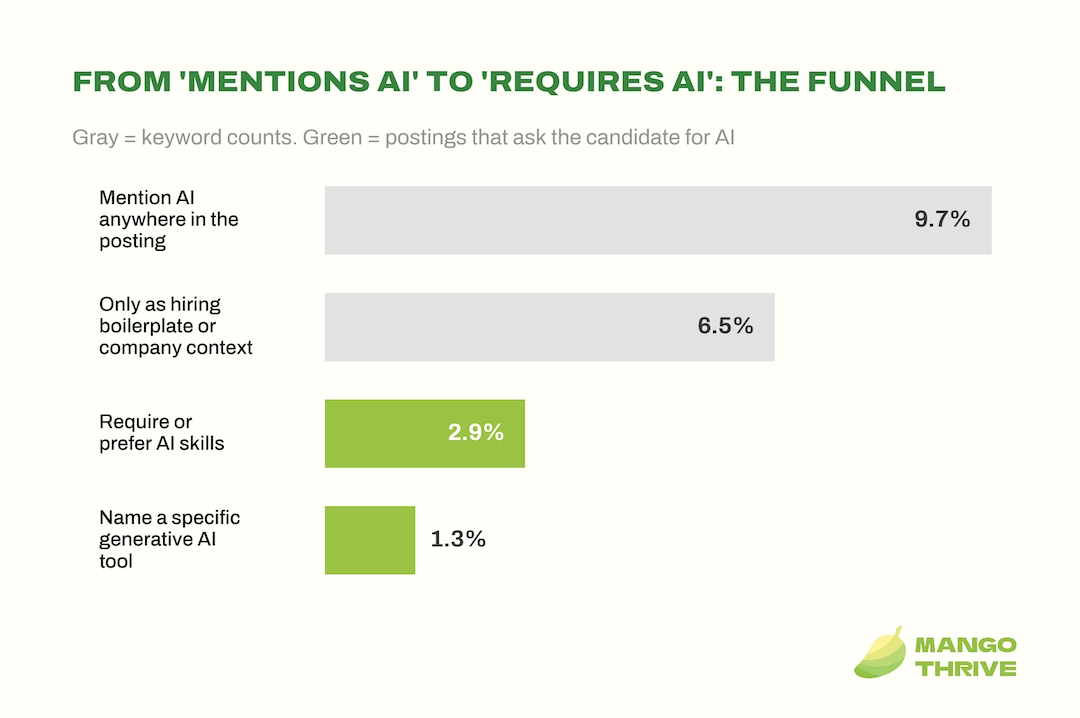
Two-thirds of AI mentions ask nothing of the candidate
274 of the 406 postings that mention AI do so only in a contextual way. The single most common AI sentence in the dataset, appearing in 88 postings, is a hiring disclaimer: “We may use Artificial Intelligence (AI) to support parts of our hiring process, including sourcing, screening, and evaluating candidates.” Another 123 come from one staffing firm promoting its app (“notifications of AI-matched jobs”).
So an employer that mentions AI in a posting is twice as likely to be describing its own process or business as describing what the hire will do.
Which Jobs Ask for AI Skills
Copywriters top the list at 22.5% of postings asking for AI skills
Web developers (11.5%) and software developers (10.5%) follow. Eight occupations had zero.
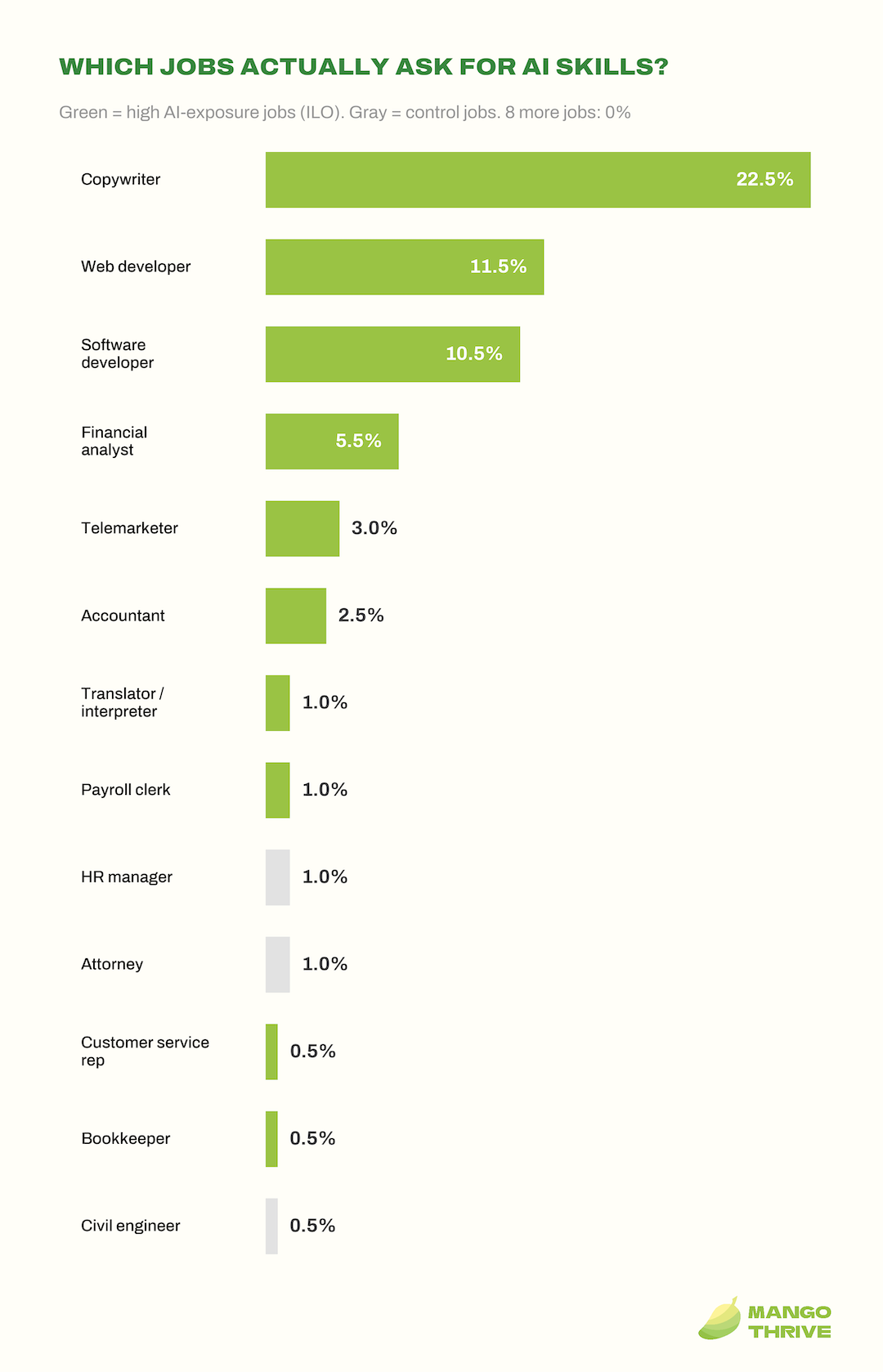
| Rank | Occupation | Tier | ILO score | Postings asking for AI | Share | Required / preferred |
|---|---|---|---|---|---|---|
| 1 | Copywriter | B | 0.55 | 45 of 200 | 22.5% | 42 / 3 |
| 2 | Web developer | A | 0.60 | 23 of 200 | 11.5% | 20 / 3 |
| 3 | Software developer | B | 0.53 | 21 of 200 | 10.5% | 18 / 3 |
| 4 | Financial analyst | A | 0.62 | 11 of 200 | 5.5% | 5 / 6 |
| 5 | Telemarketer | A | 0.61 | 6 of 197 | 3.0% | 3 / 3 |
| 6 | Accountant | B | 0.51 | 5 of 200 | 2.5% | 2 / 3 |
| 7 | Translator / interpreter | B | 0.59 | 2 of 199 | 1.0% | 2 / 0 |
| 8 | Payroll clerk | A | 0.61 | 2 of 200 | 1.0% | 2 / 0 |
| 9 | HR manager | C1 | 0.36 | 2 of 200 | 1.0% | 1 / 1 |
| 10 | Attorney | C1 | 0.36 | 2 of 200 | 1.0% | 0 / 2 |
| 11 | Customer service representative | B | 0.58 | 1 of 199 | 0.5% | 0 / 1 |
| 12 | Bookkeeper | A | 0.64 | 1 of 200 | 0.5% | 1 / 0 |
| 13 | Civil engineer | C1 | 0.30 | 1 of 200 | 0.5% | 1 / 0 |
| 14 | Data entry clerk | A | 0.70 | 0 of 200 | 0.0% | — |
| 15 | Loan officer | A | 0.60 | 0 of 200 | 0.0% | — |
| 16 | Office clerk | A | 0.60 | 0 of 200 | 0.0% | — |
| 17 | Receptionist | B | 0.57 | 0 of 200 | 0.0% | — |
| 18 | Elementary school teacher | C1 | 0.26 | 0 of 197 | 0.0% | — |
| 19 | Registered nurse | C2 | 0.25 | 0 of 200 | 0.0% | — |
| 20 | Truck driver | C2 | 0.24 | 0 of 200 | 0.0% | — |
| 21 | Electrician | C2 | 0.19 | 0 of 200 | 0.0% | — |
Tiers: A = ILO top exposure tier, B = second tier, C1 = low-exposure office jobs (control), C2 = physical jobs (control). Counts below 5 should be read as “close to zero,” not ranked against each other.
42 of the 45 copywriter postings that ask for AI make it a requirement
And the language is specific:
“Use AI as a force multiplier, not a shortcut.” — Concurate, copywriter
“Able to explain how you use AI tools in your process — we screen for judgement, not avoidance.” — content writer posting
“Lead adoption of AI and automation for high-volume, lower-complexity copy work. Decide what gets automated versus what stays human while preserving brand voice.” — Copy Principal posting
Counting only generative AI does not change the order: copywriters (16 postings), web developers (15), software developers (14), then a steep drop to financial analysts (4).
What Employers Ask For
80% of postings that ask for AI make it a requirement
Of the 122 postings that asked for AI, 97 listed it under qualifications without a “plus,” or wrote it into the day-to-day duties. Only 25 framed it as a nice-to-have.
“Candidates who do not currently use AI tools in their daily workflow may not be a strong fit for this position.” — Rise Capital Group, web developer
“All hired employees are expected to have experience with Microsoft Copilot and/or an approved equivalent AI solution.” — DSA Inc., software developer
“Use AI-assisted development tools as part of normal daily work, and remain fully accountable for every line you ship, whether you or a tool wrote it first.” — Yield Solutions Group, software developer
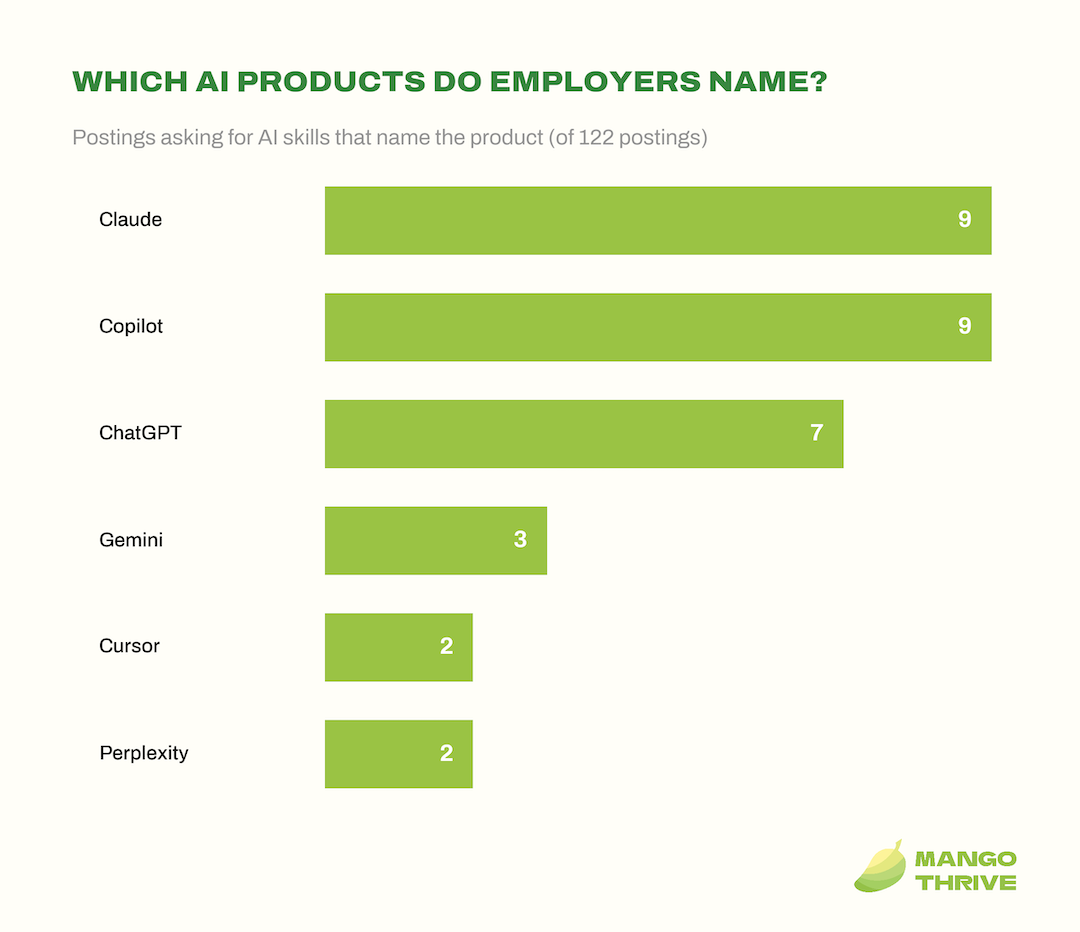
Claude and Copilot are named as often as ChatGPT
Among the 122 postings asking for AI skills, Claude came up 9 times. Microsoft or GitHub Copilot, also 9. ChatGPT, 7. Gemini (3), Cursor (2), and Perplexity (2) trail. Another 10 referred to large language models in general without naming a product. The counts are small. No single product dominates.
AI Skills and Advertised Pay
Postings that ask for AI skills advertise 6.6% higher median salaries than other postings in the same occupation
That’s based on the 98 AI-requiring postings that listed a salary. Each was measured against the median advertised salary for its own occupation.
Copywriters were the only occupation with enough salaried postings on both sides to break out separately. Postings that asked for AI advertised a median 6.2% higher than those that didn’t (33 vs 130 postings).
This is an advertised salary differential, not a causal effect. The sample is small.
Employers That Ban AI
13 postings told candidates not to use AI in the hiring process
That is 0.3% of the sample. Five of the thirteen were for truck drivers and electricians.
“Use of AI throughout the application and recruiting process may result in removal from consideration.” — U-Haul, accountant
“We do not use artificial intelligence (AI) tools to make hiring decisions, and we ask that candidates disclose any use of AI in the application and interview process.” — CBRE, electrician
“To uphold the security and fairness of our hiring process, we ask that candidates refrain from using AI tools, including ChatGPT, during interviews and assessments.” — Foot Locker, HR manager
Some employers draw the line explicitly:
“Please feel free to use AI to refine and polish your application materials, research Curology and the role, prepare for your interviews. Please refrain from using AI tools during live interviews.” — Curology, copywriter
The number is too small to generalize. But in the same three months, more postings told candidates not to use AI in the hiring process (13) than told data entry clerks, loan officers, office clerks, and receptionists combined to use it on the job (0).
Conclusion
The ILO index says which jobs generative AI could change most. Job postings say which jobs employers are asking people to use it in. In the summer of 2026, those aren’t the same list.
The most-exposed clerical occupations, like data entry, bookkeeping, payroll, loan processing, and office administration, are almost never asking for AI skills. The occupations that are asking, copywriting and web and software development, sit in the middle of the exposure ranking.
When employers do ask, they mostly mean it: 80% of AI-skill mentions are requirements. And the most common way AI shows up in a posting isn’t as a skill at all. It’s a note about how the employer screens applicants.
Methodology
Data. 4,192 U.S. job postings from Coresignal’s multi-source job postings database, posted between June 3 and September 1, 2026. We selected 21 occupations from the ILO’s 2025 generative-AI exposure index: 8 from the highest exposure tier, 6 from the second tier, 4 low-exposure office occupations and 3 physical occupations as controls. Postings were matched on job title, deduplicated (by ID, by company/title/location, and by description fingerprint), and randomly sampled to roughly 200 per occupation. The sample is occupation-balanced; aggregate figures describe the occupations we analyzed, not the U.S. labor market.
Classification. Each posting was scanned for a two-tier dictionary of AI terms — generative AI (ChatGPT, Copilot, Claude, Gemini, LLM, prompt engineering, and similar) and AI/ML broadly (AI, artificial intelligence, machine learning). Each mention was classified from the surrounding language as Required (a stated qualification without a “plus,” or a listed duty), Preferred (“a plus,” “nice to have,” or a soft attribute such as “openness to AI tools”), Context (the employer mentions AI without asking anything of the candidate), Anti (the posting restricts candidates from using AI), or Not AI (a false positive such as “LLM” meaning Master of Laws). “Asking for AI skills” means at least one Required or Preferred mention. Contract postings for generating or evaluating AI training data (4) were classified as Context; including them raises the overall figure from 2.9% to 3.0%.
Validation. A random sample of 100 matching postings (161 mentions) was independently reviewed blind by a second reviewer. Initial agreement was 93.2%; after clarifying one classification rule, 98.1%. The remaining three disagreements were corrected before the final analysis. A further 100 randomly selected non-matching postings were reviewed in full; none contained an AI requirement the dictionary had missed.
Salary and sensitivity. Advertised salaries were annualized from the listed pay period using the midpoint of any range. The salary differential compares postings within the same occupation and is descriptive only. The overall share of postings asking for AI skills (2.9%) is 3.1% when postings are capped at five per company, 3.0% when staffing-agency postings (10.9% of the sample) are excluded, and 1.7% when weighted by each occupation’s posting volume, because high-volume occupations such as nursing and truck driving had none.
Limitations. Job postings measure hiring demand, not employment or actual tool use inside firms. The database is weighted toward aggregator job boards. About one in five postings listed no salary. The 21 occupations were chosen deliberately, so correlations are descriptive for these occupations only. The ILO index measures task exposure; exposure is not a prediction that a job will be automated or replaced. The findings reported here were specified before data collection. The full occupation-to-search-term mapping and the underlying dataset are available on request.
Sources. ILO Working Paper 140, “Generative AI and Jobs: A Refined Global Index of Occupational Exposure” (2025). Job postings: Coresignal.