
66 AI Replacing Jobs Statistics for 2026
Whether AI is replacing jobs has moved from a hypothetical debate to a question with real data behind it.
Layoff trackers now log AI as a stated reason for job cuts, government statisticians model which occupations are most exposed, and researchers can measure what is happening to the youngest workers in the most affected fields.
This page brings together the numbers that describe where things actually stand.
Here are 66 statistics on AI replacing jobs, drawn from primary sources.
Top AI Replacing Jobs Statistics
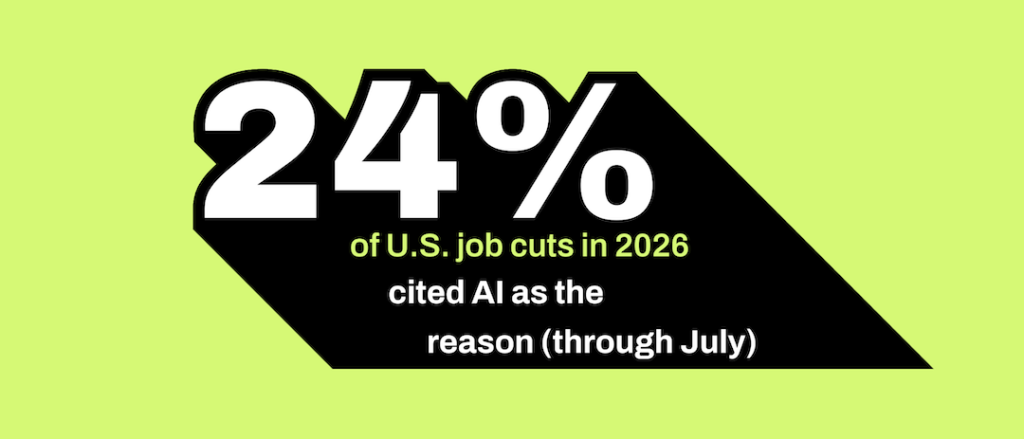
- Through July 2026, AI has been cited in 112,713 U.S. job cut announcements — approximately 24% of all cuts announced in 2026 (Challenger, Gray & Christmas).
- Between 2025 and 2030, employers expect 170 million jobs to be created and 92 million displaced worldwide — a structural churn equal to 22% of the 1.2 billion formal jobs studied, for a net gain of 78 million jobs (WEF, Future of Jobs Report 2025).
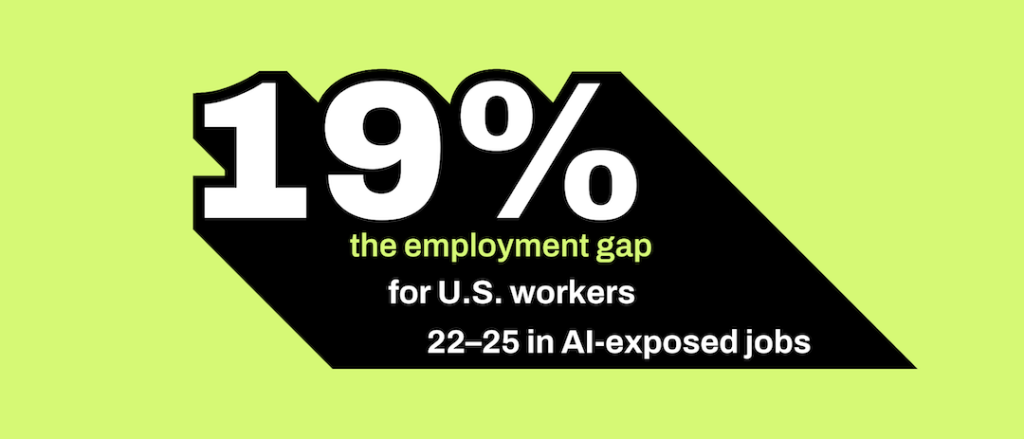
- Employment of U.S. workers ages 22–25 in highly AI-exposed occupations stood about 19% below where it would be had it kept pace with less-exposed peers as of June 2026 — while experienced workers showed no comparable gap (Stanford Digital Economy Lab). The authors describe the finding as descriptive rather than causal.
- Goldman Sachs Research estimates AI could displace 6–7% of the U.S. workforce if widely adopted, with displacement ranging from 3% to 14% under different assumptions (Goldman Sachs).
- Beyond explicitly AI-cited cuts, Challenger tracked another 20,219 U.S. job cuts in 2025 under “Technological Update (possibly AI)” — cases where employers blamed new technology without directly naming AI (Challenger, Gray & Christmas).
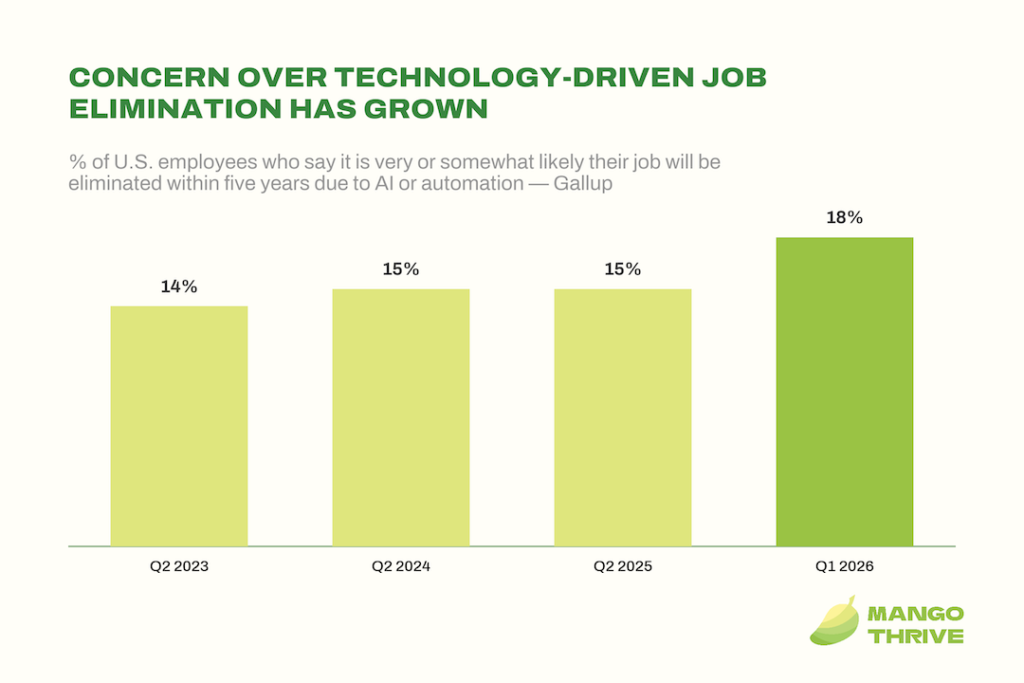
- 18% of U.S. employees say it is likely their job will be eliminated within five years due to AI or automation — up from 14% in mid-2023 — and the share rises to 23% at organizations that have adopted AI (Gallup).
- Job postings that include AI skills offer 28% higher salaries — nearly $18,000 more per year — than postings without them (Lightcast).
- Interpreters and translators top Microsoft Research’s AI applicability ranking with a score of 0.492, and 98% of their work activities appear in real-world Copilot usage (Microsoft Research).
Is AI Replacing Jobs?
The most direct measure comes from Challenger, Gray & Christmas, the outplacement firm that tracks the stated reasons behind U.S. layoff announcements.
1. Through July 2026, AI has been cited in 112,713 U.S. job cut announcements — approximately 24% of all cuts announced in 2026 (Challenger, Gray & Christmas).
Source: Challenger, Gray & Christmas, p. 3
2. AI was the leading stated reason for U.S. job cuts for the fifth consecutive month in July 2026, cited in 10,970 cuts, or 33% of the month’s total (Challenger, Gray & Christmas).
AI Layoffs in 2026
Announced job cuts capture intent, not verified eliminations, and the same reports show hiring continuing alongside the cuts. The numbers below describe both sides.
3. Since Challenger, Gray & Christmas began tracking AI as a layoff reason in 2023, U.S. employers have cited it in 184,538 job cut announcements (Challenger, Gray & Christmas).
4. The U.S. technology sector announced 149,023 job cuts through July 2026 — up 67% from the same period in 2025 and 31% of all announced cuts — with Challenger noting that AI “is still the reason companies give” (Challenger, Gray & Christmas).
5. Beyond explicitly AI-cited cuts, Challenger tracked another 20,219 U.S. job cuts in 2025 under “Technological Update (possibly AI)” — cases where employers blamed new technology without directly naming AI (Challenger, Gray & Christmas).
6. U.S. employers announced plans to hire 107,500 workers through July 2026, up 25% from the same period in 2025 — evidence, per Challenger, that AI “is shifting the labor market, it is not dismantling it” (Challenger, Gray & Christmas).
Which Companies Are Replacing Jobs With AI?
A growing list of employers now name AI directly when announcing workforce reductions, in industries well beyond tech.
7. Visa announced a 7% workforce reduction in July 2026, attributing it to an efficiency push in which AI would reshape work (Challenger, Gray & Christmas).
8. Amazon announced a reduction of approximately 14,000 corporate roles in October 2025, with HR chief Beth Galetti calling this generation of AI “the most transformative technology we’ve seen since the Internet” (Amazon). To put those cuts in context, Amazon employs nearly 1.6 million people worldwide. See our full breakdown of Amazon employee statistics.
9. Lufthansa Group plans to cut around 4,000 mostly administrative jobs worldwide by 2030, citing efficiency gains from digitalization and the increased use of AI (Lufthansa Group).
10. CrowdStrike cut approximately 500 positions — about 5% of its workforce — in May 2025, with CEO George Kurtz telling employees that “AI flattens our hiring curve” (CrowdStrike 8-K).
11. Recruit Holdings, parent of Indeed and Glassdoor, laid off about 1,300 employees — 6% of its HR-technology division — in July 2025, as CEO Hisayuki Idekoba told staff “AI is changing the world, and we must adapt” (TechCrunch).
How Many Jobs Will AI Replace? Global Forecasts
Forecasters disagree on the scale, but the most recent models from employers, banks, and research firms all point to major churn rather than simple elimination.
12. Between 2025 and 2030, employers expect 170 million jobs to be created and 92 million displaced worldwide — a structural churn equal to 22% of the 1.2 billion formal jobs studied, for a net gain of 78 million jobs (WEF, Future of Jobs Report 2025).
13. Broadening digital access is forecast to create 19 million jobs and displace 9 million by 2030 — more than any other macrotrend (WEF, Future of Jobs Report 2025).
14. Robots and autonomous systems are expected to be the largest net job displacer of any technology trend, with a net decline of 5 million jobs globally by 2030 (WEF, Future of Jobs Report 2025).
15. Aging and declining working-age populations are forecast to create 11 million jobs while driving a reduction of 7 million others globally by 2030 (WEF, Future of Jobs Report 2025).
16. 86% of employers surveyed expect AI and information processing technologies to transform their business by 2030 — the biggest impact of any technology trend (WEF, Future of Jobs Report 2025).
17. Goldman Sachs Research estimates AI could displace 6–7% of the U.S. workforce if widely adopted, with displacement ranging from 3% to 14% under different assumptions (Goldman Sachs).
18. Goldman Sachs Research estimates U.S. unemployment will rise by half a percentage point during the AI transition period as displaced workers search for new roles (Goldman Sachs).
19. Forrester forecasts AI will account for 6% of total U.S. job losses through 2030 — about 10.4 million roles (Forrester).
20. Rather than eliminating roles outright, Forrester forecasts AI will augment 20% of U.S. jobs over the next five years (Forrester).
21. Across ten European countries, 58% of current work hours are technically automatable with existing technologies — 44% by AI agents and 14% by robots — compared with 57% in the United States (McKinsey Global Institute). Technical automation potential describes hours that could be automated, not jobs that will be lost.
Which Jobs Are Most Exposed to AI?
Two of the most detailed exposure studies published to date come from the International Labour Organization and Microsoft Research, and they measure exposure in very different ways.
22. 3.3% of global employment falls into the highest generative-AI exposure tier of the 2025 ILO–NASK occupational exposure index (ILO, Working Paper 140).
23. Globally, 4.7% of female employment sits in the highest generative-AI exposure tier, versus 2.4% of male employment (ILO, Working Paper 140).
24. Only 13 occupations worldwide fall into the ILO’s highest generative-AI exposure tier, and the majority are clerical roles such as data entry clerks and general office clerks (ILO, Working Paper 140).
25. In low-income countries, just 11% of employment falls into any generative-AI exposure gradient, per the ILO–NASK 2025 index (ILO, Working Paper 140).
26. In Europe and Central Asia, 39% of female employment is in generative-AI-exposed occupations compared with 26% of male employment (ILO, Working Paper 140).
Which occupations does AI usage data flag?
Rather than modeling exposure in theory, Microsoft Research measured which occupations’ tasks people actually bring to an AI assistant.
27. Microsoft’s occupational AI applicability index is built from 200,000 anonymized Bing Copilot conversations collected between January and September 2024 (Microsoft Research).
28. Interpreters and translators top Microsoft Research’s AI applicability ranking with a score of 0.492, and 98% of their work activities appear in real-world Copilot usage (Microsoft Research).
29. Historians rank second in Microsoft Research’s AI applicability index with a score of 0.462 (Microsoft Research).
30. Customer service representatives — a U.S. occupation employing 2,858,710 people — score 0.408 on Microsoft Research’s AI applicability index, placing them in the top 10 most AI-applicable occupations (Microsoft Research).
31. Microsoft Research found only a weak correlation (r = 0.13) between an occupation’s AI applicability and its wage, contradicting earlier predictions that AI exposure rises with pay (Microsoft Research).
How Is AI Transforming Job Skills?
Inside most jobs, AI is changing the mix of skills employers ask for faster than it is eliminating the jobs themselves.
32. 26% of U.S. jobs posted on Indeed from May 2024 to April 2025 could be highly transformed by generative AI, while 54% face moderate transformation (Indeed Hiring Lab).
33. 46% of skills in a typical U.S. job posting are poised for “hybrid transformation,” where generative AI does routine work under human oversight (Indeed Hiring Lab).
34. 81% of skills in the typical U.S. software development job posting fall into generative AI hybrid-transformation categories — the most exposed occupation in Indeed’s 2025 index (Indeed Hiring Lab).
35. At the other end of the scale, 68% of skills in the typical U.S. nursing job posting fall into generative AI’s minimal-transformation category (Indeed Hiring Lab).
36. Skills sought by employers are changing 66% faster in occupations most exposed to AI versus least exposed — up from 25% a year earlier (PwC, 2025 Global AI Jobs Barometer).
37. The share of AI-augmented jobs requiring a formal degree fell from 66% in 2019 to 59% in 2024 (PwC, 2025 Global AI Jobs Barometer).
38. Employers expect 39% of workers’ core skills to change by 2030, down from 44% when surveyed in 2023 (WEF, Future of Jobs Report 2025).
39. 63% of employers identify skill gaps as the biggest barrier to business transformation over the 2025–2030 period (WEF, Future of Jobs Report 2025).
Which Clerical and Sales Jobs Are Projected to Decline?
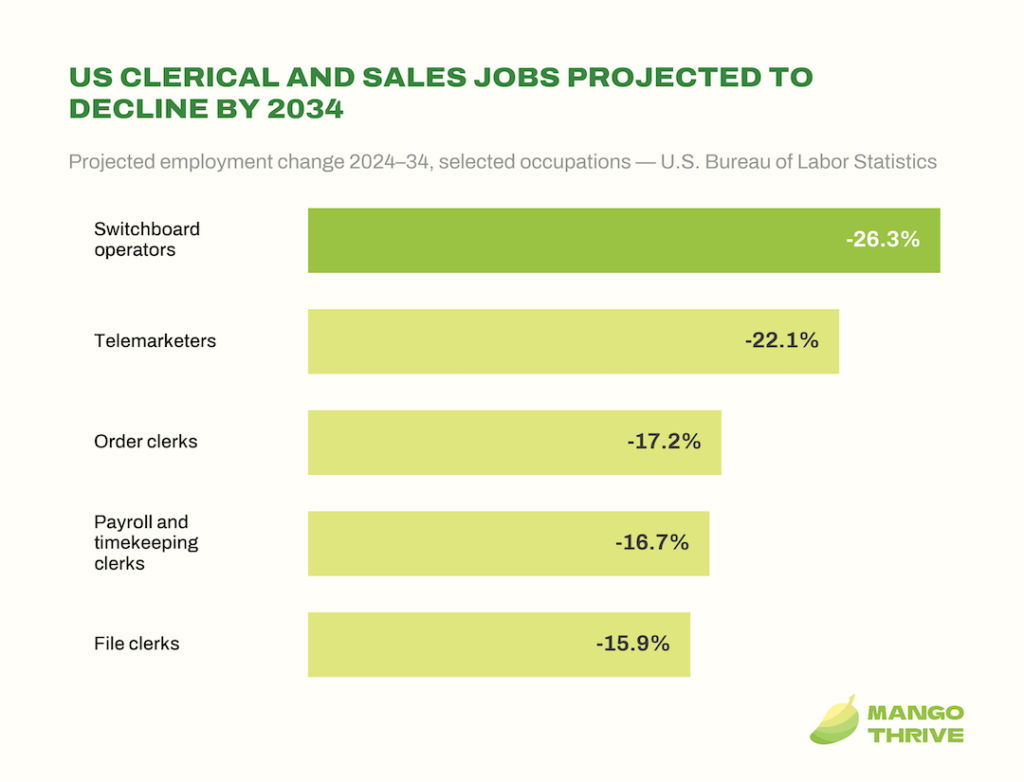
The Bureau of Labor Statistics projects steep declines for several clerical and sales occupations over the next decade; the BLS does not attribute the declines to a single cause.
Source: BLS, Employment Projections
40. U.S. switchboard operator employment is projected to fall 26.3% between 2024 and 2034, from 36,600 to 27,000 jobs (BLS, Employment Projections).
41. U.S. telemarketer employment is projected to fall 22.1% between 2024 and 2034, from 67,400 to 52,500 jobs (BLS, Employment Projections).
42. Order clerk employment in the U.S. is projected to decline 17.2% from 2024 to 2034, from 89,500 to 74,100 jobs (BLS, Employment Projections).
43. Payroll and timekeeping clerk jobs in the U.S. are projected to decline 16.7% from 2024 to 2034, a loss of 27,000 positions (BLS, Employment Projections).
44. U.S. file clerk employment is projected to shrink 15.9% between 2024 and 2034, from 84,300 to 70,900 jobs (BLS, Employment Projections).
Is AI Replacing Entry-Level Jobs?
If AI is taking over the routine work that once trained beginners, the first place it should show up is in hiring for the youngest workers. That is exactly where researchers are looking.
45. Employment of U.S. workers ages 22–25 in highly AI-exposed occupations stood about 19% below where it would be had it kept pace with less-exposed peers as of June 2026 — while experienced workers showed no comparable gap (Stanford Digital Economy Lab). The authors describe the finding as descriptive rather than causal.
Source: Stanford Digital Economy Lab
46. The AI employment gap for young U.S. workers has widened steadily — from 15% at the July 2025 data vintage to 19% as of June 2026 (Stanford Digital Economy Lab).
47. Employment of 22–25-year-olds in the two most AI-exposed occupation quintiles fell about 11% between November 2022 and June 2026, while employment of the same age group in the three least-exposed quintiles grew about 10% (Stanford Digital Economy Lab).
48. The unemployment rate for recent U.S. college graduates stayed elevated at about 5.6% through Q2 2026 (New York Fed).
49. The underemployment rate for recent U.S. college graduates edged up to 42% in Q2 2026 — meaning they were working jobs that typically do not require a degree (New York Fed). The New York Fed does not attribute these rates to AI.
50. New-grad and entry-level hiring is down roughly 65% at the large tech companies SignalFire tracks as “Tech Majors” and about 76% at early-stage startups compared with 2019 (SignalFire).
51. Graduates of top-20 U.S. computer science programs in 2025 were 45% less likely to take an engineering role at a major tech company than just a few years earlier (SignalFire).
52. Job postings on Handshake had declined more than 16% year over year as of August 2025, while the average number of applications per job had risen by 26% (Handshake).
Is AI Creating Jobs?
The same reports that track displacement also track the other side of the ledger: new roles, new skill demands, and pay premiums for workers who use AI.
53. 70% of employers plan to hire staff with new skills over the 2025–2030 period (WEF, Future of Jobs Report 2025).
54. Job postings that include AI skills offer 28% higher salaries — nearly $18,000 more per year — than postings without them (Lightcast).
55. As of 2024, 51% of job postings requiring AI skills sit outside IT and computer science occupations (Lightcast).
56. Generative AI roles in non-tech industries have grown 800% since 2022 (Lightcast).
57. 78% of business leaders are considering hiring for AI-specific roles — rising to 95% among AI-mature “Frontier Firms” (Microsoft Work Trend Index 2025).
58. Headcount at the most prominent AI startups on LinkedIn grew 20.6% year over year — nearly twice Big Tech’s 10.6% pace (Microsoft Work Trend Index 2025).
59. Farmworkers top the list of largest-growing roles globally, with 35 million additional jobs expected by 2030 (WEF, Future of Jobs Report 2025). The biggest job growth of the next five years is not in AI roles at all.
How Do Workers Feel About AI Replacing Jobs?
Worker sentiment sits somewhere between the layoff headlines and the reassuring forecasts, and it is measurably shifting.
60. 43% of workers globally fear AI will take their jobs, versus just 21% of leaders at AI-mature Frontier Firms (Microsoft Work Trend Index 2025).
61. 18% of U.S. employees say it is likely their job will be eliminated within five years due to AI or automation — up from 14% in mid-2023 — and the share rises to 23% at organizations that have adopted AI (Gallup).
Source: Gallup
62. 34% of U.S. employees at AI-adopting organizations say their employer is hiring and expanding the workforce, versus 28% at organizations that have not adopted AI (Gallup).
63. Employees at AI-adopting U.S. organizations are also more likely to report workforce reductions — 23% versus 16% at non-adopting organizations (Gallup).
64. Only 22% of workers worldwide strongly agree their job is safe from elimination (ADP Research, survey of 39,000+ workers in 36 markets).
65. Confidence that one’s job is safe from elimination climbs with seniority: 18% of individual contributors strongly agree, versus 35% of C-suite executives (ADP Research).
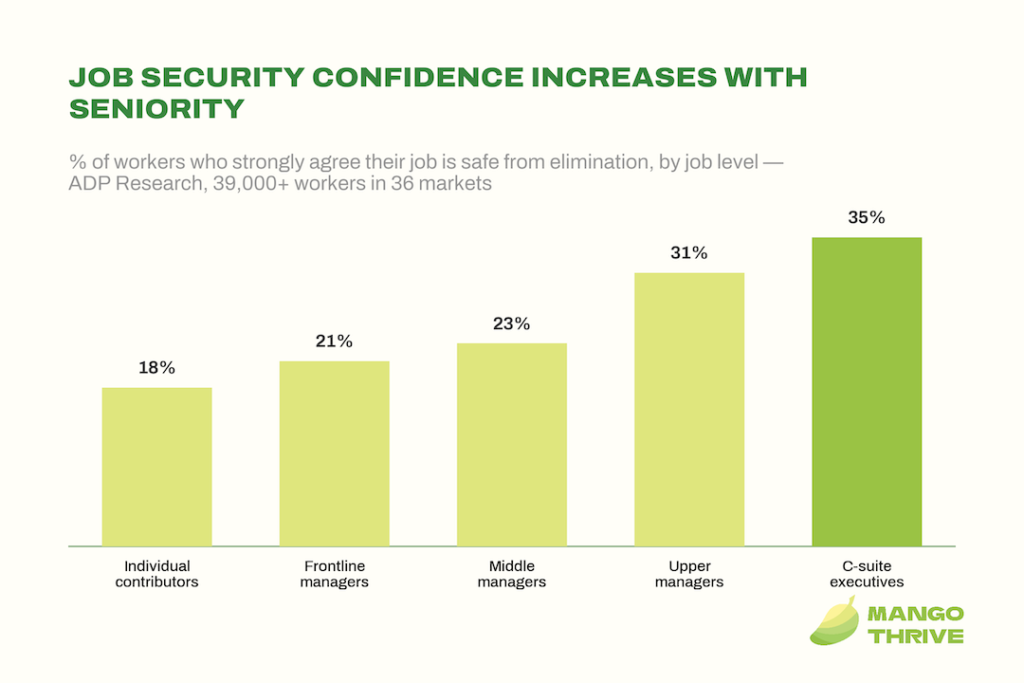
Source: ADP Research
66. 35% of adults across 30 countries believe AI will make the job market worse, versus 31% who expect it to improve (Ipsos AI Monitor 2025).
Conclusion
The data describes a labor market in transition rather than one in collapse. Displacement is real and measurable, but so are the new roles, rising pay premiums, and hiring that continue alongside it. The sharpest effects so far are concentrated among specific occupations and the youngest workers, not spread evenly across the workforce. How wide that concentration spreads is the question the next few years of data will answer.