
How Many People Use AI? 76 Statistics for 2026
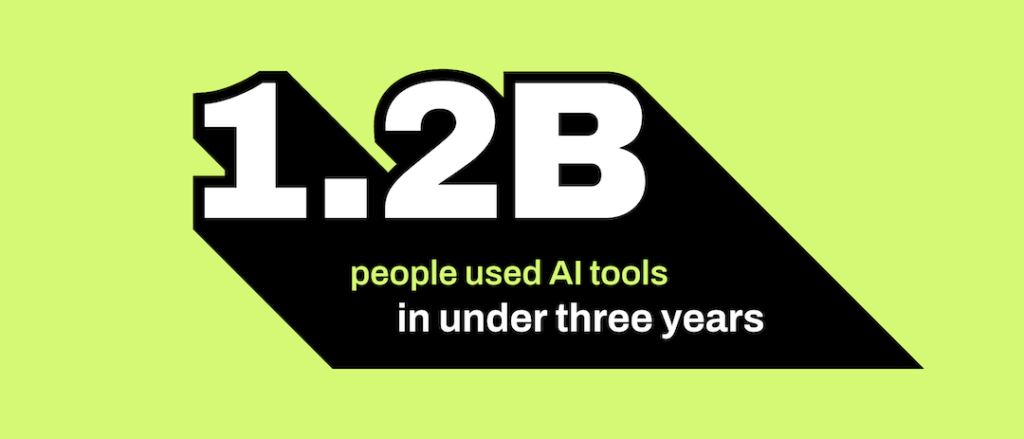
More than 1.2 billion people used AI tools within less than three years of ChatGPT’s launch, an adoption rate faster than the internet, the PC, or the smartphone, per Microsoft telemetry-based estimates (Microsoft AI Diffusion Report). Roughly one in six people worldwide used generative AI tools by the end of 2025 (Microsoft, Global AI Adoption in 2025).
Here are 76 statistics on who uses AI, where, how often, and what they think about it:
Top AI User Statistics
- eMarketer forecasts 133.0 million Americans, 39.2% of the population, will use generative AI in 2026 (eMarketer, FAQ on Generative AI 2026)
- More than 1.2 billion people used AI tools within less than three years of ChatGPT’s launch, per Microsoft telemetry-based estimates (Microsoft AI Diffusion Report)
- 66% of adults across 21 surveyed countries used an AI tool or application in the past twelve months (Google/Ipsos, Multi-Country AI Survey 2026)
- 54.6% of US adults ages 18–64 used generative AI as of August 2025, up 10 percentage points in one year (St. Louis Fed, The State of Generative AI Adoption in 2025)
- The UAE leads the world in AI adoption with 64.0% of its working-age population using AI tools at the end of 2025 (Microsoft, Global AI Adoption in 2025)
- ChatGPT reached 900 million weekly active users as of February 2026 (OpenAI, Scaling AI for Everyone)
- Google’s Gemini app reached 950 million monthly active users as of Q2 2026 (Alphabet Q2 2026 earnings, CEO remarks)
- About a quarter (24%) of US adults use AI chatbots daily (Pew Research Center, Americans and AI 2026)
- 52% of US employees use AI in their role at least a few times a year as of May 2026 (Gallup, AI adoption indicator)
- 50% of US adults say the growing use of AI in daily life makes them more concerned than excited (Pew Research Center, How Americans view AI, September 2025)
How Many People Use AI Worldwide?
No single tracker counts every AI user on the planet, so the best answers come from telemetry estimates and large multi-country surveys.
1. More than 1.2 billion people used AI tools within less than three years of ChatGPT’s launch, an adoption rate faster than the internet, the PC, or the smartphone, per Microsoft telemetry-based estimates (Microsoft AI Diffusion Report)
Source: Microsoft AI Diffusion Report
2. Roughly one in six people worldwide used generative AI tools by the end of 2025 (Microsoft, Global AI Adoption in 2025)
3. An estimated 1.7–1.8 billion people worldwide use AI tools, including 500–600 million daily users, per Menlo Ventures’ 2025 extrapolation from its US survey (Menlo Ventures, 2025: The State of Consumer AI)
4. The share of people who have ever used a generative AI system jumped from 40% in 2024 to 61% in 2025 across six countries surveyed by the Reuters Institute: Argentina, Denmark, France, Japan, the UK, and the US (Reuters Institute, Generative AI and News Report 2025)
5. Weekly generative AI use across six countries nearly doubled from 18% to 34% between 2024 and 2025, growth the Reuters Institute calls roughly three times faster in relative terms than internet adoption in the late 1990s (Reuters Institute, Generative AI and News Report 2025)
6. 66% of adults across 21 surveyed countries say they used an AI tool or application in the past twelve months, according to a late-2025 Google/Ipsos survey (Google/Ipsos, Multi-Country AI Survey 2026)
7. 62% of adults across 21 countries say they used generative AI tools specifically in the past twelve months, per the same Google/Ipsos polling (Google/Ipsos survey topline, 2026)
Is AI spreading faster than the internet did?
8. 54.6% of US adults ages 18–64 used generative AI as of August 2025, up 10 percentage points in one year (St. Louis Fed, The State of Generative AI Adoption in 2025)
9. Three years after ChatGPT’s launch, generative AI’s 54.6% US adoption rate dwarfs where the PC (19.7%) and the internet (30.1%) stood three years into their own rollouts (St. Louis Fed, The State of Generative AI Adoption in 2025)
10. 49% of US adults now say they use AI chatbots like ChatGPT, Gemini or Copilot, up from 33% in 2024 (Pew Research Center, Americans and AI 2026)
AI Users by Country
Adoption looks nothing alike from one country to the next, and the countries leading the rankings are not the ones you might expect.
11. The UAE leads the world in AI adoption with 64.0% of its working-age population using AI tools at the end of 2025, ahead of Singapore at 60.9% (Microsoft, Global AI Adoption in 2025)
12. The US ranks only 24th worldwide in AI usage, with 28.3% of its working-age population using AI tools at the end of 2025, despite leading in AI infrastructure and frontier models (Microsoft, Global AI Adoption in 2025)
13. 24.7% of the working-age population in the Global North uses AI tools, compared with 14.1% in the Global South (Microsoft, Global AI Adoption in 2025)
14. Generative AI use in the past year runs highest in the UAE (85%), Nigeria (84%) and India (83%) among 21 countries surveyed by Google/Ipsos in late 2025 (Google/Ipsos survey topline, 2026)
15. In the same Google/Ipsos survey, past-year generative AI use was lowest in the US (40%), Japan (42%) and Germany (47%) (Google/Ipsos survey topline, 2026)
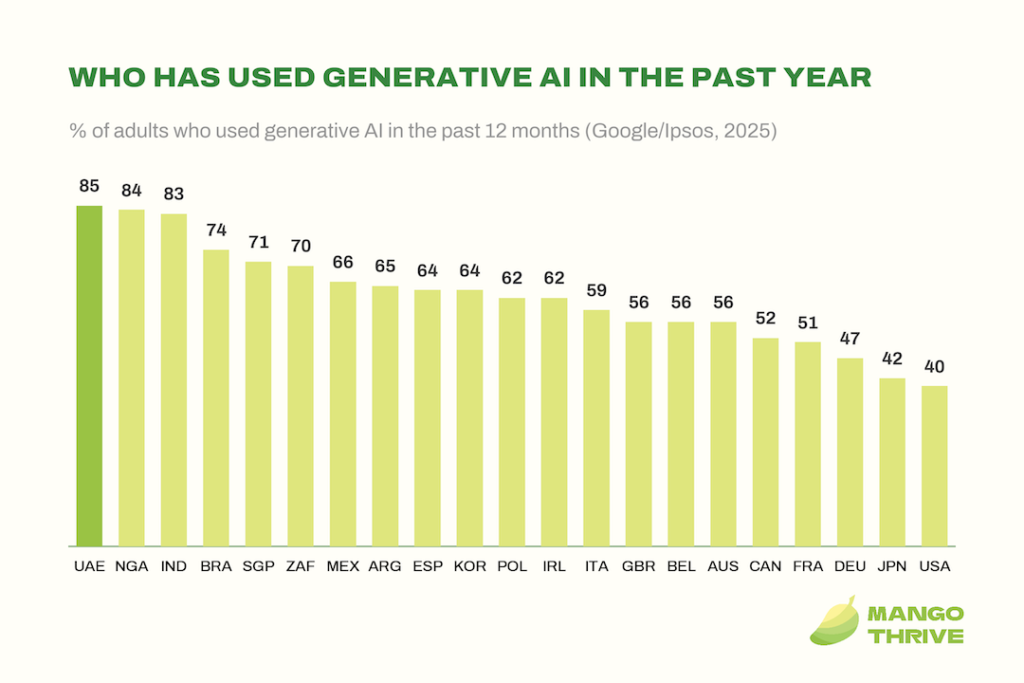
Source: Google/Ipsos survey topline, 2026, p. 2. US respondents came from a probability-based panel; other countries used online panels.
| Country | % who used generative AI in the past 12 months |
| UAE | 85% |
| Nigeria | 84% |
| India | 83% |
| Brazil | 74% |
| Singapore | 71% |
| South Africa | 70% |
| Mexico | 66% |
| Argentina | 65% |
| Spain | 64% |
| South Korea | 64% |
| Poland | 62% |
| Ireland | 62% |
| Italy | 59% |
| UK | 56% |
| Belgium | 56% |
| Australia | 56% |
| Canada | 52% |
| France | 51% |
| Germany | 47% |
| Japan | 42% |
| US | 40% |
Source: Google/Ipsos survey topline, 2026, p. 2 (Q4)
16. In 20 of 21 countries surveyed by Google/Ipsos in 2025, more than half of adults said they had used an AI application in the past year (Google/Ipsos, Multi-Country AI Survey 2026)
17. 32.7% of EU residents aged 16–74 used generative AI tools in 2025, according to Eurostat’s ICT household survey (Eurostat, ICT usage in households 2025)
18. Within the EU, 25.1% of people used generative AI for personal purposes in 2025, versus 15.1% for work and 9.4% for formal education (Eurostat, ICT usage in households 2025)
19. Denmark leads the EU in generative AI use at 48.4% of residents aged 16–74 in 2025, followed by Estonia (46.6%) and Malta (46.5%) (Eurostat, ICT usage in households 2025)
20. The EU’s lowest generative AI usage rates in 2025 were in Romania (17.8%), Italy (19.9%) and Bulgaria (22.5%) (Eurostat, ICT usage in households 2025)
21. Outside the EU, 56% of people in Norway and 47% in Switzerland used generative AI tools in 2025, per Eurostat data (Eurostat, Use of AI by individuals)
AI Users by Age and Demographics
Age is the sharpest dividing line in who uses AI, but income and education draw clear lines too.
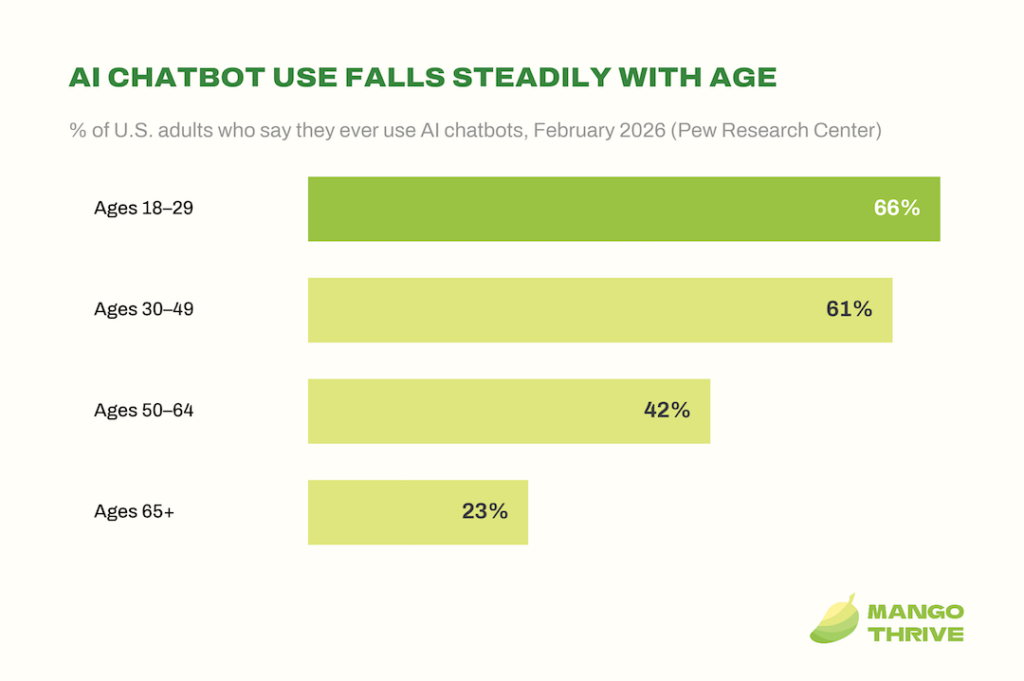
22. AI chatbot use in the US falls steadily with age: 66% of adults 18–29 use them, versus 61% of 30–49s, 42% of 50–64s and 23% of those 65 and older (Pew Research Center, How opinions and use of AI differ by age)
Source: Pew Research Center, How opinions and use of AI differ by age
23. Chatbot use in the US climbs with income: 41% of lower-income adults use them, versus 49% of middle-income and 66% of upper-income adults (Pew Research Center, Americans and AI 2026)
24. The gender gap in US chatbot adoption has closed, with 50% of men and 47% of women now using chatbots versus an 11-point gap in 2024, though men remain likelier to use them daily (27% vs 20%) (Pew Research Center, The Gender Gap in AI)
25. 1 in 5 US adults under 30 say they turn to AI chatbots for emotional support or advice, compared with just 2% of those 65 and older (Pew Research Center, How opinions and use of AI differ by age)
26. 64% of US teens ages 13–17 use AI chatbots, and about 3 in 10 use them daily (Pew Research Center, Teens, Social Media and AI Chatbots 2025)
27. In the EU, 64% of people aged 16–24 used generative AI in 2025, the biggest user group, versus just 7% of those aged 65–74 (Eurostat, Use of AI by individuals)
28. Education strongly predicts AI use in the EU: 49% of people with high formal education used generative AI in 2025, versus 26% with medium and 22% with little or no formal education (Eurostat, Use of AI by individuals)
29. Across six countries, 59% of 18–24-year-olds used generative AI in the past week in 2025, compared with 20% of those 55 and over (Reuters Institute, Generative AI and News Report 2025)
Which AI Tools People Use Most
Company disclosures and independent surveys tell the same story: a handful of assistants now count their users in the hundreds of millions.
30. ChatGPT reached 900 million weekly active users and more than 50 million consumer subscribers as of February 2026, OpenAI announced (OpenAI, Scaling AI for Everyone)
31. ChatGPT became the fastest mobile app ever to reach 1 billion monthly active users in May 2026, hitting the mark in three years, faster than TikTok, YouTube, and Instagram, per Sensor Tower (Sensor Tower, State of AI 2026)
32. Google’s Gemini app reached 950 million monthly active users as of Q2 2026 (Alphabet Q2 2026 earnings, CEO remarks)
33. The Gemini app had crossed 750 million monthly active users as of February 2026, before passing 950 million by July (Google announcement via TechCrunch, February 2026)
34. Google’s Q&A-style AI Mode in Search crossed 1 billion users, the company said in Q2 2026 (Alphabet Q2 2026 earnings, via TechCrunch)
35. Meta AI passed 1 billion monthly active users across Meta’s family of apps as of May 2025 (CNBC, Zuckerberg at Meta’s 2025 shareholder meeting)
36. Microsoft’s family of Copilot apps surpassed 150 million monthly active users as of late October 2025 (Microsoft FY26 Q1 earnings call)
37. Microsoft 365 Copilot passed 30 million paid seats, Microsoft said on its Q4 FY2026 earnings call in July 2026 (Microsoft Q4 FY2026 earnings call, via UC Today)
38. Roughly 117 million monthly active users use Grok’s AI features, according to SpaceX’s May 2026 IPO filing (SpaceX S-1 filing, via Forbes)
39. China’s AI-native apps reached a combined 499 million monthly active users by May 2026, up 85.4% year over year, according to QuestMobile (QuestMobile 2026 first-half report, via TechNode)
40. DeepSeek held 130 million monthly active users in China as of May 2026, ranking third among AI-native apps behind Doubao (382 million) and Qwen (167 million), per QuestMobile (QuestMobile 2026 first-half report, via TechNode)
41. Claude is the fastest-growing challenger among AI assistants, with its share of unique US users (apps plus web) rising from 4.4% to nearly 14% in the year to May 2026, per Sensor Tower (Sensor Tower, State of AI 2026)
Which AI chatbot do Americans use most?
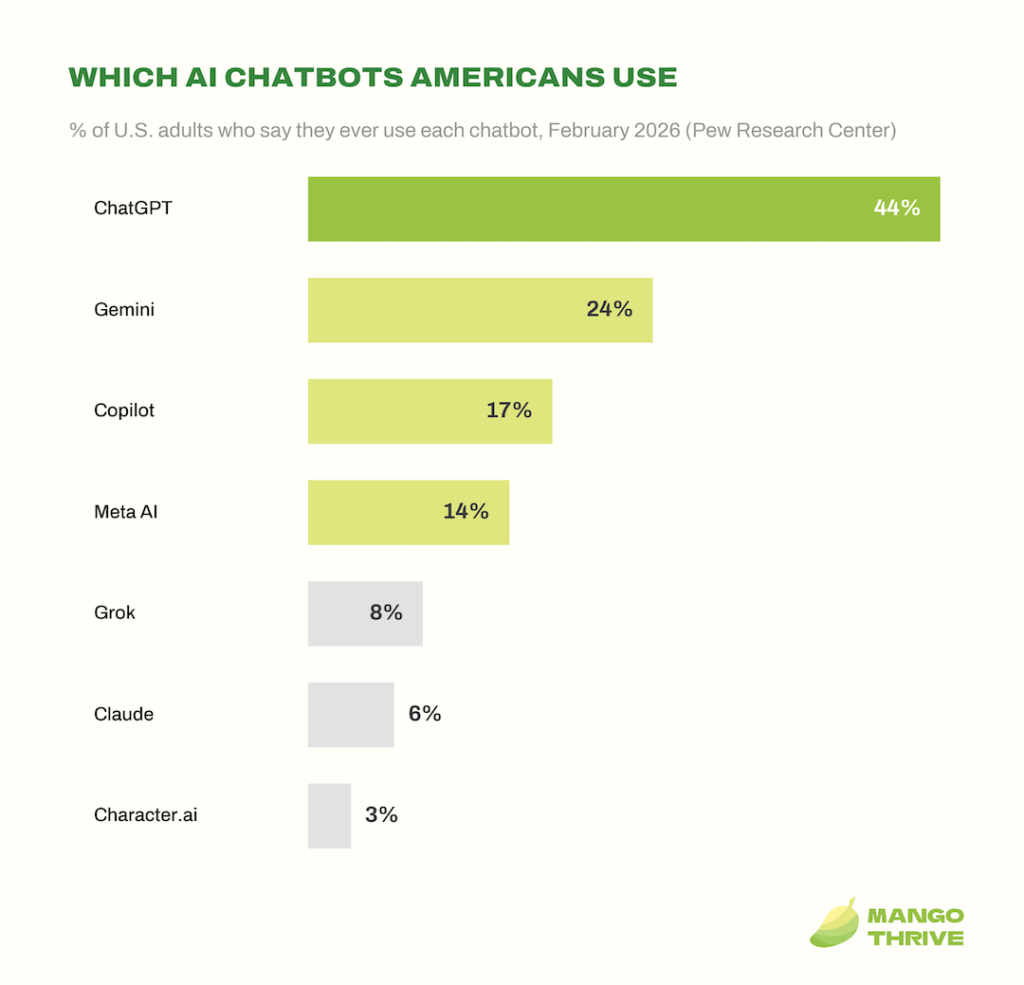
42. ChatGPT is the chatbot Americans use most (44% of adults), followed by Gemini (24%), Copilot (17%), Meta AI (14%), Grok (8%), Claude (6%) and Character.ai (3%) (Pew Research Center, Americans and AI 2026)
Source: Pew Research Center, Americans and AI 2026
43. Across six countries, 22% of people used ChatGPT in the last week in 2025, followed by Google Gemini (11%), Meta AI (9%) and Microsoft Copilot (6%) (Reuters Institute, Generative AI and News Report 2025)
44. Perplexity handled 780 million queries in May 2025, the last company-confirmed volume figure, with CEO Aravind Srinivas citing 20% month-over-month growth (Aravind Srinivas, via Search Engine Land)
How Often People Use AI
Trying something once is not the same as building a habit, and the frequency numbers show both sides.
45. About a quarter (24%) of US adults use AI chatbots daily, including 12% several times a day and 4% “almost constantly,” and a third of adults under 50 are daily users (Pew Research Center, Americans and AI 2026)
46. 61% of American adults used AI in the six months before Menlo Ventures’ April 2025 survey, and nearly 1 in 5 used it daily (Menlo Ventures, 2025: The State of Consumer AI)
47. Global time spent in generative AI apps is projected to reach 36 billion hours in H1 2026, up from 17.2 billion hours in H1 2025 (Sensor Tower, State of AI 2026)
48. About four in ten US adults use AI chatbots to search for information, and 38% of employed adults use them for work tasks (Pew Research Center, Americans and AI 2026)
49. 10% of people globally now use AI chatbots for news each week, up from 7% a year earlier, but only 1% say AI is their main source of news (Reuters Institute DNR 2026, AI chatbots chapter)
50. Across 27 markets, just 4% of all respondents say they always or often click through to the original news source from AI chatbots, compared with 19% from search engines (Reuters Institute DNR 2026, AI chatbots chapter)
51. Young people lead AI news consumption: 17% of the youngest age group use chatbots for news weekly, three times the rate of the oldest group (5%) (Reuters Institute DNR 2026, AI chatbots chapter)
AI Use at Work
Surveys of workers, not companies, show how far AI has actually traveled into daily jobs.
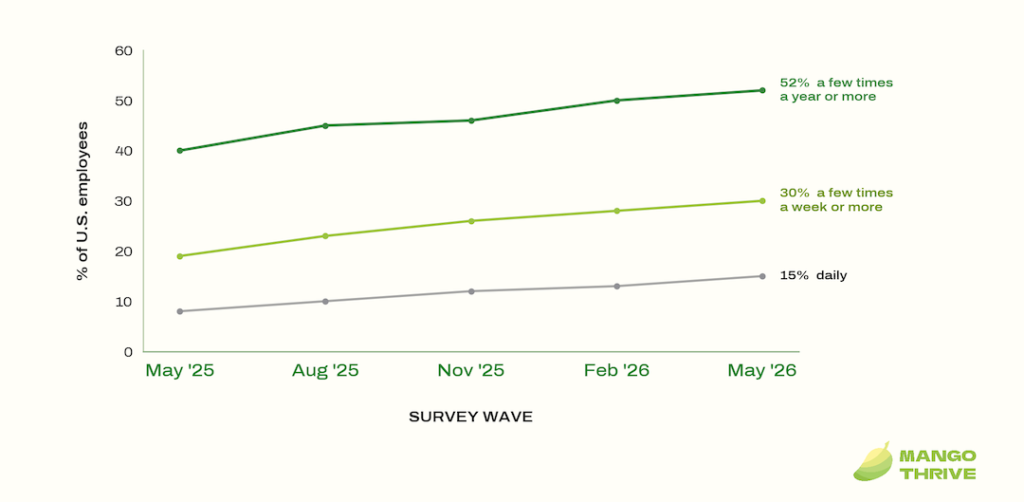
52. 52% of US employees now use AI in their role at least a few times a year as of May 2026, including 30% who use it a few times a week or more (Gallup, AI adoption indicator)
53. The share of US employees using AI at work has risen from 21% in May 2023 to 52% in May 2026, while daily use grew from 4% to 15% over the same period (Gallup, AI adoption indicator)
Source: Gallup, AI adoption indicator
54. Daily AI use at work is highest in technology (42%), finance (27%) and professional services (22%), while the remaining seven industries Gallup tracks range from 9% to 15% (Gallup, AI adoption indicator)
55. 37.4% of US working-age adults (18–64) used generative AI for work as of August 2025, up from 33.3% a year earlier (St. Louis Fed, The State of Generative AI Adoption in 2025)
56. Across the entire US workforce, the share of work hours spent using generative AI rose from 4.1% in November 2024 to 5.7% in August 2025 (St. Louis Fed, The State of Generative AI Adoption in 2025)
57. US workers report generative AI time savings equivalent to 1.6% of all work hours, which the St. Louis Fed estimates may have raised labor productivity by up to 1.3% since ChatGPT’s release (St. Louis Fed, The State of Generative AI Adoption in 2025)
58. 21% of US workers say at least some of their work is done with AI as of September 2025, up from 16% a year earlier, while 65% say they don’t use AI much or at all in their job (Pew Research Center, workers survey October 2025)
59. 28% of US workers with at least a bachelor’s degree do some of their work with AI, versus 16% of workers with some college or less education (Pew Research Center, workers survey October 2025)
60. Globally, 58% of employees across 47 countries intentionally use AI at work on a regular basis, and 31% use it weekly or daily (KPMG and University of Melbourne, Trust, Attitudes and Use of AI 2025)
61. 65% of US employees at organizations that have implemented AI say it has had a positive effect on their productivity, including 17% who call the impact “extremely positive” (Gallup, AI adoption indicator)
62. Only 14% of US employees in AI-adopting organizations strongly agree that AI has transformed how work gets done in their organization (Gallup, AI adoption indicator)
63. 18% of US employees say it is very or somewhat likely their job will be eliminated within five years due to AI or automation, up from 15% a year earlier (Gallup, February 2026 workforce survey)
What People Think About AI
Usage keeps climbing, but sentiment tells a more complicated story.
64. 50% of US adults say the growing use of AI in daily life makes them more concerned than excited, versus just 10% who are more excited than concerned (Pew Research Center, How Americans view AI, September 2025)
65. The share of Americans who are more concerned than excited about AI has climbed from 37% in 2021 to 50% in 2025 (Pew Research Center, Key findings on views of AI, March 2026)
66. Across 25 countries, a median of 34% of adults are more concerned than excited about AI in daily life, and in no country surveyed is the largest share more excited than concerned (Pew Research Center, Global views of AI, October 2025)
67. Across 47 countries, 54% of people are wary about trusting AI systems, and only 46% say they are willing to trust AI (KPMG and University of Melbourne, Trust, Attitudes and Use of AI 2025)
68. Even amid low trust, 72% of people globally say they accept the use of AI (KPMG and University of Melbourne, Trust, Attitudes and Use of AI 2025)
69. 70% of people across 47 countries believe AI regulation is necessary, but only 43% think current laws are adequate (KPMG and University of Melbourne, Trust, Attitudes and Use of AI 2025)
70. 56% of AI experts believe AI will have a positive impact on the US over the next 20 years, compared with just 17% of the American public, per Pew’s 2024 surveys (Pew Research Center, Public and AI experts survey, April 2025)
71. 47% of Americans say they have heard a lot about AI, up from 26% in 2022, and 31% now say they interact with AI several times a day (Pew Research Center, AI in Americans’ lives, September 2025)
AI User Growth Forecasts
Forecasters expect steady growth rather than another explosion, with the next fight over market share.
72. An estimated 121.1 million people in the US, 35.8% of the population, used generative AI in 2025 (eMarketer, FAQ on Generative AI 2026)
73. eMarketer forecasts 133.0 million Americans, 39.2% of the population, will use generative AI in 2026, up 9.8% year over year (eMarketer, FAQ on Generative AI 2026)
74. eMarketer forecasts Google’s AI tools will have more US users than ChatGPT by Q1 2027 (eMarketer, US GenAI Consumer Adoption Forecast H1 2026)
75. eMarketer projects Gemini’s US user base will grow from 55.7 million in 2025 to 85.7 million by 2029, reaching 52.6% of US generative AI users (eMarketer, Gemini growth analysis, December 2025)
76. US generative AI users crossed the 100 million milestone in 2024, per eMarketer’s forecast (eMarketer, GenAI hits 100 million users milestone)
Conclusion
Well over a billion people have now used AI, and the fastest growth is happening outside the countries that build the technology. The next shift to watch is not whether people try AI, but whether occasional use hardens into a daily habit: that is where the frequency, workplace, and forecast numbers above will move first. We update this page as new data lands, so check back for the latest figures.