
How Many Companies Use AI? 71 Statistics for 2026
88% of organizations regularly use AI in at least one business function, according to a 2025 McKinsey survey of 1,993 respondents worldwide.
Here are 71 statistics on how many companies use AI. Let’s dive in:
Key statistics
- 88% of organizations reported regularly using AI in at least one business function in McKinsey’s June–July 2025 survey (McKinsey, The State of AI in 2025), but only 7% of respondents said AI was fully scaled (McKinsey, AI at work but not at scale).
- 21.5% of US businesses used AI in any business function in the two weeks to July 12, 2026 — a series the Census Bureau updates every two weeks. (US Census Bureau, BTOS national data)
- The Census AI supplement reads 18% when weighted by firm and 32% when weighted by employment — because most firms are tiny and most workers are not. (US Census Bureau, CES working paper 26-25, p. 1)
- 20.0% of EU enterprises with 10 or more employees used at least one AI technology in 2025, up from 13.5% in 2024. (Eurostat, Use of AI in enterprises)
- Across 70,000-plus US businesses on the spend platform Ramp, the median firm spends $11.38 per employee per month on AI. (Ramp AI Index, June 2026)
- 39% of respondents attribute any EBIT impact at all to AI, and most of those put it below 5% of EBIT. (McKinsey, The State of AI in 2025 (PDF))
- 61.6% of US businesses with no plans to adopt AI say the reason is simply that “AI is not applicable to this business.” (US Census Bureau, BTOS AI Supplement 2026)
- Only 16% of enterprise “AI agent” deployments meet the technical definition of an agent. (Menlo Ventures, State of Generative AI in the Enterprise 2025)
- 12.8% of US manufacturing firms use AI in sales and marketing, against 2.2% in the production of goods. (US Census Bureau, BTOS AI Supplement 2026)
- 64.3% of AI-using US businesses made no organizational changes whatsoever in order to use AI. (US Census Bureau, BTOS AI Supplement 2026)
How many companies use AI?
Surveys of US firms as a whole land anywhere from 7% to 78%. The low end asks only about production and the high end asks executives; each survey asks different companies a differently worded question, then counts the answers differently.
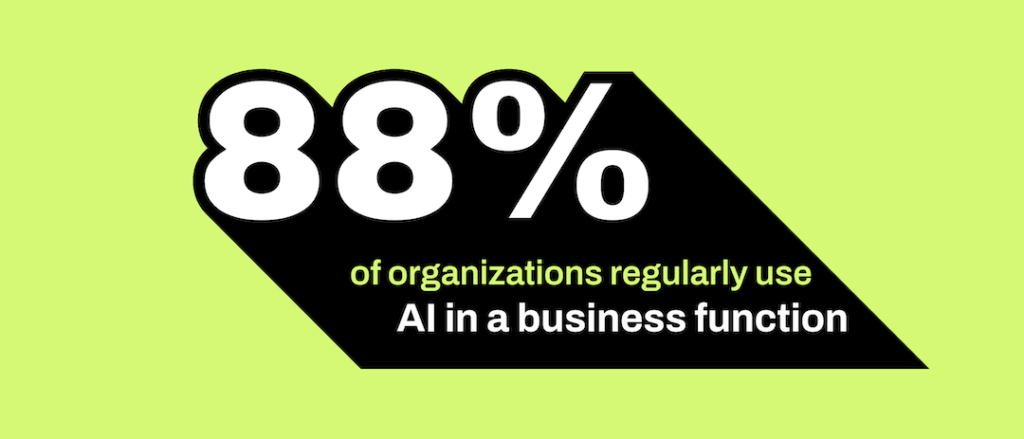
Source: McKinsey, The State of AI in 2025 (PDF), p. 3. Based on 1,993 respondents across 105 countries, surveyed 25 June to 29 July 2025 — see stat 1
1. 88% of organizations regularly use AI in at least one business function, up from 78% a year earlier, according to a survey of 1,993 respondents across 105 countries fielded between 25 June and 29 July 2025. (McKinsey, The State of AI in 2025)
2. Only 7% of respondents say AI has been fully scaled across their organization (McKinsey, AI at work but not at scale), and nearly two-thirds say their organizations have not yet begun scaling it (McKinsey, The State of AI in 2025).
3. McKinsey’s series runs 55% in 2023, 72% in early 2024, 78% in mid-2024 and 88% in 2025 — though the survey waves are unevenly spaced and the 2025 wave introduced a new “regular use” definition. (McKinsey, The State of AI: rewiring to capture value)
4. 79% of respondents say their organization regularly uses generative AI in at least one business function, up from 71% in 2024 — the same McKinsey panel as above, as reported by Stanford’s AI Index. (Stanford HAI, 2026 AI Index ch.4, p. 193)
5. 21.5% of US businesses answered yes to “In the last two weeks, did this business use Artificial Intelligence (AI) in any of its business functions?” in the cycle covering June 29 to July 12, 2026. (US Census Bureau, BTOS national data)
6. In July 2026, 26.2% of US businesses said they did not know whether they would be using AI in six months’ time — a larger share than the 24.3% who said yes. (US Census Bureau, BTOS national data)
7. The Census Bureau’s separate AI supplement, pooling more than 117,000 firms, reads 18% weighted by firm and 32% weighted by employment, because the US business population is overwhelmingly made up of very small firms while most employees work at large ones. (US Census Bureau, CES working paper 26-25, p. 1)
8. Asked directly in surveys fielded between November 2025 and January 2026, senior executives put adoption at 78% in the US, 71% in the UK, 65% in Germany and 59% in Australia. The figures are employment-weighted, so large firms carry more of the answer; the paper’s pooled average is 69%. (NBER, Firm Data on AI, p. 12)
9. Ask firms whether they use AI “for the production of goods or services” rather than for any purpose, and the figure falls to 7% in the US, in data collected between December 2024 and April 2025. (Mind the Gap, St. Louis Fed)
10. Across OECD countries with available data, 20.2% of firms used AI in 2025, up from 14.2% in 2024 and 8.7% in 2023. (OECD, ICT Access and Usage Database (January 2026))
11. In the EU, 20.0% of enterprises with 10 or more employees used at least one AI technology in 2025, up from 13.5% a year earlier — though that survey excludes agriculture, mining, the financial sector, and every enterprise with fewer than 10 employees. (Eurostat, Use of AI in enterprises)
Why the US rate jumped in November 2025
The Census Bureau changed the wording of its AI question, and the series stepped up with it.
12. The Census Bureau revised its AI question from AI used “in producing goods or services” to AI used “in any business function” in November 2025, and the measured rate stepped from 10.0% to 17.3%: the last reading under the old wording against the first under the new. (US Census Bureau, America Counts; rates from the current BTOS file and the archived pre-revision BTOS file)
13. The Bureau’s own methodology note says a “level shift [was] observed in conjunction with the new question wording” and that it therefore created an entirely new time series rather than continuing the old one. (US Census Bureau, BTOS question-wording note, p. 1)
AI adoption by company size
Company size predicts AI use in every dataset examined for this article. What is less well known is where the line actually falls.
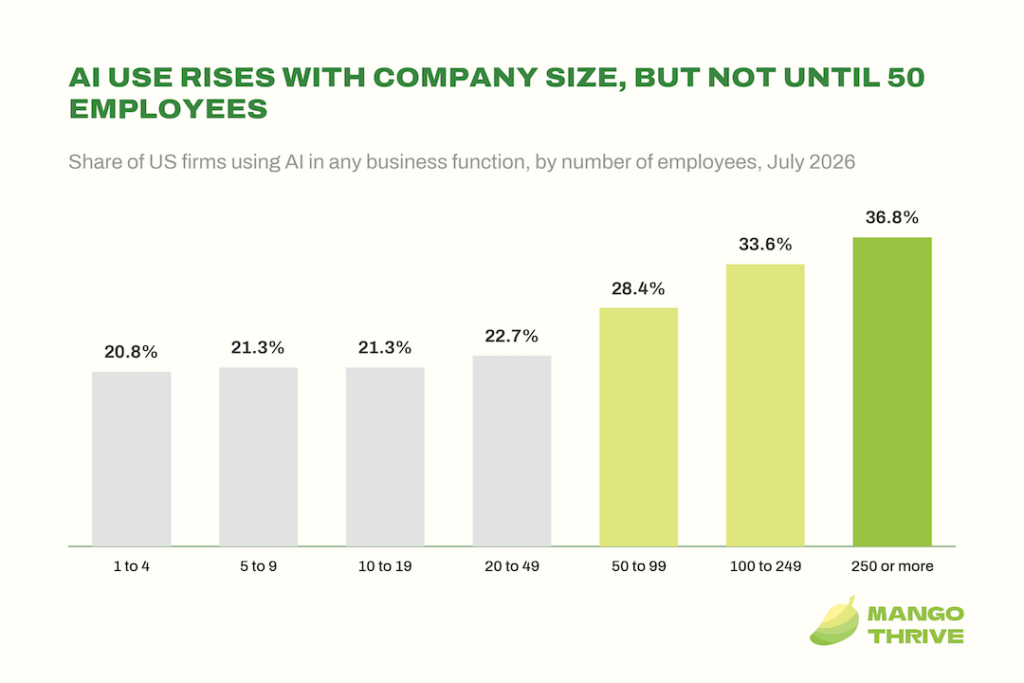
Source: US Census Bureau, BTOS by employment size, Employment Size Class table, cycle 202615 — see stat 14
14. Among US firms, AI use runs 20.8% (1–4 employees), 21.3% (5–9), 21.3% (10–19), 22.7% (20–49), 28.4% (50–99), 33.6% (100–249) and 36.8% (250 or more) — essentially flat below 50 employees, then climbing steeply. (US Census Bureau, BTOS by employment size)
15. In the EU, 55.0% of large enterprises used AI in 2025, against 30.4% of medium and 17.0% of small enterprises. (Eurostat, Key results 2026 edition)
16. The EU large-versus-small gap widened from 22.3 percentage points in 2021 to 38.0 points in 2025. (Calculated from Eurostat, dataset isoc_eb_ai)
17. The gap extends to depth: 33.6% of large EU enterprises use three or more AI technologies, against 6.5% of small ones. (Eurostat, Key results 2026 edition)
18. Across the OECD, 52.0% of large firms use AI against 17.4% of small firms. (OECD, ICT Access and Usage Database (January 2026))
19. 22.9% of US firms with 250 or more employees answered “do not know” when asked whether they had used AI in the prior two weeks, against 10.6% of firms with 1–4 employees. (US Census Bureau, BTOS AI Supplement 2026)
20. Analysis of 4.6 million US small businesses’ payment records found 17.7% had paid for at least one AI service by December 2025, up from 1.7% in 2019 and 11.6% in 2024. (JPMorganChase Institute, Small Business in the Age of AI, p. 6)
21. Within US small business, the gap between employers and non-employers widened from 5.6 points in January 2023 to 10.8 points in December 2025 (26.1% versus 15.3%). (JPMorganChase Institute, Small Business in the Age of AI, p. 17)
22. Among firms with under $250,000 in revenue, those with employees adopted at 27.6% against 14.3% for non-employers — and low-revenue employers out-adopted high-revenue non-employers, which the authors read as evidence that size does not explain the employer gap. (JPMorganChase Institute, Small Business in the Age of AI, p. 18)
23. One report contains both of these figures: 77% of US small and midsize businesses say they use AI regularly, while 12% of US businesses bought a standalone AI subscription at least once between 2021 and 2025 in payment records covering 4.3 million US businesses on Intuit’s platform. (Intuit QuickBooks, 2026 AI Impact Report, pp. 6, 8)
AI adoption by industry
The same sectors lead everywhere data exists — information and professional services at the top, construction and hospitality near the bottom — in the US, the EU and across the OECD. What has changed in 2026 is which sectors are growing.
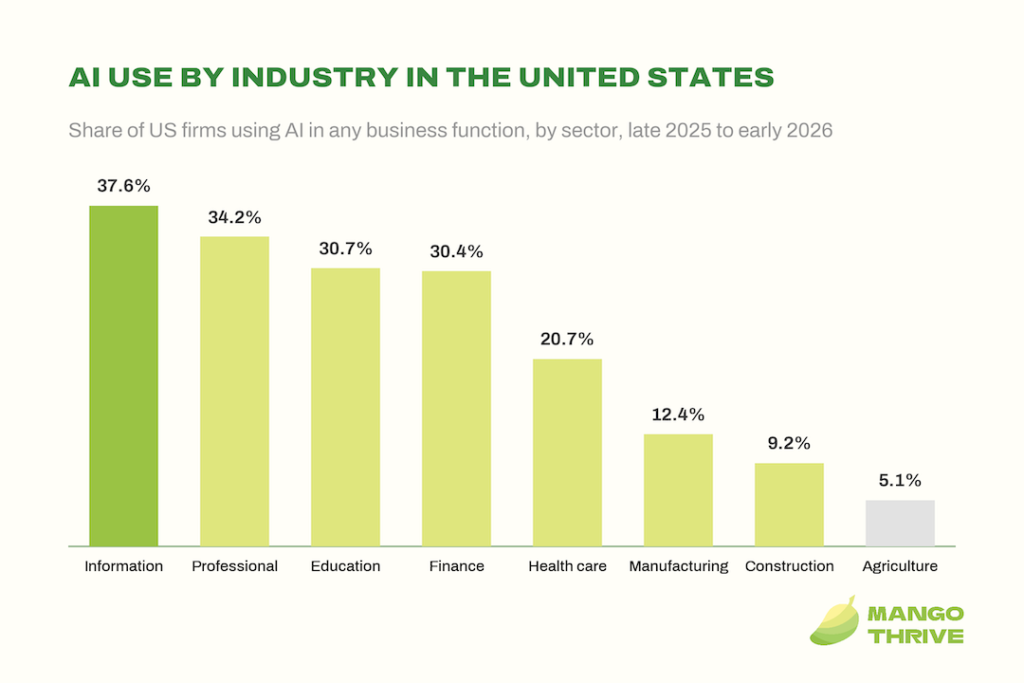
Source: US Census Bureau, BTOS AI Supplement 2026, Sector Response Estimates. Eight sectors shown; the full 19-sector ranking is in the table below
24. In the US, AI use ranged from 37.6% in Information down to 5.1% in Agriculture over the period November 2025 to February 2026. (US Census Bureau, BTOS AI Supplement 2026)
Full US ranking, share of firms using AI in any business function:
| Sector | % | Sector | % |
| Information | 37.6 | Utilities | 13.7 |
| Professional & technical services | 34.2 | Wholesale trade | 13.6 |
| Educational services | 30.7 | Retail trade | 12.6 |
| Finance & insurance | 30.4 | Manufacturing | 12.4 |
| Real estate | 23.5 | Other services | 9.8 |
| Management of companies | 20.9 | Construction | 9.2 |
| Health care & social assistance | 20.7 | Accommodation & food services | 8.0 |
| Arts & recreation | 17.5 | Mining | 7.7 |
| Admin & support services | 16.6 | Transportation & warehousing | 7.6 |
| Agriculture | 5.1 |
Source: US Census Bureau, BTOS AI Supplement 2026, reference period 17 November 2025 to 8 February 2026. National average 17.9%
25. In the EU the same pattern holds, running from 65.7% in computer programming and consultancy down to 10.79% in construction. (Eurostat, dataset isoc_eb_ain2)
26. Across the OECD, 57.3% of ICT firms used AI in 2025, the highest of the industries OECD reports, followed by professional and scientific services at 36.8%. (OECD, ICT Access and Usage Database (January 2026))
27. In some countries the ICT sector is close to saturation: 87.9% in Sweden, 79.9% in Austria and 79.8% in Finland. (OECD, ICT Access and Usage Database (January 2026))
Which industries are adopting AI fastest?
Not the ones already ahead. The OECD reports growth strongest in the industries that previously lagged, and the US and EU series show the same low-base sectors climbing.
28. In the US biweekly series, construction climbed from 7.4% in November 2025 to 13.6% in July 2026, and manufacturing from 12.7% to 20.3%, while Information barely moved, from 41.0% to 41.9%. These come from the biweekly sector series rather than the pooled supplement used in the table above, so the levels differ by up to several points. (US Census Bureau, BTOS by sector)
29. In the EU, construction rose from 4.62% in 2021 to 10.79% in 2025 — still the lowest rate of any sector in Eurostat’s 2025 ranking. (Eurostat, dataset isoc_eb_ain2)
30. Across the OECD, year-on-year growth in firm AI use reached 62.5% in accommodation and food services and 59.1% in construction — industries the OECD says “previously lagged behind” — against 42.4% growth for OECD firms overall. (OECD, ICT Access and Usage Database (January 2026))
What do manufacturers actually use AI for?
Marketing, mostly — not the factory floor.
31. Among all US manufacturing firms, 12.8% use AI in sales and marketing but only 2.2% use it in the production of goods, with quality management at 2.3% and distribution at 1.0%. (US Census Bureau, BTOS AI Supplement 2026)
32. The EU data leans the same way, on a narrower base: among manufacturing enterprises that already use AI, 30.41% use it mostly for marketing and sales, rising to 58.82% in accommodation and 48.18% in retail. (Eurostat, Use of AI in enterprises)
33. US construction firms show the same split. Asked what they had initiated or increased AI use for in the past year, 45% named office applications against 13% for “onsite construction activity, monitoring, documentation” — and 39% named nothing at all. (AGC of America and Sage, survey results, p. 8, question 15)
Industry-specific adoption rates
34. In the 2024 Bank of England and FCA survey — the most recent published — 75% of UK financial services firms already used AI, up from 58% in 2022, while the share planning to adopt within three years fell from 14% to 10%. (Bank of England and FCA, AI in UK financial services 2024)
35. The 2024 sub-sector spread ran to 38 points: 95% of insurers used AI, against 57% of financial market infrastructure firms. (Bank of England and FCA, AI in UK financial services 2024)
36. In the same survey, UK financial firms reported a median of 9 AI use cases, expected to more than double to 21 within three years — but large UK and international banks reported medians of 39 and 49. (Bank of England and FCA, AI in UK financial services 2024)
37. 72% of surveyed US physicians report at least one specific AI use case in practice, up from 48% in 2024 and 38% in 2023, with the average number of use cases per physician rising from 1.1 to 2.3. The AMA cautions that changes to its instrument “limit strict comparability across all survey waves.” (AMA, 2026 Physician Survey on Augmented Intelligence, p. 5)
38. 79% of legal professionals used AI in their firm in 2025, the same share Clio reported a year earlier — while the share using a legal-specific AI tool fell from 58% to 40%. (Clio, 2025 Legal Trends Report)
What companies use AI for
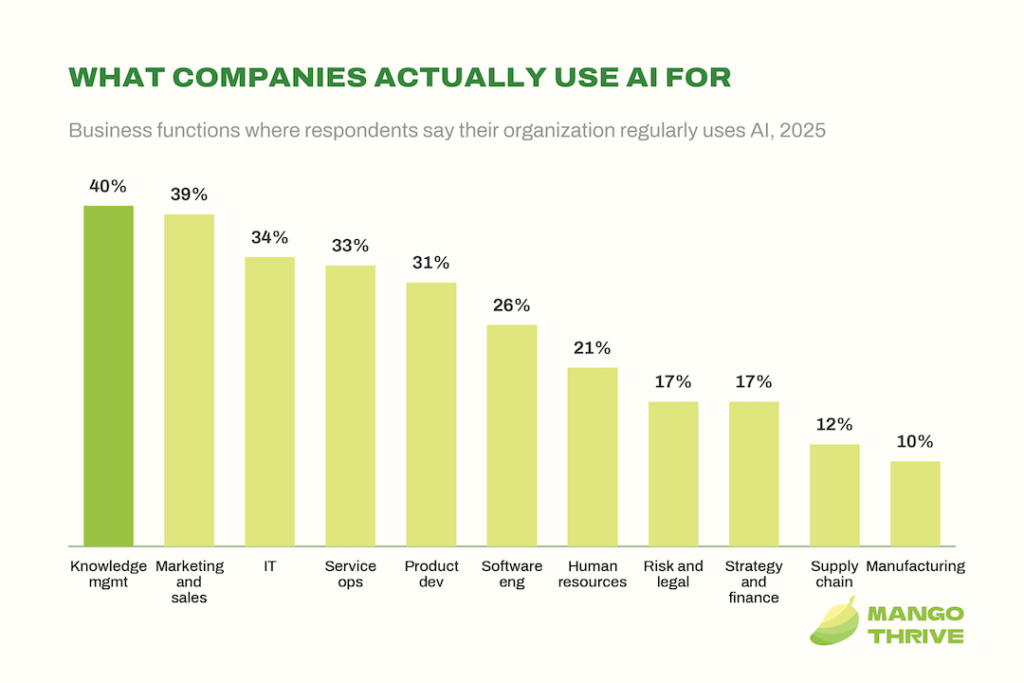
Source: McKinsey, The State of AI in 2025 (PDF), p. 9, sidebar exhibit, Total column; survey fielded 25 June to 29 July 2025. Chart labels are abbreviated; full function names in stat 39
39. By business function, the share of respondents whose organization regularly uses AI runs knowledge management 40%, marketing and sales 39%, IT 34%, service operations 33%, product and/or service development 31%, software engineering 26%, human resources 21%, risk/legal/compliance 17%, strategy and corporate finance 17%, supply chain and inventory 12%, and manufacturing 10%. (McKinsey, The State of AI in 2025 (PDF))
40. Knowledge management reaching the top is new. McKinsey notes that across eight years of the survey, IT and marketing and sales had consistently been the most-reported functions. (McKinsey, The State of AI in 2025 (PDF))
41. Among US enterprises with 1,000 or more employees and revenue above $50 million, the most common generative AI uses in a July 2025 survey were data analysis (73%), document and meeting summarization (70%), document and proposal editing or writing (68%) and presentation and report creation (68%), followed by a three-way tie at 66% between idea generation, marketing content creation and customer service. (Wharton and GBK Collective, Accountable Acceleration, p. 30)
42. More than two-thirds of respondents say their organization uses AI in more than one function, and half report three or more. (McKinsey, The State of AI in 2025 (PDF))
43. But among US firms using AI in a business function, only 4% are “comprehensive adopters” — 1.2% of all US firms, per the paper’s firm-weighted Table 3 — while 37% are “minimalist adopters”, the largest of the five adopter classes. (US Census Bureau, CES working paper 26-25, pp. 3, 26, 28)
44. 90% of surveyed technology professionals report using AI at work, in a survey of 4,867 practitioners fielded in mid-2025. (Google Cloud DORA, 2025 State of AI-assisted Software Development, p. 24)
45. Reliance varies sharply by task. Among respondents who perform each task, 71% use AI for writing new code and 66% for modifying existing code, against 25% for calendar management. (Google Cloud DORA, 2025 State of AI-assisted Software Development, p. 27)
46. 39% of organizations have adopted AI within the HR function, most commonly in recruiting (27%), HR technology (21%) and learning and development (17%), per a survey of about 1,900 US HR professionals. (SHRM, The State of AI in HR 2026)
47. 65% of surveyed IT decision-makers had a dedicated AI budget line in Foundry’s 2026 study, up from 49% a year earlier and 36% the year before that. (Foundry, AI Priorities Study 2026)
AI agents in business
Most organizations report some agentic AI activity. Very little of it is running at scale.
48. 23% of organizations are scaling an agentic AI system somewhere in the enterprise, with a further 39% experimenting — 62% in total at some stage of adoption. (McKinsey, The State of AI in 2025 (PDF))
49. But in any given business function, no more than 10% of respondents say their organizations are scaling AI agents. (McKinsey, The State of AI in 2025 (PDF))
50. Only 16% of enterprise deployments and 27% of startup deployments qualify as true agents — systems where a model plans, executes, observes feedback and adapts — in a November 2025 survey of about 500 US enterprise AI decision-makers. The rest fall short of that definition on at least one of those four steps. (Menlo Ventures, State of Generative AI in the Enterprise 2025)
51. 61% of surveyed technology professionals say they have never interacted with AI tools in an agentic mode, against 10% who have never used AI chat. (Google Cloud DORA, 2025 State of AI-assisted Software Development, p. 29)
52. Organizations surveyed in late 2025 use an average of 12 AI agents, and about 50% of those agents operate in isolated silos. (Salesforce MuleSoft, 2026 Connectivity Benchmark)
53. Governance lags deployment: 21% of surveyed companies report a mature governance model for autonomous agents, while 74% expect to be using agentic AI at least moderately within two years. (Deloitte, State of AI in the Enterprise 2026, pp. 17, 20)
54. In a separate McKinsey survey of about 500 organizations fielded in December 2025 and January 2026, nearly two-thirds cite security and risk concerns as the top barrier to fully scaling agentic AI, well ahead of regulatory uncertainty or technical limitations. (McKinsey, State of AI trust in 2026)
AI spending and ROI
55. Worldwide AI spending is forecast to reach $2.59 trillion in 2026, a 47% year-on-year increase — of which AI infrastructure alone accounts for $1.43 trillion. (Gartner, worldwide AI spending forecast)
56. Gartner analyst John-David Lovelock qualifies that number: “Up to this point, AI spending has primarily been driven by technology companies and hyperscalers,” he said. “Enterprises have yet to really flex their spending potential.” (Gartner, worldwide AI spending forecast)
Source: Ramp AI Index, June 2026, based on card and bill-pay transaction data from more than 70,000 US businesses — see stat 57
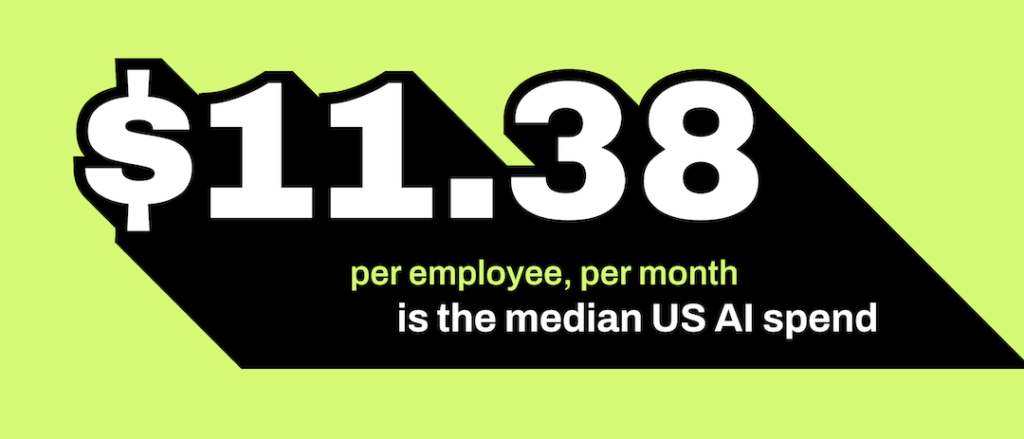
57. Enterprise budgets look very different from the ground up. Across the 70,000-plus US businesses on the spend platform Ramp, the median firm spends $11.38 per employee per month on AI — while the top 1% spend $7,449. (Ramp AI Index, June 2026)
58. 39% of respondents attribute any level of EBIT impact to AI, and most of those say it accounts for less than 5% of EBIT. (McKinsey, The State of AI in 2025 (PDF))
59. McKinsey’s “AI high performers” — respondents reporting both a 5%-plus EBIT impact and “significant” value from AI — represent about 6% of respondents, an exhibit base of just 109 people. (McKinsey, The State of AI in 2025 (PDF), pp. 14–15)
60. Only 25% of respondents say their organization has moved 40% or more of its AI pilots into production, and 37% report using AI at a surface level with little or no change to underlying business processes. (Deloitte, State of AI press release)
61. In KPMG’s late-2025 pulse survey, 59% of US C-suite leaders at billion-dollar organizations said their company will continue investing in AI regardless of its ability to measure tangible ROI. (KPMG, AI Quarterly Pulse Survey Q4 2025, p. 4)
62. An MIT working paper found 95% of the organizations it studied reported no measurable profit-and-loss return from generative AI, with the 5% that did succeed described as “extracting millions in value.” Its research combined a review of more than 300 publicly disclosed AI initiatives with interviews at 52 organizations, and the authors label the findings preliminary. (MIT NANDA, The GenAI Divide)
63. Only 30% of surveyed organizations are redesigning key business processes around AI, the step Deloitte ties to measurable returns. (Deloitte, State of AI press release)
Why companies don’t use AI
The most common reason companies give for not adopting AI is not cost, skills, or regulation. It is that they do not think it applies to them.
64. Among US businesses with no plans to use AI, 61.6% say “AI is not applicable to this business” — the next-most-common reason, lack of knowledge about AI’s capabilities, sits at 22.0%. (US Census Bureau, BTOS AI Supplement 2026)
65. The full ranking of reasons runs: not applicable 61.6%, lack of knowledge about AI’s capabilities 22.0%, privacy or security concerns 20.7%, AI not mature enough 13.0%, bias concerns 8.6%, other 7.9%, lack of skilled workforce 7.1%, too expensive 6.9%, lack of required data 5.1%, prior use did not meet expectations 3.2%, and laws or regulations 2.8%. Respondents could pick more than one. (US Census Bureau, BTOS AI Supplement 2026)
66. Only 3.2% of non-adopting US firms cite a previous disappointing experience with AI — though the survey does not establish how many of the rest ever tried. (US Census Bureau, BTOS AI Supplement 2026)
67. Over the period November 2025 to February 2026, 56.2% of US businesses said they would not be using AI in any business function within six months, against 21.6% who said they would and 22.2% who did not know. (US Census Bureau, BTOS AI Supplement 2026)
68. Measured across all businesses rather than only non-adopters, Canada finds the same attitude: 40.0% of Canadian businesses said AI use is simply not relevant to them, rising to 41.4% of firms with 1–4 employees and falling to 21.3% of firms with 100 or more. (Statistics Canada, AI use by businesses Q2 2026)
69. In the EU, the picture differs: among enterprises that considered AI but did not adopt it, the top reasons were lack of relevant expertise (70.89%), unclear legal consequences (52.52%) and data protection concerns (48.83%), as extracted in December 2025. (Eurostat, Use of AI in enterprises)
70. 64.3% of US businesses that do use AI made no organizational changes at all to do so: no new workflows, no training, no data practice changes. (US Census Bureau, BTOS AI Supplement 2026)
71. Only 1.3% of AI-using US firms hired staff trained in AI, the least common of every organizational change measured. (US Census Bureau, BTOS AI Supplement 2026)
Conclusion
Most large organizations now touch AI in some form, but far fewer have it running across the business. The gap between those two things is where most AI statistics get lost. So whenever you cite one, cite who was asked along with it.